

Want to know how paint a door like a pro? Painting interior doors with my simple step by step tips is a breeze and will get you the professional finish you’re looking for!
The last two houses we’ve lived in have been older homes with doors that were yellowed and not in great shape so as I make over each space, I also paint the doors. It’s pretty amazing what a difference a fresh coat of paint makes, especially if you’re changing out the hardware too!
Years ago, a professional painter gave me tips on how to paint a door, including the order for painting paneled interior doors and the results are so much better than when I used to just paint a door from the top to the bottom. I’ve also experimented with different painting tools and methods over the years and figured out what works best so today I’m sharing my how-to for painting interior doors like a pro! (affiliate links included in post – full disclosure statement available {here})
1. Choose an Interior Door Paint Color
If you’re painting your door white and have white trim around it, I recommend using the same paint color and finish as the trim. Some of my favorite whites for trimwork and doors are Benjamin Moore’s Cloud White and Benjamin Moore Simply White in either semi-gloss or satin.
You might also want to consider painting your doors a color other than white – interior doors in dark black or gray are a beautiful choice! I painted the door from our kitchen to the garage in our previous home a dark gray (Benjamin Moore Charcoal Slate) and loved it:
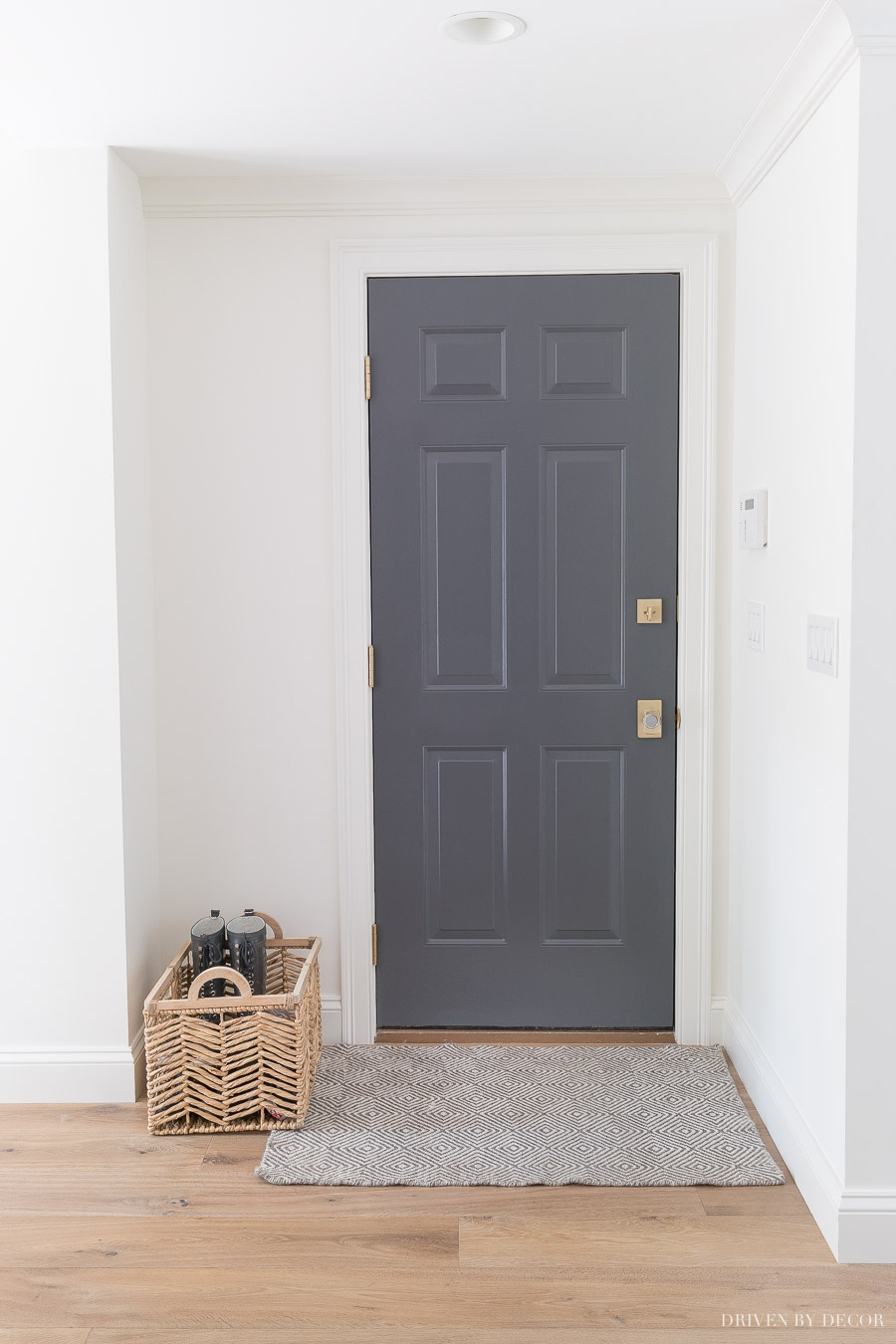
While there are an endless number of door colors you could choose to paint your front door, sticking with white or a gray for the interior is always going to be a win. These are my six favorite paint colors for interior doors:
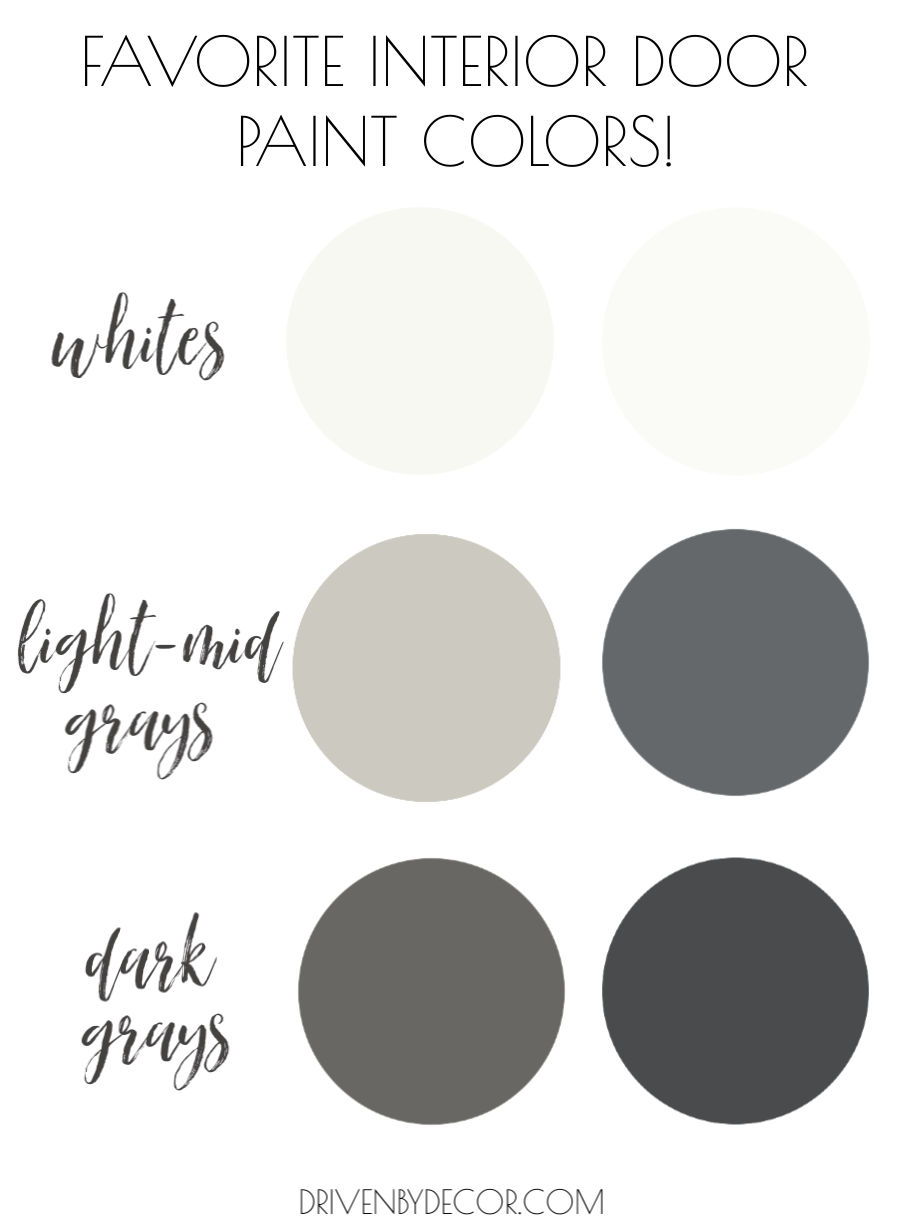
Whites: Benjamin Moore Dove White | Benjamin Moore Simply White
Light – Mid Tone Grays: Sherwin-Williams Repose Gray | Benjamin Moore Charcoal Slate
Dark Grays: Benjamin Moore Kendall Charcoal | Benjamin Moore Wrought Iron
2. Gather Your Painting Tools
Other than your paint, there are just a few things you’ll need to knock out your door painting job including:
Wood filler if it’s an old door with nicks ({this filler} is my favorite – it doesn’t dry out as quickly as filler in a regular container) and a putty knife
Sandpaper – I use 150 grit and 220 grit
Canvas or plastic drop cloth to protect your floor (I use {these} that you can wash and reuse)
Roll of painter’s tape such as {this one}
Retractable razor such as {this one}
Paintbrush – {this 2″ angled brush} is my favorite – it works with both oil and latex paints
4″ woven rollers with ¼″ nap such as {these rollers} or 4″ foam rollers such as {these rollers} – both work well
Roller handle for 4″ rollers + mini roller tray such as {this}
3. Prep Your Door for Painting
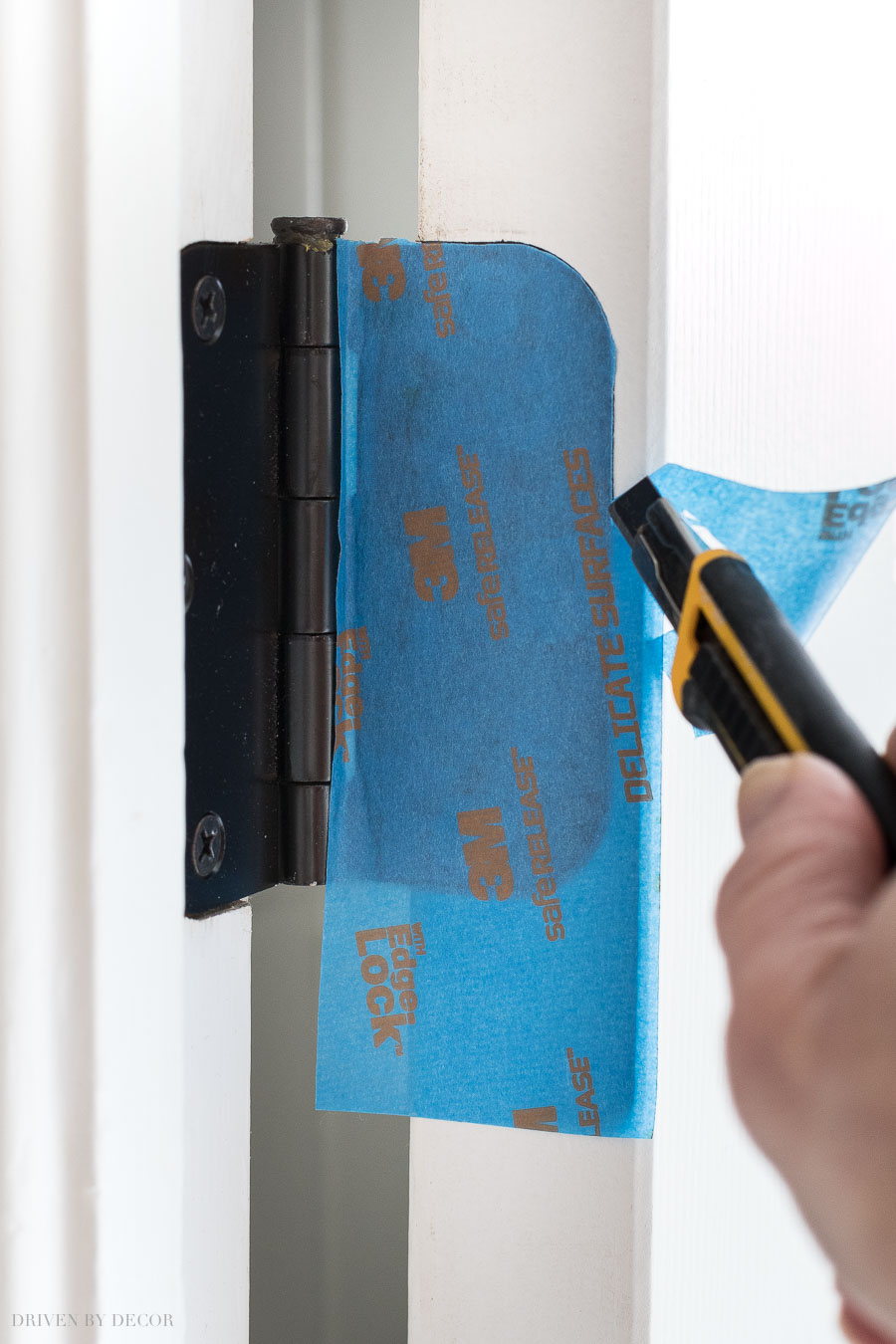
The success of any paint job always starts with good prep work. You can either paint your doors in place or take them down and paint them on sawhorses. If your door already has knobs on it, I recommend removing them – it’s easier than painting around them. If you want to leave the knobs on, cover your knobs and your hinges with painter’s tape.
For the door hinges, I use a utility knife to gently trace the outside of the hinge, cutting the tape as I go:
If you’re repainting an older door, the first step is to fill in any gouges or imperfections with wood filler and sand those areas until smooth (I use 150 grit for this) and then lightly sand the entire door with fine grit (220) sandpaper. Use a cloth to remove most of the sanding dust and then go back over the entire door with a tack cloth to get the rest of it. Note: If your door was previously painted prior to the ’80s, it could be lead paint which you wouldn’t want to sand without appropriate precautions so be sure to test for lead paint if that’s a possibility.
The next step is to prime your doors if needed. You will need to prime if:
- You are working with a new, unprimed door
- You are using a standard latex paint on a door that was previously painted with an oil-based paint. How do you know if your door was previously painted with oil-based or latex paint? Put rubbing alcohol on a rag (I use a dark rag if it’s white paint so it’s easier to see) and rub it on your door – if paint comes off on your rag it’s latex, if not it’s oil-based.
You don’t need to prime if:
- You are working with new, pre-primed doors
- You are using latex paint on a door that was previously painted with latex paint
- You are using Benjamin Moore Advance paint over a previously painted door – this paint can be used over either latex or oil-based paint and is awesome for not leaving roller or brush marks so it’s my go-to paint for trim and doors.
Priming is ideally done in the same order (edges first, etc. as I’ll describe for painting below).
3. Paint Your Paneled Door in This Order
Now it’s time to paint! Many people have success painting doors using just a brush, but I like to use a combination of a brush and a small roller because it gets the job done faster and results in a much smoother finish. Rather than simply painting the door from top to the bottom, you can get the best paint job by painting paneled doors in a certain order. For a standard 6-panel door, this is the order to go in:
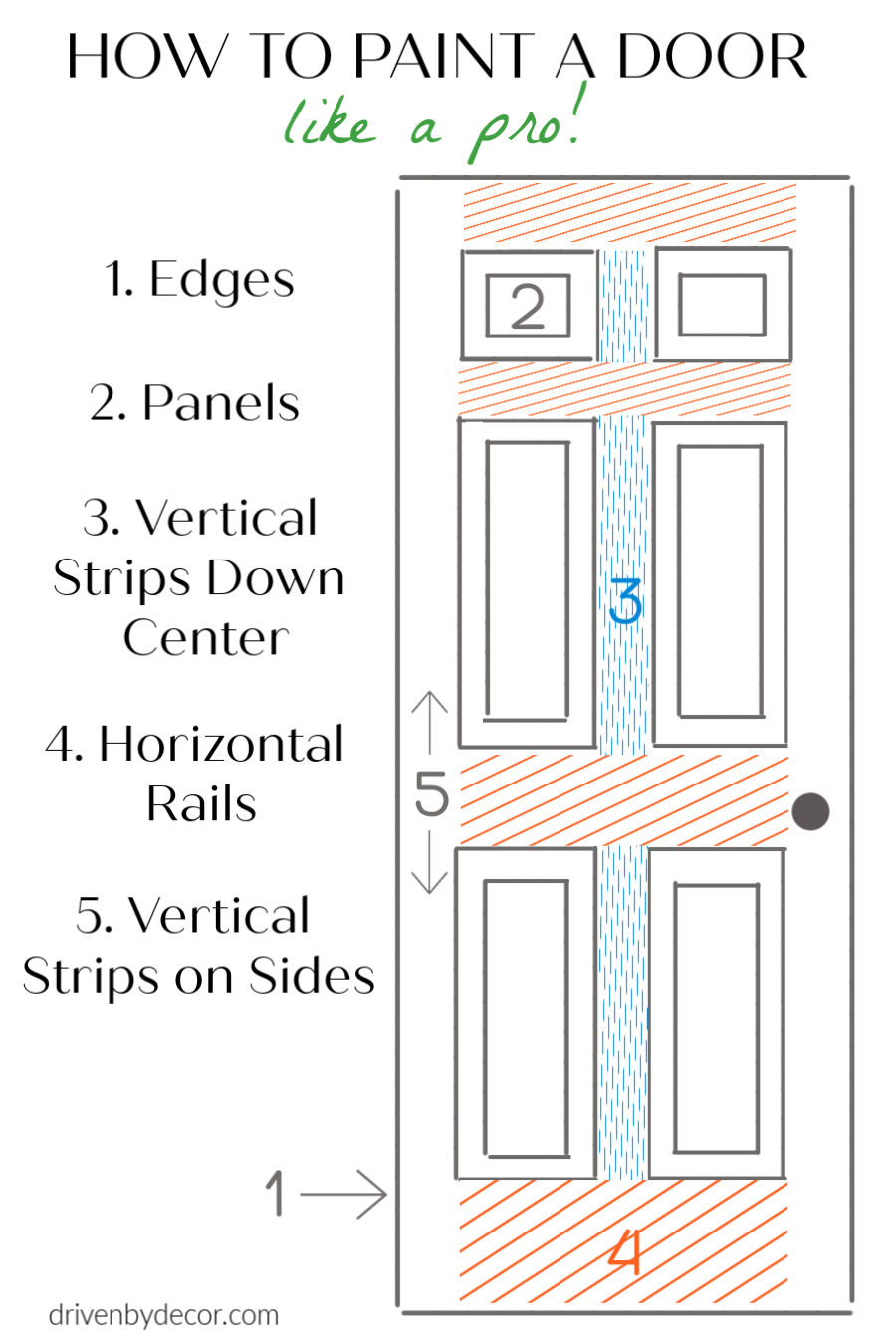
1. Start by painting the edges of the door with either the brush or roller
2. Next, paint the door panels. I like to use a 1 ½″ brush to paint the recessed molding areas followed by a 4″ roller for the flat surfaces in the middle.
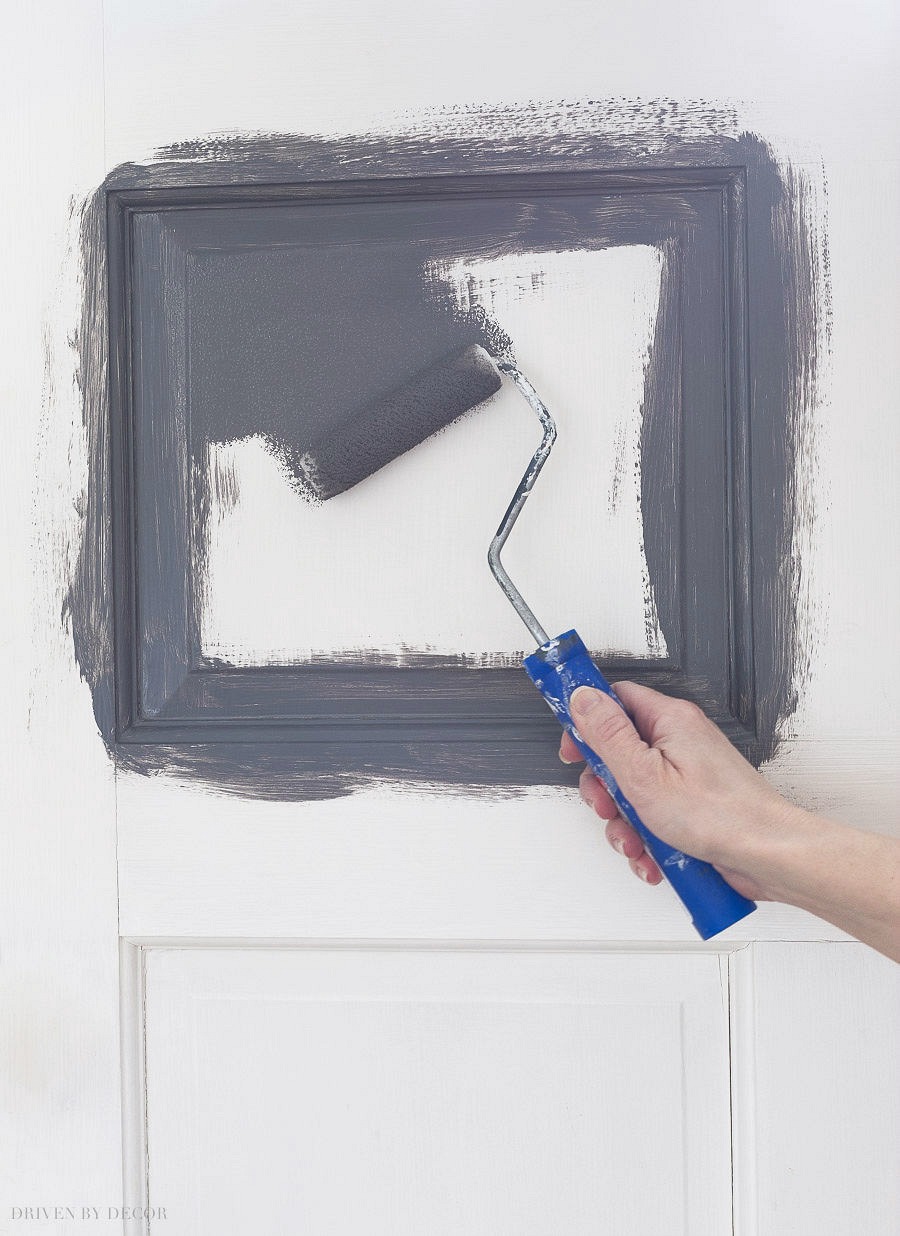
Make sure to feather the edges of the molding you’re brushing – you don’t want any hard edges.
3. Then paint the three vertical strips down the center with the 4″ roller.
4. Next, paint the four horizontal rails with the 4″ roller.
5. Finally, paint the two vertical strips on the sides with the 4″ roller
4. Sand & Recoat
Once you’re done, allow the paint to dry (if you’re using Benjamin Moore Advance note that it has a longer than typical dry time), give your door a quick, very light sanding with with 320 grit sandpaper, remove the sanding residue with a tack cloth, and then apply a second coat of paint.
If you’re using sawhorses and painting one side at a time, allow the paint to dry at least 24 hours before flipping the door over on the sawhorses and repeating for the second side. Cover your sawhorses with a cloth to prevent the newly painted door from sticking to them (and make sure that the cloth you use is smooth with no texture to it, or you could end up with a textured pattern in your door once it comes of the sawhorses). Once your second side is dry, simply rehang your doors and reinstall your door hardware. Done!
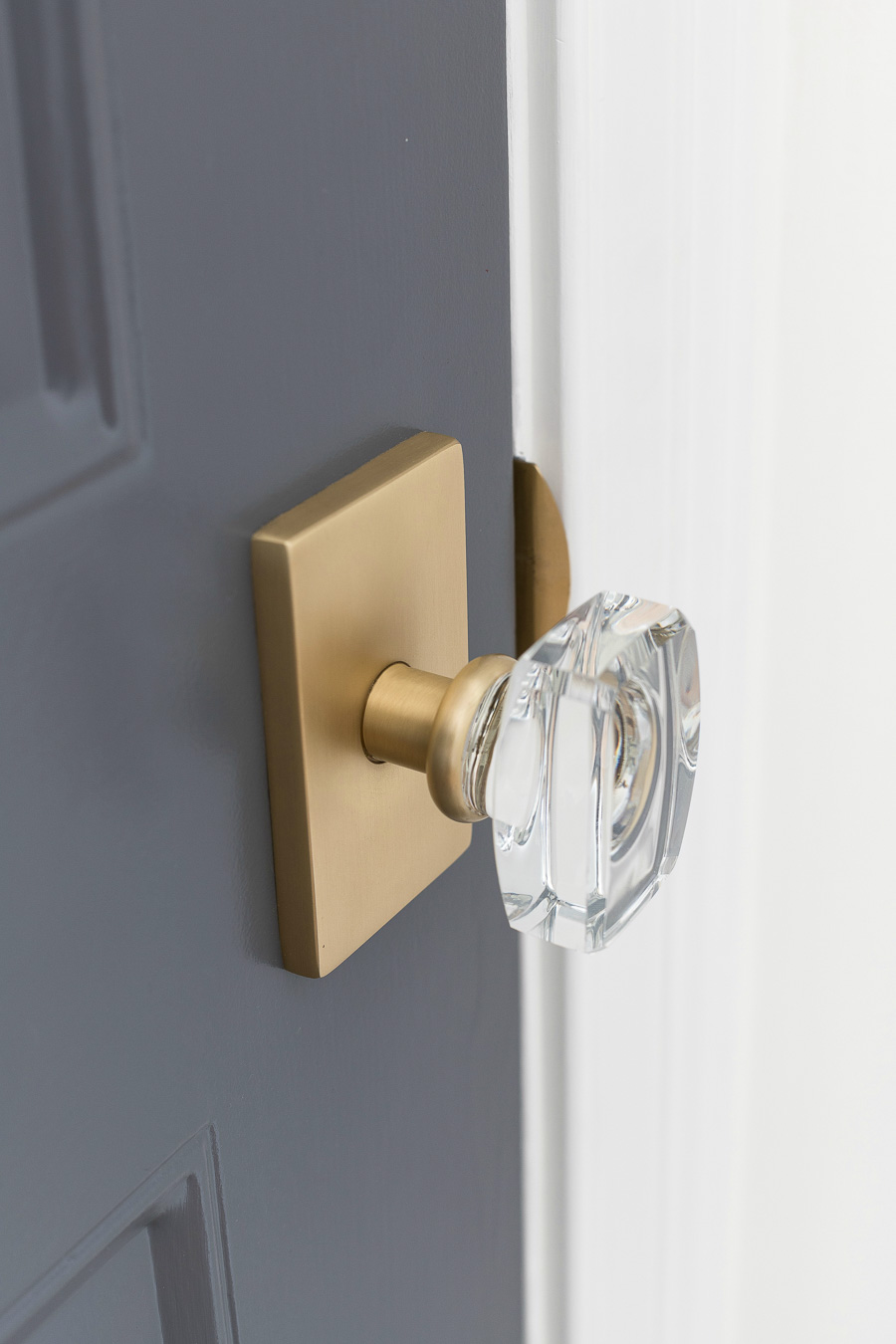
(Our brass + crystal door hardware can be found {here})
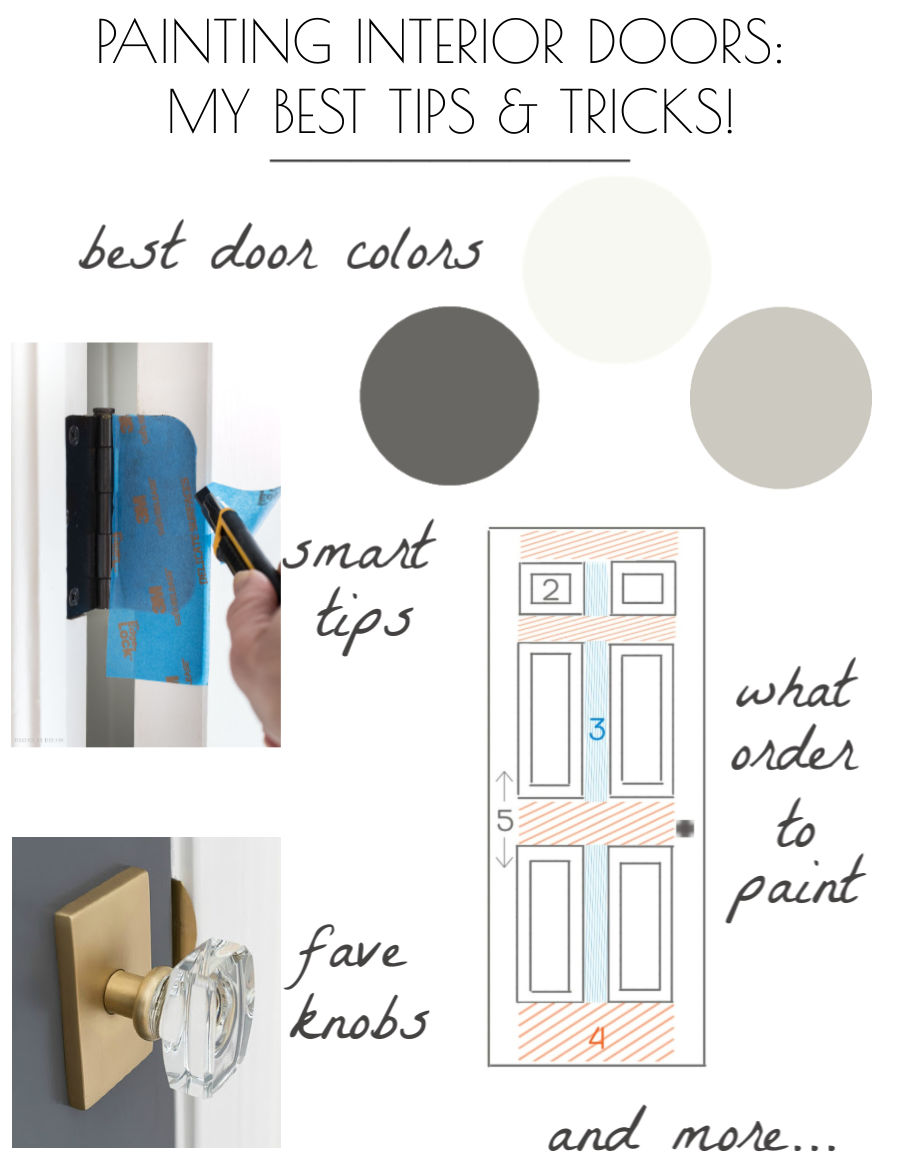
I know talking about painting doors isn’t the most exciting DIY project ever 🙂 but I hope you’ve found a tip or two to help on your next door painting project! Let me know if you guys have any questions! And if you want to make sure you can find this post easily in the future, Pin the image below:
XO,



Vicki lavender says
Have learned to paint doors recently ……….Full Gloss is not a good idea, shows the brush marks & imperfections too easily, Semi Gloss is the best, I didn’t undercoat so the door, using white gloss paint, needed 4 coats, so from now on I will always use an undercoat …………… Undercoat has more Titanium in it & it hides and covers better , Titanium makes it more opaque than normal white top paints , Titanium is an expensive addative so it only has a little used in the manufacture of white top coating paints .
In Painting Rooms white…………..I’ve found a paint that looks white but is not white is the best to use, covers better., and is easier on the eyes. Pale Creamy Gold Colour is a great feature wall or as a feature colour, goes well with Navy or Grey or Black. Especially if you want to show off black furniture or brass or royal blue & white vase decorations.
Dark colour lounges coverings , are easier to keep the lounge room looking smart and tidy rather than medium colours.
Linda says
Your tips were great!
Marlana Byrne says
I Painted my interior doors a dark Gray over the original white. I’ve noticed some of the paint scratching off mostly around the door knob. Would it help to put a sealant Over the paint to protect it?
Kris Jarrett says
I’ve never polyurethaned over paint on a door but you could if you make sure you choose one compatible with the type of paint you used. Also make sure that you didn’t use water-based paint for the gray if the white underneath it was oil-based – if you did, the paint is never going to adhere well. I’d be inclined to sand down the scratches and repaint the door using a high quality, high sheen paint such as Benjamin Moore Advance that wears super well.
John says
Did you use any additives in the paint to help paint flow or slow drying times?
carole a branch says
I am painting over 6 panel doors with a acrylic latex primer plus paint. The new paint is peeling off the old doors. What am I doing wrong?
Jen says
Can be a couple of things. You need to dry wipe them then clean them very good with some little dawn and water, rinse/dry. Sand remember to wipe very well, and when you think you have it all do one last time. Go top to bottom, use dry brush to get in panels, use a good primer. Lot of people use Kilz, I am not a fan, and use Zinsser
Grace says
“Hi I HVE OLD DOORS FROOM 1900 . The frame are metal and doors are wood. I stripped around 8-10 layers of pain and sanded. I want to paint white. Which paint and what kind of primer I use to look beautiful.
Nettie says
My white painted over wood 6 panel doors are splitting away at the panel edges. What happened? Any ideas on how to fix?
Jen says
You need to use construction adhesive. Then take a clamp, and leave for a whole day. If you still have any tiny gaps, spackle lightly then proceed with prep/paint.
Deloris says
Great instructions. I’m painting a 2 panel door and using a roller. However, I’m finding it difficult not to have roller marks. How do you prevent them?
Vicky says
Hi
Just wondering are you using semigloss or eggshell, from the photo it seems not as shine as semi-gloss finishes.
Thanks
Sharlene King says
Your painting tips were very helpful. I would have only used a brush, but will also try a roller after reading your tips.
Carole Nguyen says
Hi I am repainting the doors and With same paint color and do you have to have a second coat and do you have to sand after the first coat? I am using oil base
Sheryl says
Thanks
Penny Streets says
Hi, I am painting my bathroom trim and 6 panel doors, white on the inside. The doors open into the bathroom, however when closed the one is part of the bedroom and the other part of the hallway. My bathroom color is Behr Bright White but I wanted to use Behr Delicate Lace on the other side which faces into bedroom and the the other into the hallway. What color do I paint the door edge?
Thanks,
Penny
alyr says
You paint it the color that will show when you have the door open, which, assumingly will be most of the time.
Mona says
Hi Kris, any tips on dealing with old, torn sweeps at bottom without having to remove the entire door from its hinges? I have tried sliding, tearing old sweep but I think it’s glued on. Maybe just not possible… Thank you!
Karen Bunch says
What a great tool. The mister is the painter in our family. I don’t have much patience for the task, but this detailed instruction will be helpful to everyone who has ever had to paint a door. I love the colors.
xo,
Karen
Jenna White says
Thank you!! I am gearing up to repaint all the doors in our house (as my children are now old enough to not beat down a closed door with a toy if either of us parents are trying to claim some privacy). I would also love similar tips on repainting window frames!
Vic says
It looks like no paint brush marks. Is that possible? Impressed.