

We’re a few months out from demoing our kitchen for a complete remodel, and I’m knee deep in selecting our cabinets, countertops, and appliances. One appliance I can’t get rid of fast enough is the super old electric cooktop and rusted downdraft vent in our kitchen island. In our previous home, I had this 48″ gas Monogram range in our kitchen and absolutely loved it:
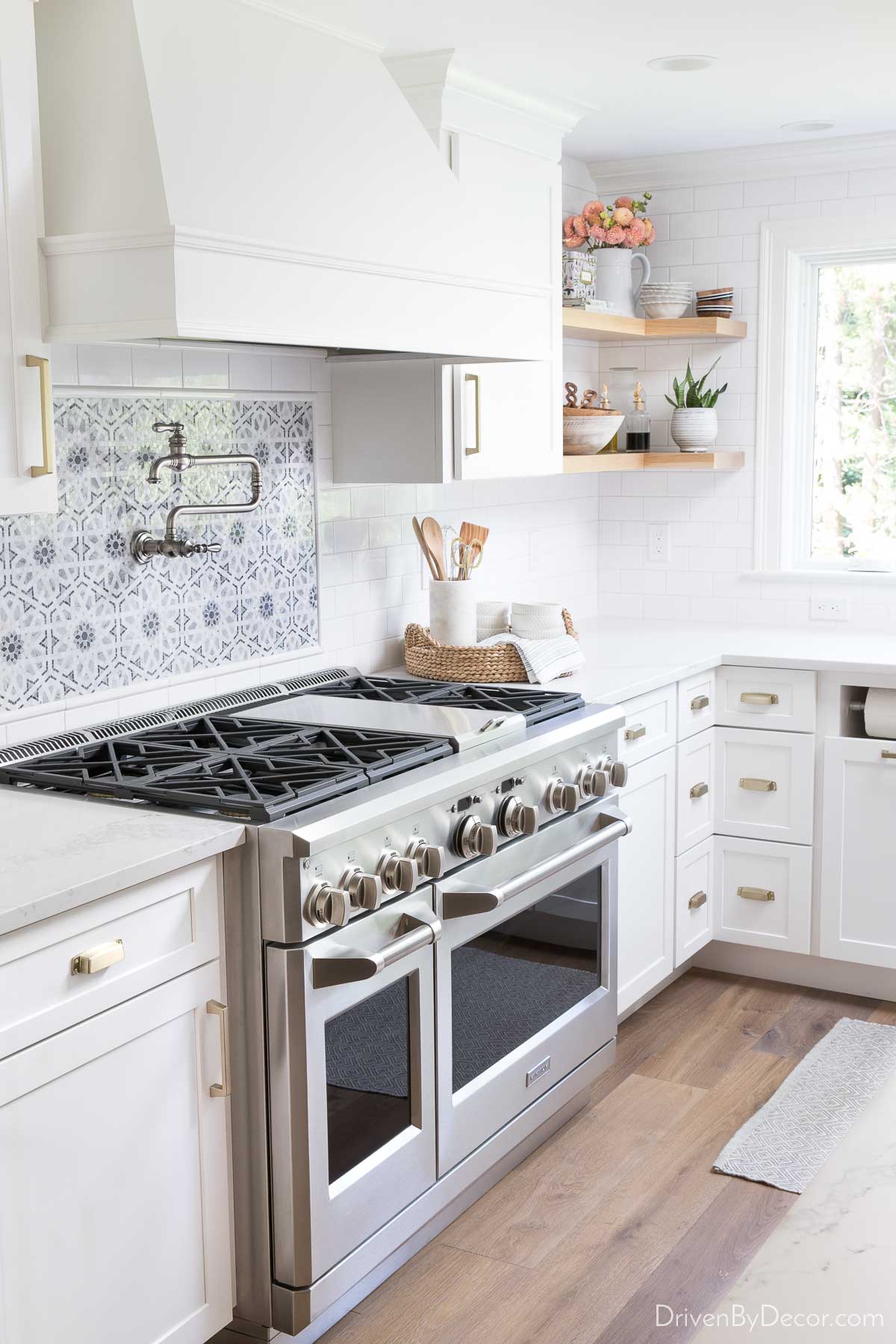
Going from cooking with gas back to cooking with electric has been no fun.
For our new kitchen, I’m considering getting an induction range because (1) it would cost less since we don’t currently have a gas line running to our kitchen, and (2) it would give me a chance to see how I like cooking on induction so I’ll know whether to choose induction or gas in our new build.
I’ve done a lot of research on the pros and cons of the two, and today I’m sharing the breakdown of how these two methods of cooking compare. Hopefully, it will be helpful to any of you who are also considering switching to induction. And for those of you who already have an induction cooktop in your home, I’d love to hear what you think of it! (post includes commissionable links; for more information, see my full disclosure statement {here})
The Basics of Induction
The basic difference between gas and induction cooktops is that gas heats indirectly while induction heats directly. This direct transfer of heat occurs through the use of electromagnetic coils. It results in a more efficient method of cooking, with induction cooktops being three times more energy efficient than gas. Induction cooking heats up cookware much faster than with gas too. You can actually boil water in under a minute (as a pasta lover, this excites me 😂)!
Cookware
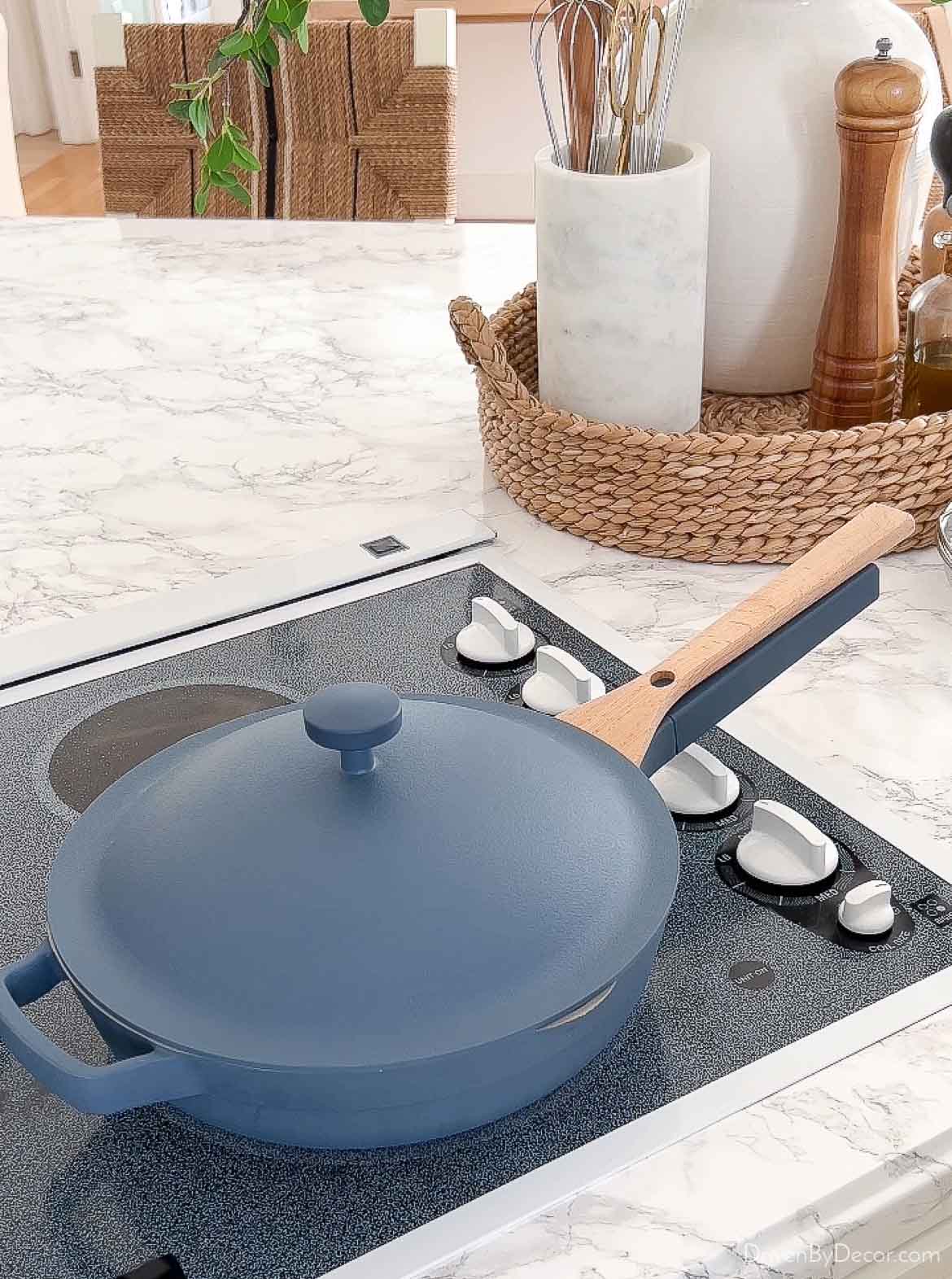
The need for specific cookware is one of the negatives of induction. While gas cooktops are compatible with a wide range of cookware materials, induction cooking requires magnetic cookware. So if you’ve always used gas or electric cooktops, you may need to invest in new cookware when making the switch to induction. Any cast iron cookware you have will work on induction. Also, {this Always pan}, which is my most-used pan, is compatible with all cooktops, including induction:
Temperature Control
When it comes to temperature control, both gas and induction cooking are known for being quick and precise compared to electric cooktops. Induction does have an edge in heating up your cookware faster than gas. While chefs have almost universally cooked on gas in the past, more and more chefs are making the switch to induction since its responsiveness matches that of gas, plus it comes with a few other benefits we’ll address next!
Ease of Cleaning
Those who love induction cooking often list ease of cleaning among the reasons they prefer it to gas. Gas ranges have grates and burner caps like these that need to be removed and cleaned separately, which can be a bit of a pain:

Also, spills and splatters can make their way below the burners, requiring extra effort to clean.
In contrast, induction cooktops have a smooth surface that’s easy to wipe down with a damp cloth. And since induction involves the direct transfer of heat, the surface of induction cooktops doesn’t get hot. So if something boils over or splatters, it won’t get burnt onto your cooktop and can simply be wiped off. This is something I definitely won’t miss about cooking with electric!
Safety & Environmental Concerns
Gas ranges have been in the news a lot in recent years regarding possible safety and environmental concerns. With regards to safety, there’s evidence that poorly ventilated gas cooktops and stoves can increase volatile organic compounds (VOCs) in your home. Increased VOCs have been linked to a variety of health effects, including an association with asthma. However, several studies I read noted that these risks are likely minimal with adequate ventilation of a gas range. When using gas, it’s important to have a strong ventilation hood that’s turned on every time you use your appliance.
As far as environmental concerns go, the US is trying to move away from using as many fossil fuels as possible, including gas. Several cities, counties, and even states have enacted or are considering legislation to ban gas ranges in new buildings due to these environmental concerns. At one point, a possible nationwide ban on gas ranges was raised, but this is no longer expected to be put in place, at least in the near future.
Cost
Induction ranges used to be much more expensive than gas, but the price between the two has evened out in recent years. Gas ranges do have a higher annual operation cost because of the cost of fuel and the fact that they’re less energy efficient.
Along with the cost of your appliance, you should also consider the cost of installation prep work when you switch from one method of cooking to another. If you currently have an electric range, the cost to switch it out to an induction range is usually going to be less than switching it to a gas range because of the cost of running a new gas line. If you currently have a gas range, installation is cheaper if you stick with gas since you’ll have to pay to cap your gas line and install the appropriate electrical outlet for an induction range.
Availability
There are plenty of options for both 30″ and 36″ gas and induction ranges, but the options for 48″ and 60″ ranges are more limited. Most of the 48″ and 60″ induction ranges are made by European brands since induction has been more widely adopted in Europe than the US.
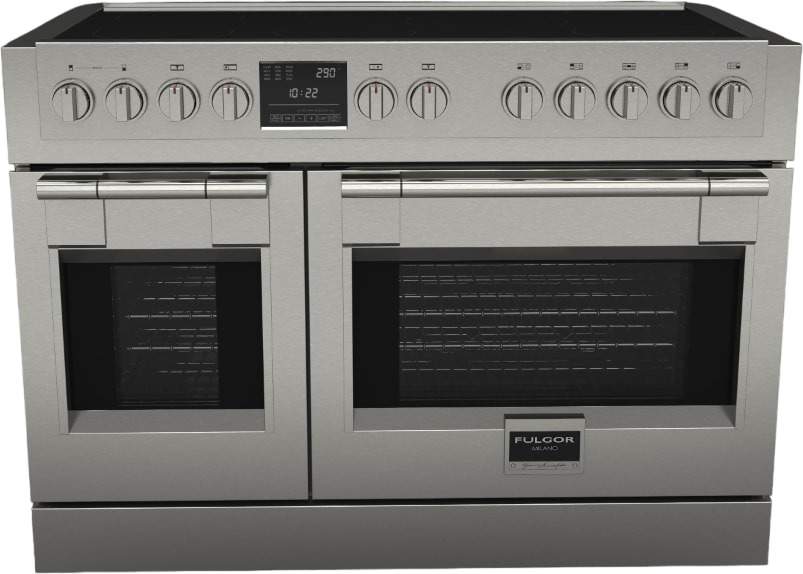
Looking at 48″ induction ranges, brand options include Fisher & Paykel, Bertazzoni, Ilve, AGA, and Fulgor Milano. I’ve also found two 48″ ranges that have a combination of gas and induction cooktops, including {this Fisher & Paykel range} and {this Signature Kitchen suite range}. Right now, I’m leaning toward {this 48″ Fulgor Milano induction range}. I think it’s a great looking range other than wishing that the Fulgor Milano branding wasn’t so prominent:
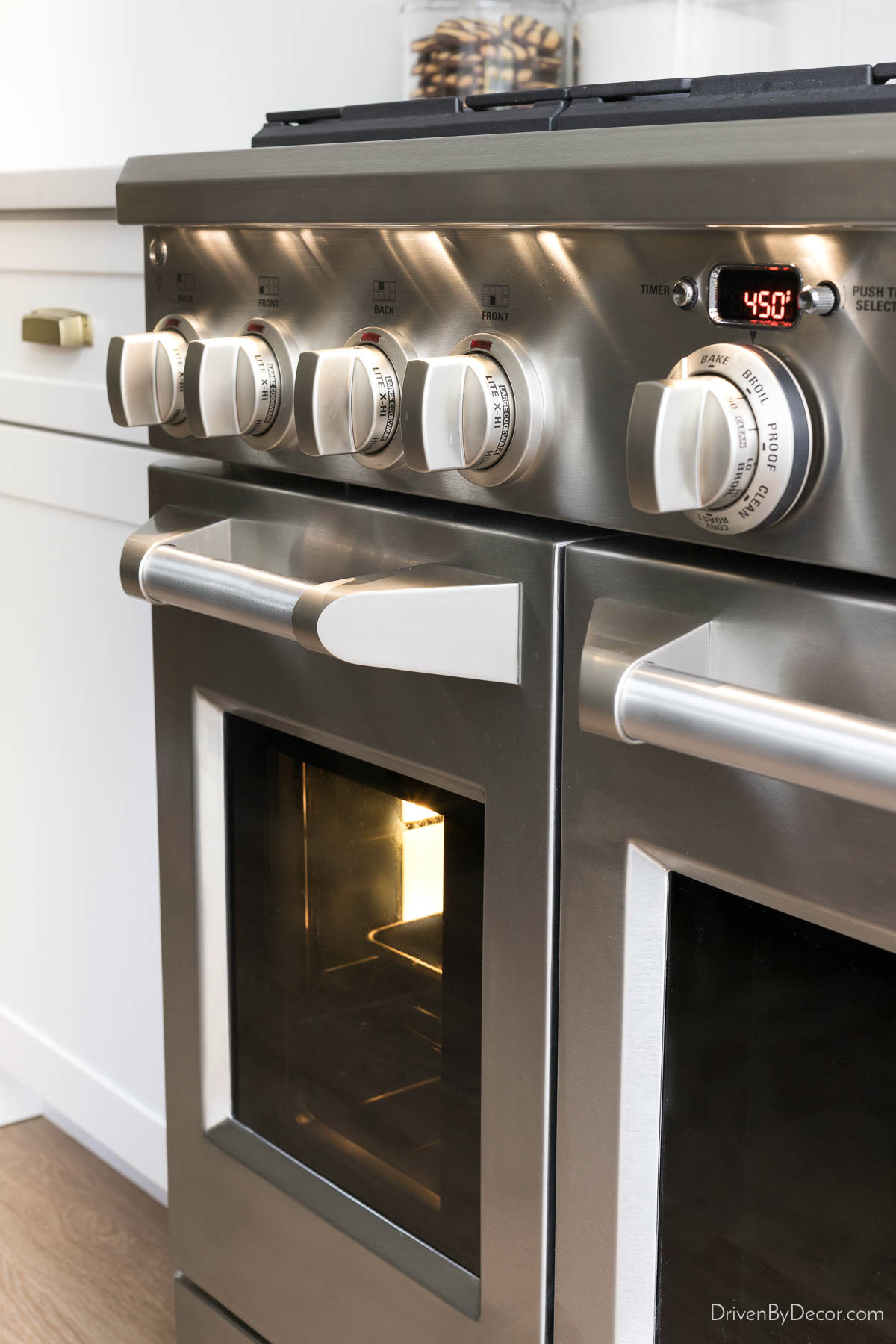
The knobs and handles remind me a lot of our gas Monogram range:
One helpful piece of advice I was given is to look into the availability of service for your appliance in your specific area if you’re considering going with a lesser known brand. You’d want to find out if there are local technicians that routinely service that brand and how long it typically takes to receive parts when repairs are needed.
What Do You Think?
Here’s where I’d love your input and experience! If you’ve had experience cooking on both induction and gas, which do you prefer? And if you have a large induction range, what brand is it, and how have you liked cooking with it? I’m excited to hear what you all have to say!



Ricardo says
I’m Ricardo from L’Atelier Paris, where we specialize in luxury kitchen design and custom French ranges made in America. This is a helpful comparison for anyone choosing a new range. Gas and induction each have their advantages, so it really comes down to cooking habits, personal preferences, and what works best in the kitchen.
Kathe Irowez says
I am a big fan of induction. I’ve always hated gas, to be honest – hate the danger/gas/flame factors, and also cleaning the big, complicated thing. Why are we so in love with those behemoths? Anyway – induction has all the benefits (fast heat up; fast temp reduction; not very hot surface left behind briefly; easy, easy cleanup, and use of the smooth top for anything! What’s not to love? Plus it looks so sleek. Most European countries don’t allow gas, and we should get away from it, too. IMHO
Margaret says
Absolutely, go with induction. I put a two burner in a student rental, because I didn’t want the tenants burning down the house. That plus a convection microwave was all that we needed when we spent time in the rental. I loved induction, and any new home I remodel will have it. This decision firmed up once I read about the hazards of gas appliances, leaking gas even when your stove is off! Enough with environmental hazards! Thermador now Carie’s a beautiful induction cooktop, and Cornue dies as well. Maybe you could do a partnership with them?
Cindy Mowry says
I have a Samsung induction range which I absolutely hate. If water drips on the cooktop at all, like when lifting a lid to check the contents, the whole range shuts off until you can dry it off and then wait a couple of minutes. It is nowhere near as responsive as a gas stove. It has magnetic controls, which are really wacky and the temperature will randomly change in the middle of cooking. I can’t wait to get rid of it and get gas!
Lynette says
Will an induction cooktop crack like a glass cooktop? I had a glass cooktop for about 15 years and all of a sudden heard a crack sound when cooking. Saw a small visible crack. About a month later it sounded like an explosion when the majority of the surface cracked. I’m a little leary of anything glass or similar to glass. Thoughts?
Heidi says
We remodeled our kitchen two years ago and installed a Jenn-Aire induction cooktop. I love the ease of cooking with it, water boils quickly, I like the safety of it and the smooth modern countertop look. Very easy to clean. I can also bridge two of the burners and use a griddle pan for pancakes, grilled cheese, etc.
Kathy W says
Hi Kris, I am 74 and have had electric, gas and induction stoves. Having had all this experience, my favorite by far is my induction stove. I have a GE Cafe’ induction stovetop with dual ovens. This is by far my favorite stove. As you have stated cooktop surface is a breeze to clean. Heats water and other things really super fast. Yet you can turn off the eye and it immediately stops heating. Love, love love it.
Rebecca Schildroth says
I have had gas, electric, gas, electric in my 50 plus years of marriage. I have had an induction cook top for the past six years. I will never go back to either gas or electric. It is an awesome way to cook. The temperature control is terrific!
Barbara says
I have been using induction since 2013 in two different houses. Love it. It’s fast, responsive, and easy to clean. I have a GE Profile which has not any problems since installed in 2019. No buzzing. I got a special deal of free Chantal cookware when I bought my last induction stove. I use a mat under my pots/pans to keep my cooktop pristine. Yes, you can do this and not alter the cooking ability. I echo all the positive comments for induction. I really haven’t experienced any cons that I can think of. I feel like it is a lot safer and environmentally friendly. I seldom use my exhaust now. The burners turn off when a pan is taken off. The dials are flat, so nothing catches on them. So easy to keep clean without being a slave to cleaning so my kitchen looks clean with a few stokes of glass cleaner. Induction is a choice that I believe you will enjoy.
Mudrick says
I’ve cooked on all types of stoves and I always thought gas was my preference until I moved into my current home where my only option for gas would have been to have a propane tank put on the property. I decided to go induction instead and I will never go back. It truly is the easiest stove I’ve ever had to clean and it is super responsive. I can boil water in no time! My set of stainless steel All-clad pans that I’ve had for years works perfectly on it and I’ve had no problem finding other pans and even a tiny espresso pot to work on it. I have a standard size 30 inch Samsung that has performed flawlessly. And I just put a compact, 3-burner 24 inch cooktop In a small cottage we own. As someone who suffers with asthma, I feel it’s a better choice for my health as well.