

Looking for details on how to refinish a table? I’ll walk you through the step by step of how I brought my beat up (but sentimental favorite) end table back to life!
A lot of us have furniture pieces that we can’t part with for sentimental reasons even if we don’t love how they look, right?! And while I’m all about painting wood furniture that you scored at a flea market or on Craigslist, I can’t bring myself to paint old stained wood furniture pieces that hold special meaning.
Case in point… this dark, round side table that’s been sitting in our living room doing nothing but blending into the dark corner since the day we moved in:
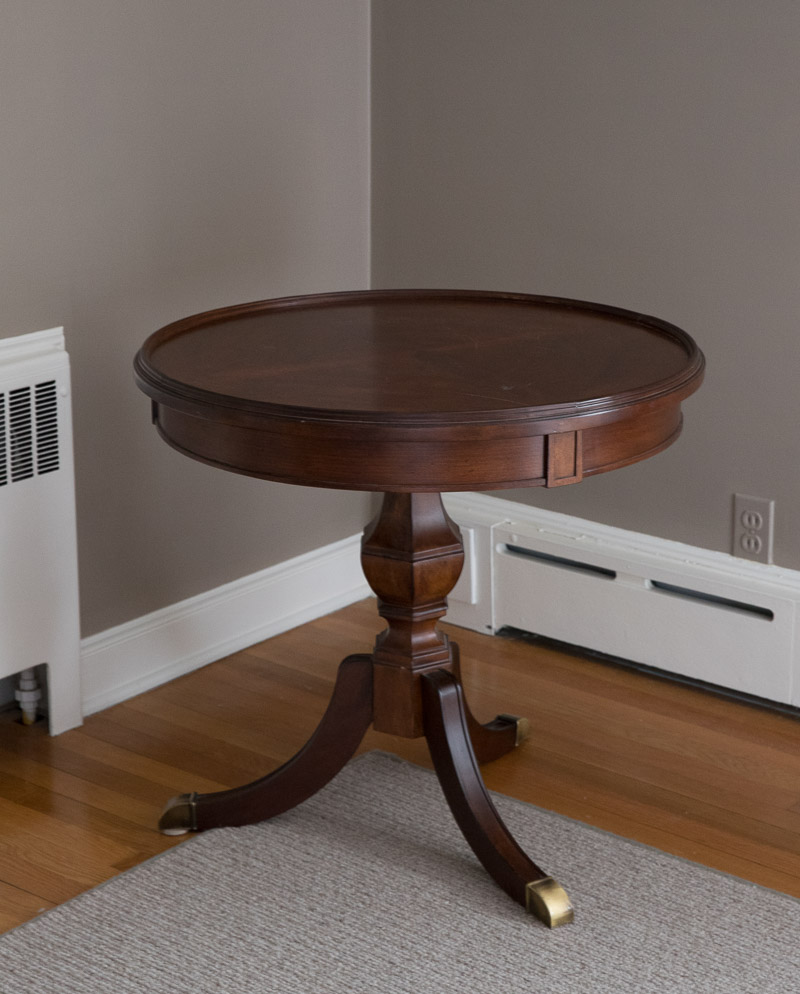
I bought this little lady during my “mahogany phase” about 20 years ago when I thought that dark, reddish mahogany colored wood was where it was at! Kinda funny considering that I steer 100% clear of it when looking at furniture pieces now. From a distance, it looks like she’s in pretty good shape but a closer look reveals lots and lots of scratches:
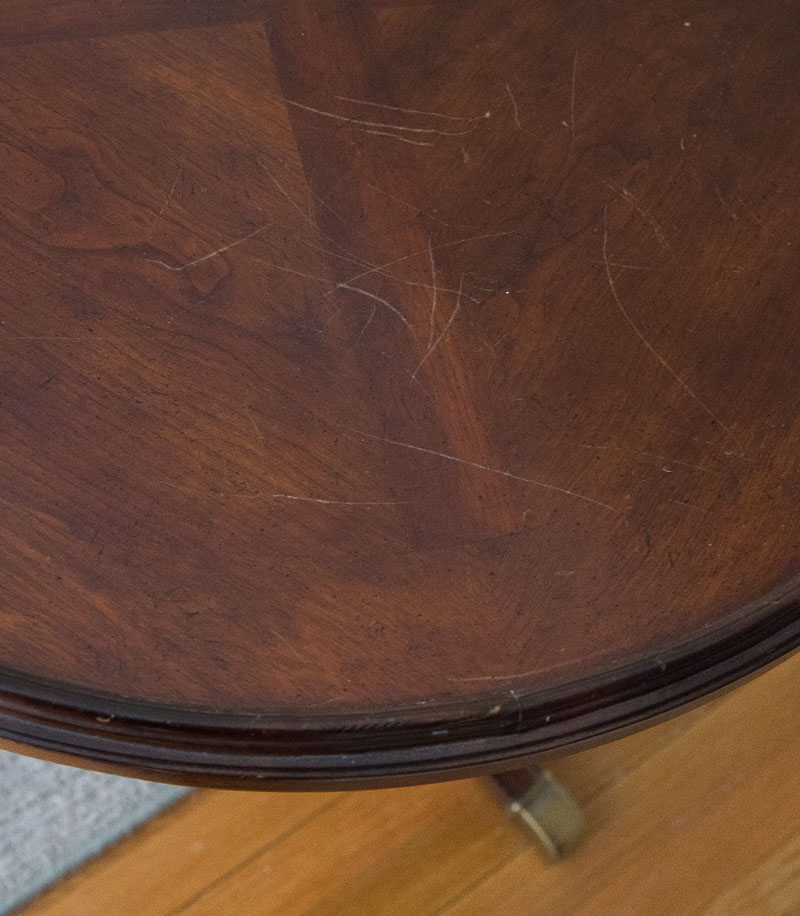
How did it get so scratched? One day when our family was out in our front yard, our previous dog was so upset that she wasn’t part of the action going on out the window that she hopped up on this table and scratched the heck out of it. I was so upset. It was the first nice piece of furniture my husband and I bought together and I vividly remember my excitement in finally buying something that didn’t come from IKEA or as part of a six-piece set from Value City. So needless to say, this piece holds a lot of sentimental value.
Fast forward about 10 years (yes, I’ve held on to this scratched up piece THAT long!!) and her time has come. Using my table I’m showing you step by step how to refinish a table, hopefully giving you the know-how and confidence to tackle a piece of your own.
No more sitting in a dark corner for this not-going-to-be-mahogany-much-longer lady! Here’s how my makeover went down… (Read the directions on the label of every product mentioned before use, including all precaution and disposal info; Post contains affiliate links – for more information, see my disclosure statement {here})
1. Clean the Surface of Your Table
The first step is to get your table free of dirt and grime, which will make it easier to strip. You can do this using a simple mixture of water with a small amount of mild dish. Saturate a sponge with the mixture, wring it out, and then gently scrub! Rinse with a sponge dipped in water and dry with a microfiber cloth.
2. Sand Out the Scratches
If your piece has no scratches or marks in the wood that you want to get rid of, you can skip to step three. If you have scratches, let’s take care of those first! There are a few ways to do this – if the scratches are on a flat area of the table, the quickest way to get rid of them is to sand them out with a power sander.
I put my respirator and safety glasses on and used {this orbital sander} on my table. You do need to be careful that you don’t over-sand because for pieces like mine that are wood veneer (a thin top layer of wood on top) and not solid wood, you need to take care to sand evenly and not sand down too far or you may sand all the way through the veneer to the cheap particle board/MDF layer underneath it.
If you’re refinishing an antique or incredibly special piece or if it’s a painted piece that could be lead paint, using a wood stripper and then hand sanding (with appropriate precautions for lead paint) is the better route to go. With my sander, I started off with 150 grit sandpaper and then went down to 220 grit once I started seeing the wood layer underneath:
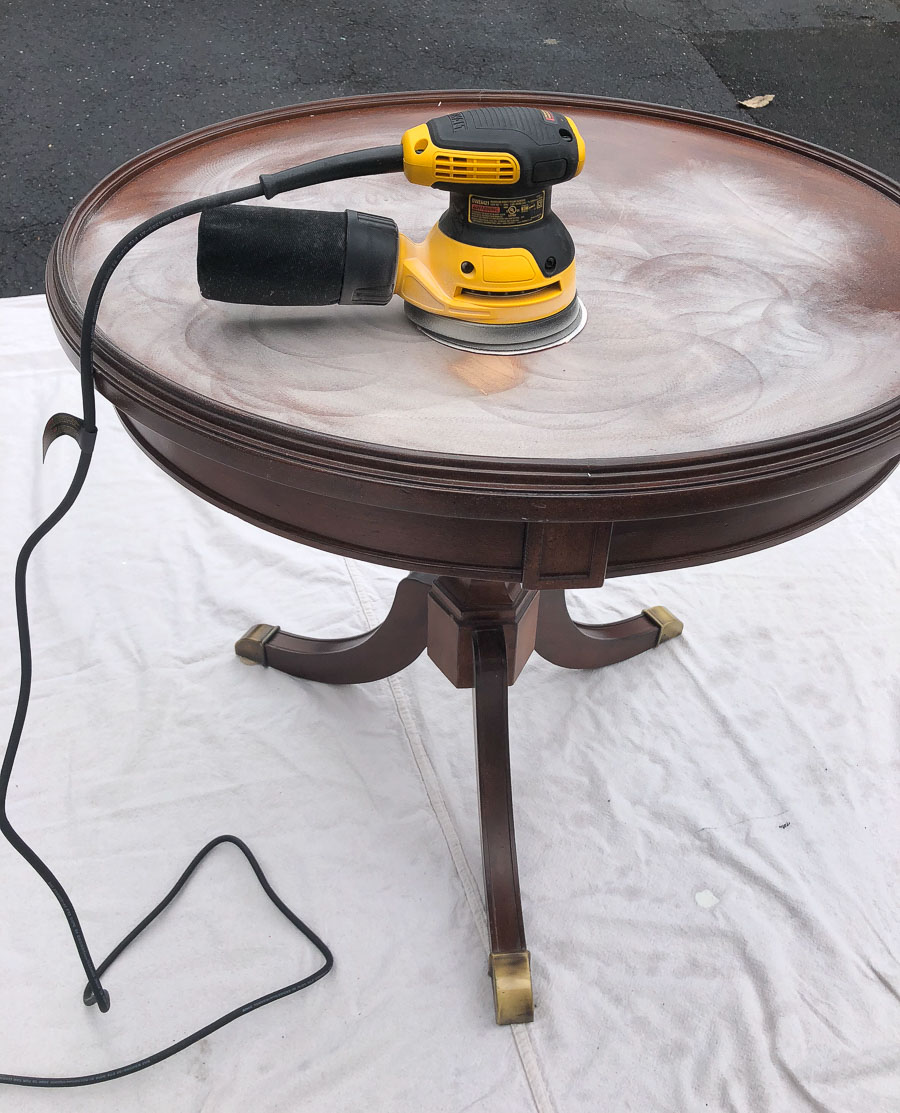
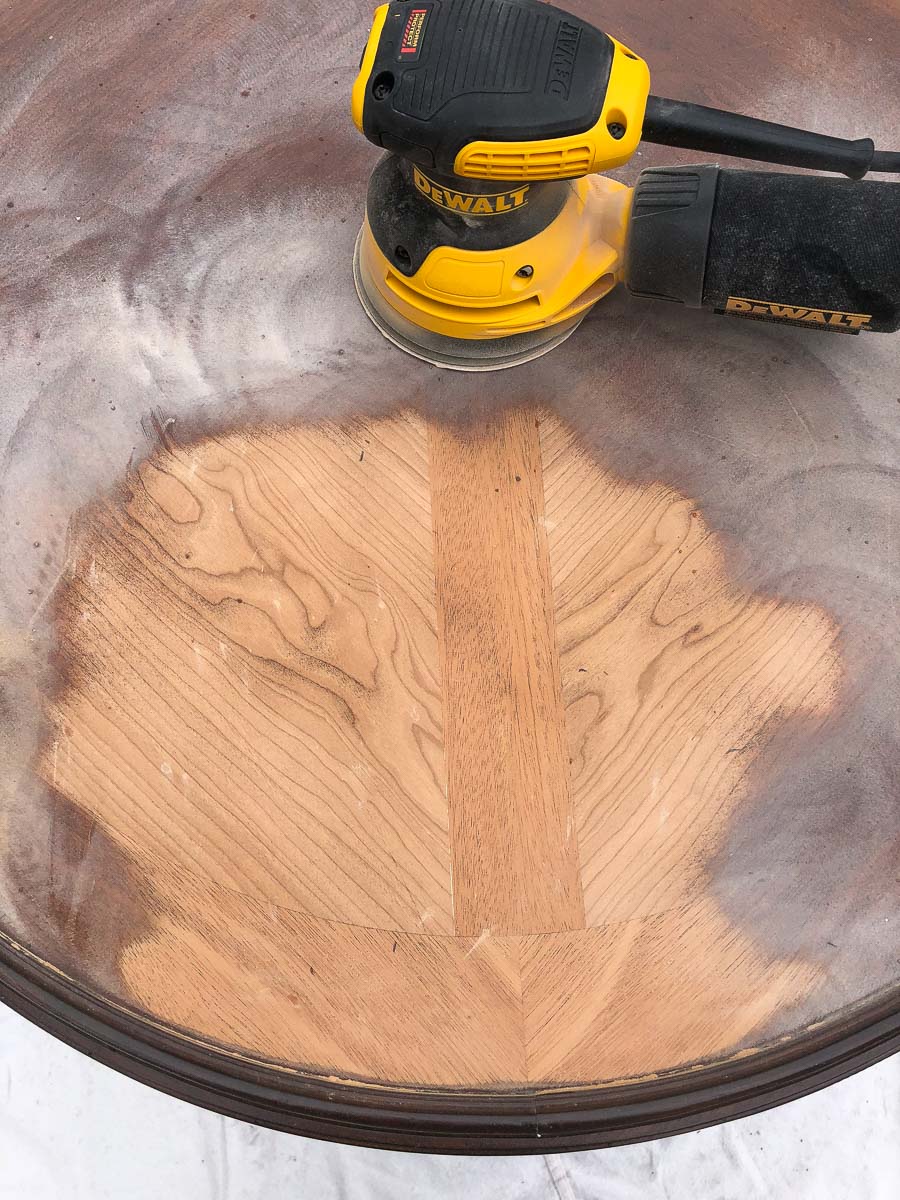
About half way through sanding the top I started seeing this – who knew such a gorgeous design was hiding underneath that dark stain!
3. Use a Wood Stripper On the Rest
Next it’s time to use a wood stripper on the rest of your table to remove the paint or varnish on its surface. I like using gel wood strippers (my favorite is {this one}) because they cling to all of the little nooks and crannies. Use all safety precautions specified on the wood stripper including using rubber gloves.
You simply apply the stripper, let it sit about 10-15 minutes (I find it works best if you don’t let the stripper start drying before removing) and then remove it. I first remove what I can with a putty knife following the grain of the wood as you remove the stripper and paint/varnish that came off with it. Then use paper towels or old rags to wipe the rest off. Sometimes it can take 2-3 rounds of using wood stripper to get it completely stripped down.
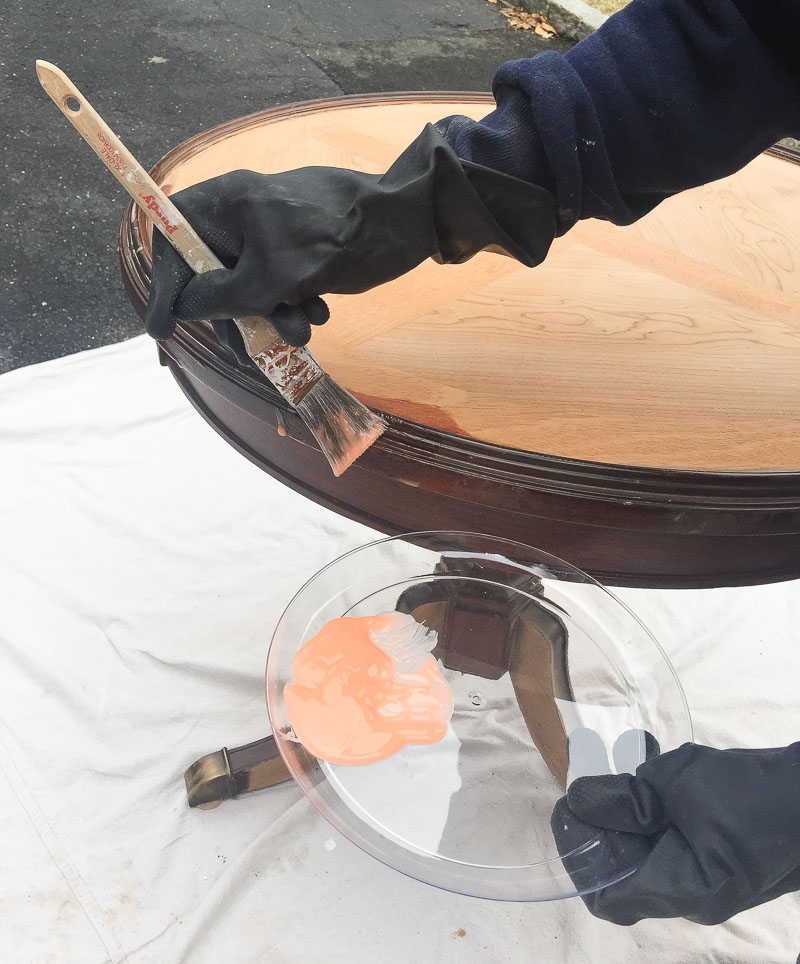
Once you’re done using the wood stripper, rub your table with a rag soaked in mineral spirits to remove any remaining residue. Then using fine sand paper (220-grit paper) or a very fine steel wool, sand any remaining spots that didn’t get completely stripped down to the bare finish. Sanding sponges like {these} work great for areas with lots of detailing like the top rim of my table.
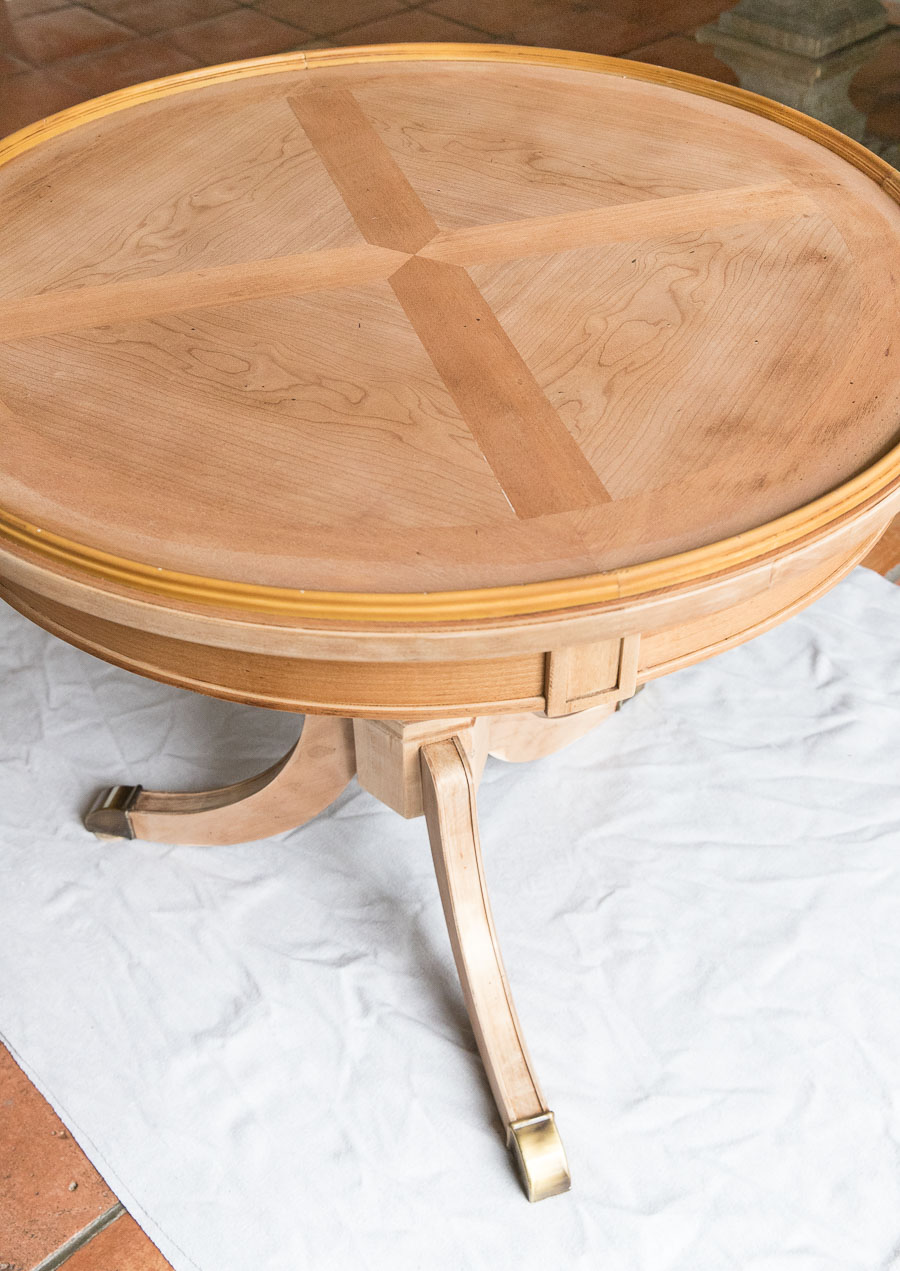
After all of the stripping and sanding, here she is, all bare and ready for stain! Having a blank slate to work with is my favorite thing about refinishing a table!
4. Apply a Pre-Stain Wood Conditioner
Before applying stain, a pre-stain wood conditioner is a must-do – it prevents streaking and blotching by evening out the absorption of the stain. After using a tack cloth to remove any residual dust, I used {this Minwax conditioner} that prepares wood for oil-based stains (if you’re using a water-based stain, you’d want to use {this Minwax conditioner}).
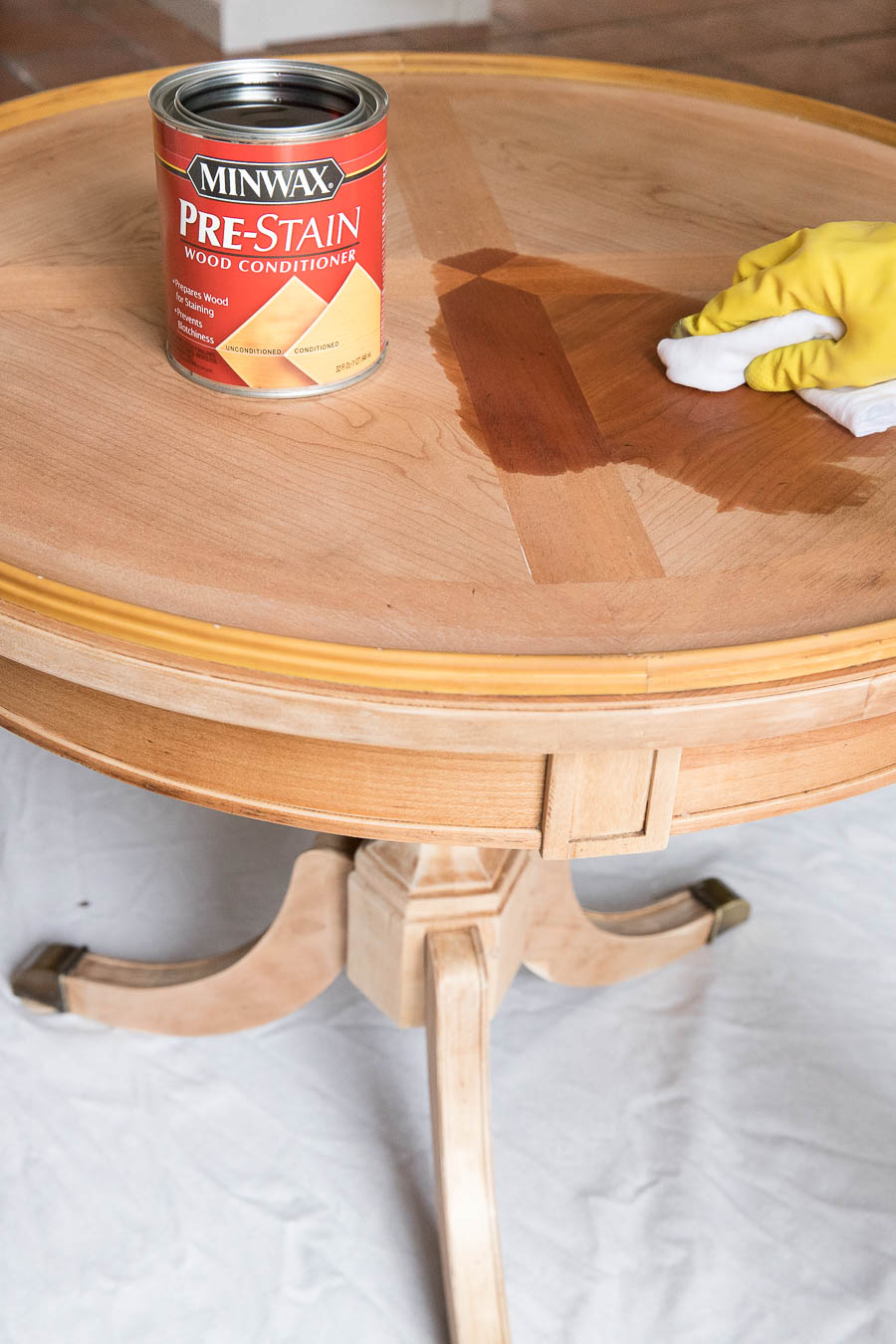
I applied it with a cloth (you can also use a brush) and then waited about ten minutes before going over it with a clean rag to remove any excess.
5. Choose & Apply the Stain
Here’s where the magic happens with refinishing a table – the stain! But before giving the how-to, let’s talk about choosing your stain. Stains are going to look different depending on (1) the type of wood you’re using it on, (2) how long you let the stain sit before wiping off the excess, and (3) how many coats of stain you apply. If you can, it’s always a good idea to test your stain out in a hidden spot before applying it to your whole piece.
In my case, I tested it out on the underside of one of my table legs. I actually tested a few different stains and also a few mixes of stains (which you can totally do as long as you’re mixing oil-based stain with oil-based stain and water-based with water-based). I ended up liking Minwax’s Classic Gray Wood Finish the best – it’s beautiful!
I applied the stain about 15 minutes after applying the conditioner (you can apply it up to two hours after conditioning but I personally think it works best when done before the conditioner dries) using a clean cloth in the direction of the wood grain. I was going for a light gray whitewash look so only let the stain sit about five minutes before wiping off the excess with a clean cloth (you can let it penetrate up to 15 minutes if you want a darker color).
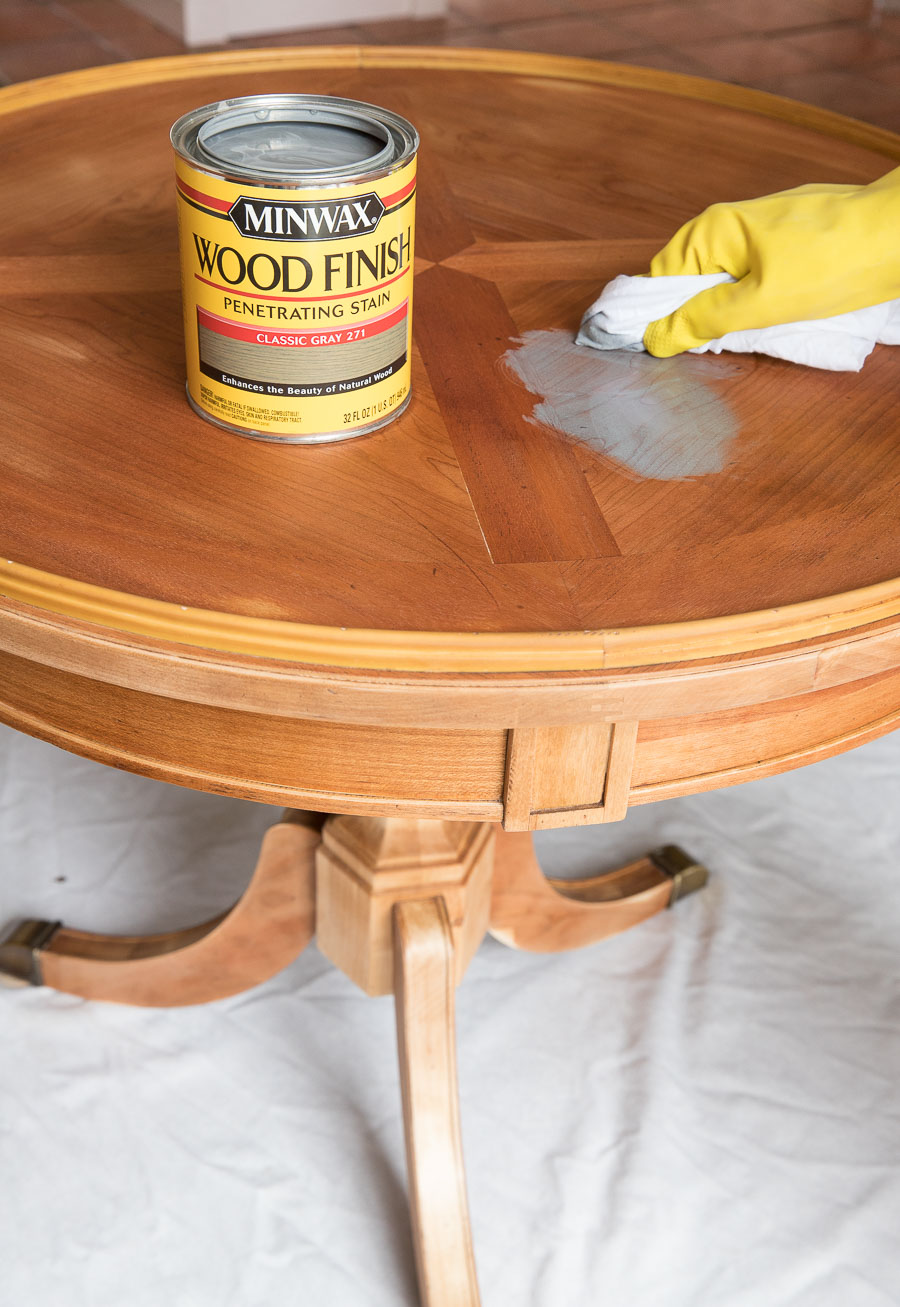
Since I was only letting my stain sit for a few minutes, I worked in sections. Here’s what the finish was looking like after staining the top of the table – I was pretty excited about it because it’s EXACTLY the type of finish I was looking for!
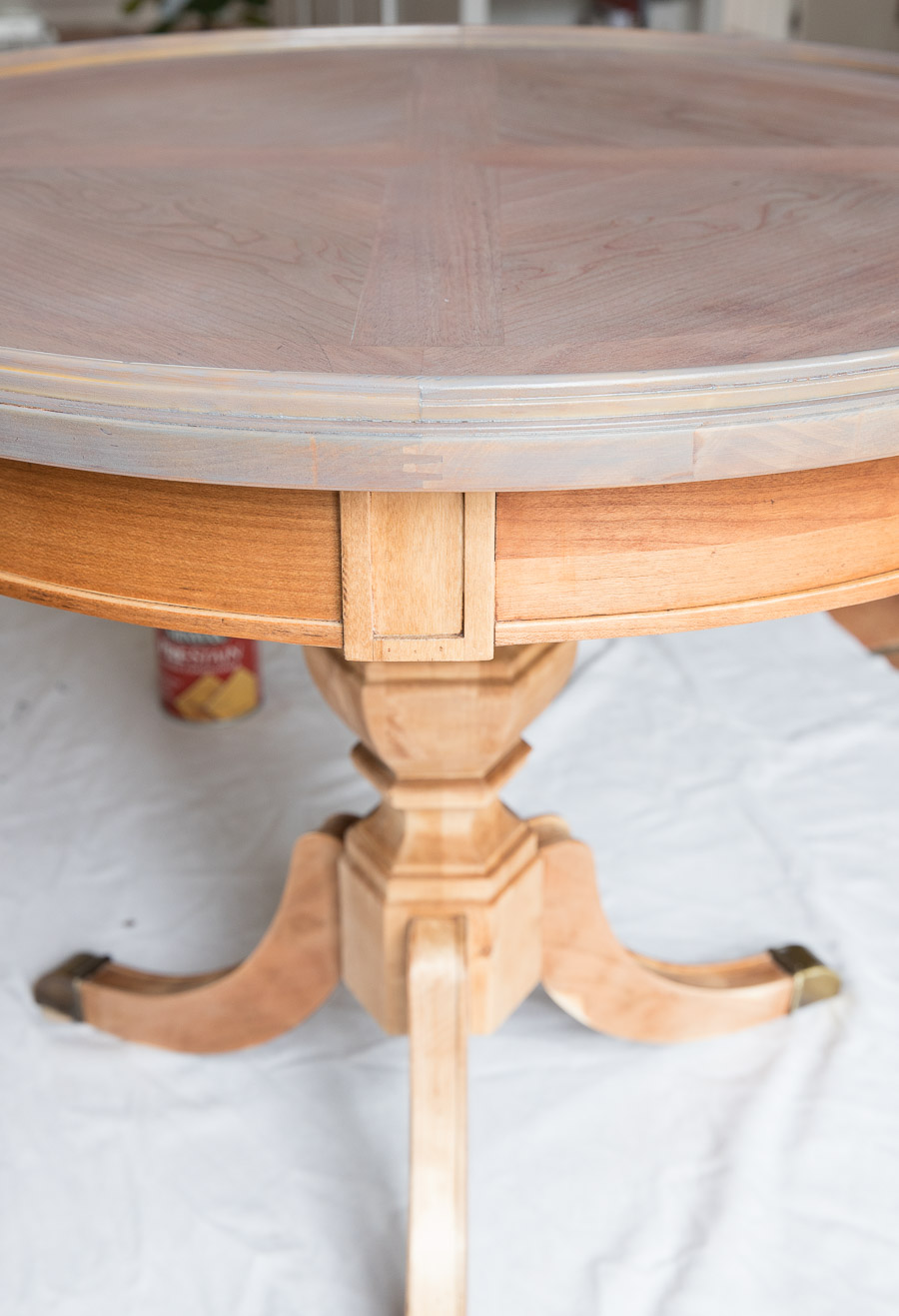
I kept going with my stain around the rest of the table and called it good with just that single coat since I liked the amount of color but you can apply a second coat of stain 4-6 hours later if you want it darker.
6. Apply a Protective Finish
Choosing the right top coat to finish off your project is key. I really love the raw, natural look of wood so was considering finishing mine with {this finishing wax} but I wanted to be able to place a vase on top of it without worrying about water issues so I went with Minwax’s Polycrylic Protective Finish. This is my favorite top coat, especially when covering a light colored stain because it doesn’t yellow like some polyurethane top coats can. And since it’s water-based, it dries fast.
I brushed on one coat with a nylon paint brush and after two hours of drying time, did a light sanding with very fine sand paper, used a tack cloth to remove the dust, and then applied a second coat.
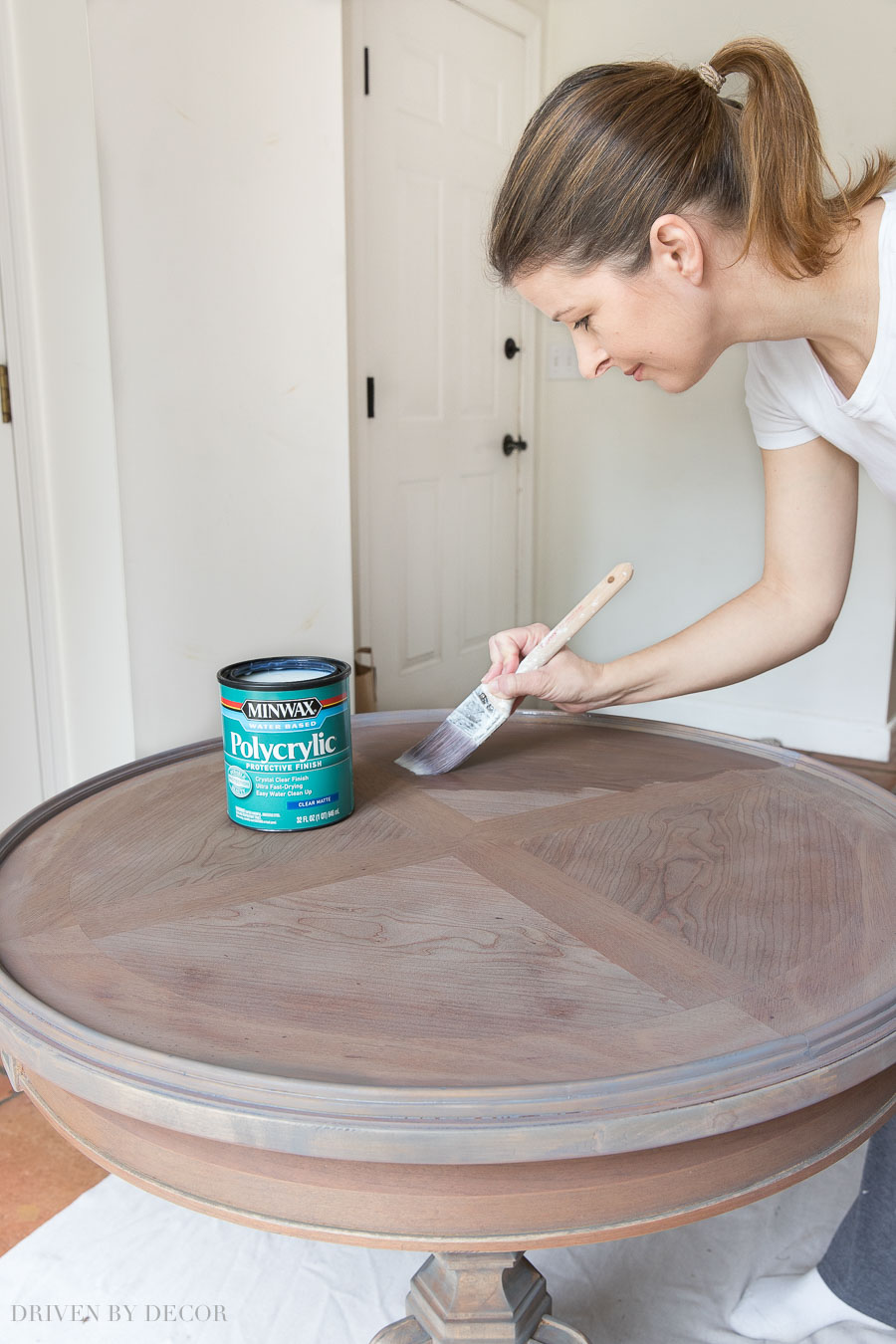
I went with the Matte finish which I had never tried before but it’s perfect! I’m not big on shine and once the Matte Polycrylic was dry, there was virtually no sheen or reflection. Ready to see my newly refinished beauty?? Love!!! It makes me so happy to see this old girl restored and looking gorgeous!
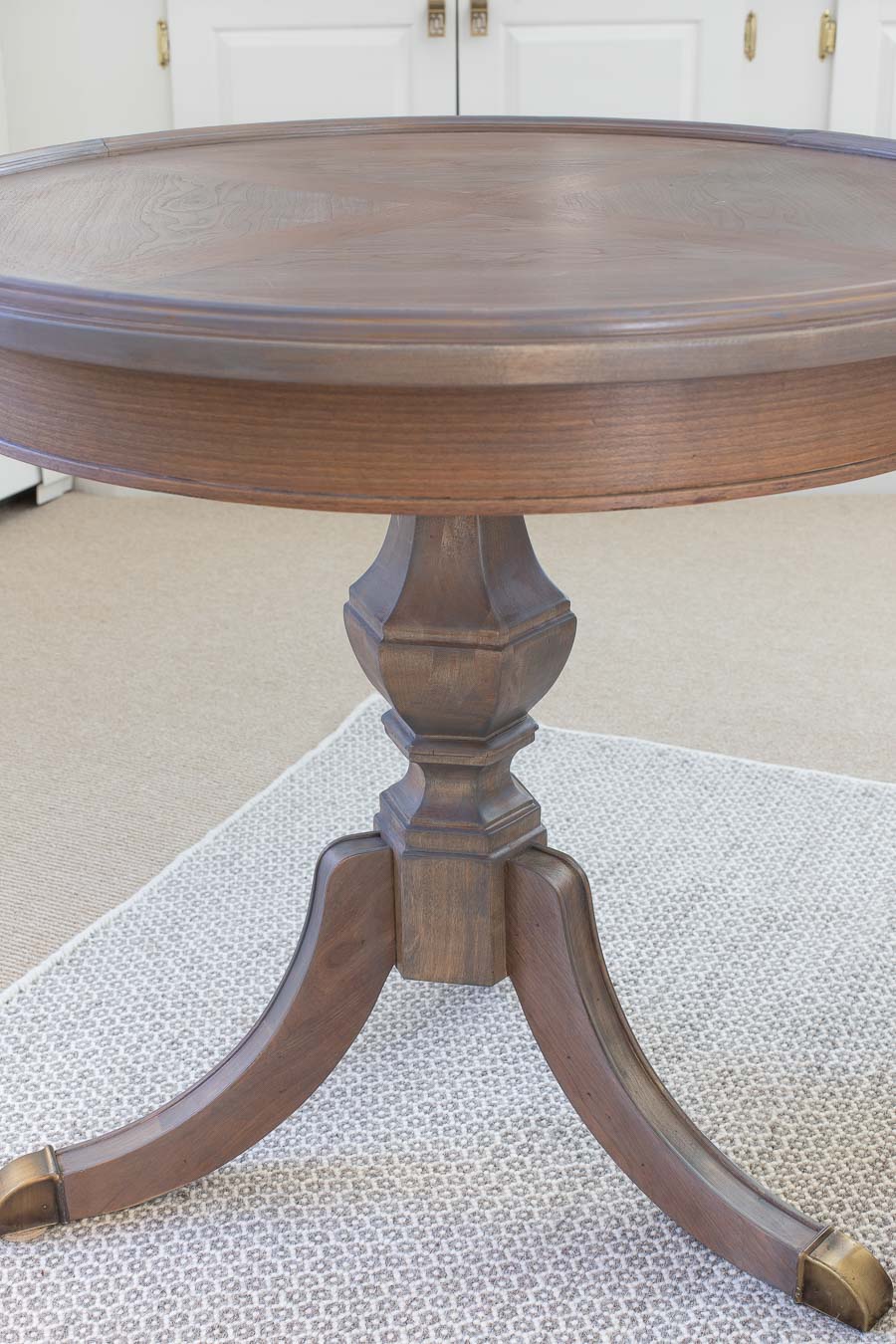
7. Put Your Beautiful Newly Refinished Piece to Use!
As I mentioned, my side table has been living in the corner of our living room and that’s probably where it will eventually end back up since it’s the perfect size and shape for that spot, but since I’m working on painting our living room (more on that later!), for now I’m giving it some time to shine in our family room. I’m so, so happy that this piece that means so much to me has been given a new lease on life!
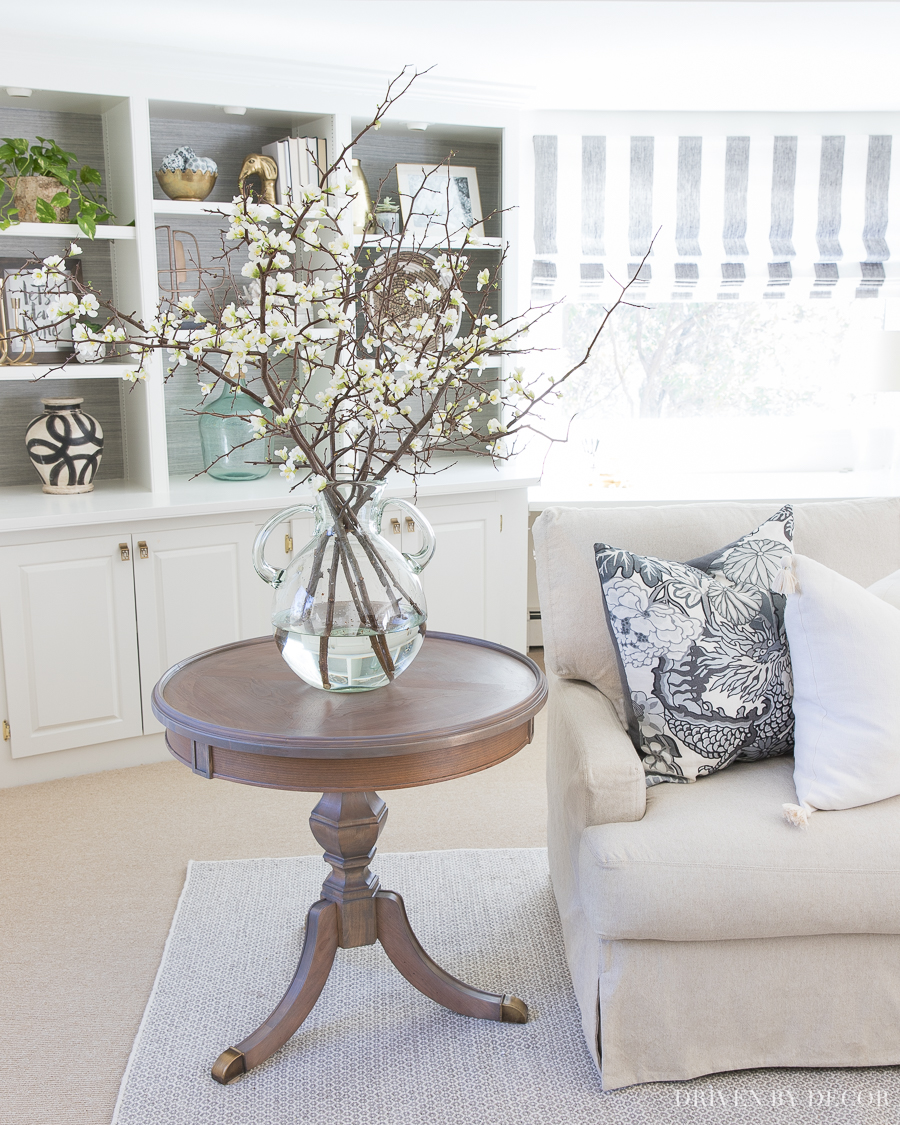

Room sources: Slipcovered sectional | Acrylic coffee table (similar) | Chandelier (satin bronze) | Honeycomb ivory/grey wool rug | Large glass jug vase – HomeGoods
Hopefully this post gave you the info and inspiration you may have needed to refinish a table of your own! Not sure you want to refinish your furniture piece but are instead thinking about painting it? Use the same steps as I did in my post on our painted bathroom vanity.
I’ll see you over on Instagram and Instagram Stories {here} and back on the blog soon!



Pamela Lay says
How do you know if you have real wood ?
Kris Jarrett says
It can be difficult to tell sometimes but usually the wood grain pattern gives it away since it’s hard to mimic true wood grain. Often when it’s not wood, you’ll see a lot of repetition in the grain pattern. Sometimes looking at the underside of a furniture piece can also give it away.
Mona says
I liked the post conditioner color for this classic style more than the finished product.
Doni says
Beautiful!
Glee says
Color better matches the decor, but to be honest, I liked the original better, minus the scratches. But then, I am completely burned out on grays.
Mary Evans says
The table is beautiful. I know you are so proud to have been able to keep this treasured piece of furniture. You have shown me what products to purchase and all the details to do my Moms table. Who would have thought such a beautiful table was under all that mahogany. Love your blog and all the ways we can decorate our homes.
Adam C says
How long did this take ? This inspired me to refinish all of our end tables and coffee tables. Going to start today. How long ?
Kris Jarrett says
Honestly I didn’t track my time during the project so can’t remember exact hours but I got the entire project done over the course of a weekend working on it intermittently.
Becky Jones says
It’s just perfect! What a great job.
Ingrid Wright says
That is absolutely fantastic! I love the look of natural solid wood with a fresh stain. Beautiful job! I have some wood pieces that can only handle chalk paint, simple veneer. But I have a very old solid wood table that I wanted to do the exact colors you have used – perfect.
Paul says
Wow, I don’t like it at all. I think it was hazy chalky and gray. What happened to the deep wood tone? The brownish orange color of beautiful wood? Where did the depth go. Am I the only one that sees this? Come on, look at the bottom picture finished and scroll up to the very first picture. You tell me which one is better. It must just be me. Good job but the results I could do withiut
susan osborne says
I’m with you on this item, Paul, sometimes if something doesn’t just cry out for a makeover, or speak to you for a future use, please, let it go on to another home where it might be appreciated and loved as it is. I have a funny little “table” similar, thought it was actually a piano stool… using it to hold my morning coffee and note book for years, until I find just the right way to further love it.
Sue
Anonymous says
Very inspirational! I have several beautiful old pieces that I love, but wish they weren’t so dark. The finish you chose was perfect. You did such a thorough job. Such a beautiful heirloom now. Enjoy your new old table!
Rachel says
Wondering how you felt with the wood grain going different directions as you are supposed to put the polycrylic on in the direction of the wood grain. Did you tape it off or just change wood directions free handed? I have a kitchen table that has 4 different trianglesthat meet in the middle but all go different directions. I’m struggling with finishing this piece because of that.
Lisa says
I am also wondering that because I have a table with multiple directions as well, that I would like to refinish
Kris Jarrett says
I followed the wood grain as much as I could with the first coat and did the entire tabletop at once with no taping off. After a light sanding, it was totally smooth so I did my second and final coat brushing the entire table top in the same direction.
If after your first coat of polyacrylic and a light sanding you’re still feeling rough spots, do a second coat that again follows the grain. Then lightly sand again and do a third and final coat where you brush the whole surface in the same direction. Hope that helps!
Kathleen Towle says
Oh my gosh! I have two of these exact tables on either side of my bed and was thinking of refinishing them in this very way. You have given me the confidence to do it! Your table looks great. Awesome job!
Kris Jarrett says
I’m so glad you were inspired! Good luck refinishing them – it’s a really rewarding DIY project!
Sue says
Oh my, oh my! In my opinion, you have made a mistake! The mahogany and the lines of the furniture are a perfect design match to each other. This finish stands the test of time throughout all trends of style and colour. OH NO!!
Kim says
An old trick to blend/fill in scratches on wood furniture that my dad taught me was to make a paste using cigarette ashes and sone vegetable oil (pour slowly, little at a time mixing between drops to form a PASTE) apply using a q-tip by dabbing the paste on, let sit a few minutes wipe excess paste off with old shirt square, dry cloth… repeat if/as needed to fill scratch in
Kris Jarrett says
What a great tip! Thank you so much for sharing!
Amanda says
This turned out great! I bought a coffee table I wanted to do this to, but when I started stripping and sanding it I noticed that it had a veneer on the top and the legs were a resin. I was devastated because I had thought it was all wood! I always thought you couldn’t stain a veneer. Did you have any trouble with it not “accepting” the stain since there wasn’t any real grain to the veneer?
Kris Jarrett says
If it’s a wood veneer you can definitely stain it – you just have to be careful when you sand because veneers are typically a very thin layer and if you sand all of the way through it to what’s below, then that will likely not be stainable.
Pat G. says
I love the finished piece! Thank you for the tip regarding veneer. My table MAY be like “Amanda’s”…veneer on top and possibly a resin for the base. Do you happen to know how the penetrating stain works with a resin that looks like wood?
Kris Jarrett says
Unfortunately I don’t have any great tips for staining resin – from my limited experience working with resin, it doesn’t take stain well at all. There might be some tricks to staining it that I’m not aware of though…
Bernadette says
Love the color! Looks absolutely fabulous!!!
Kris Jarrett says
Thank you!!