

Trying to decide whether or not to have a second floor laundry room? I share the pros and cons along with flood prevention tips if you move everything upstairs!
As with open shelving in the kitchen, second floor laundry rooms seem to divide people squarely into one of two camps – those who love it and those who are adamantly against it. When we added on to our house in Cincinnati, I had several people advise me to rethink my plan to move the laundry room to the second floor but in the end I decided to go ahead with it. I’m so glad I did – I loved it!
We used our upstairs laundry room for about four years until we moved and I thought it might help to share my experience, including the pros and cons and some important tips for preventing everyone’s biggest fear about a second floor laundry room – flooding! Hopefully this post will be helpful to those of you considering an upstairs laundry room as part of new construction or a home remodel. (post includes affiliate links – see my full disclosure statement {here})
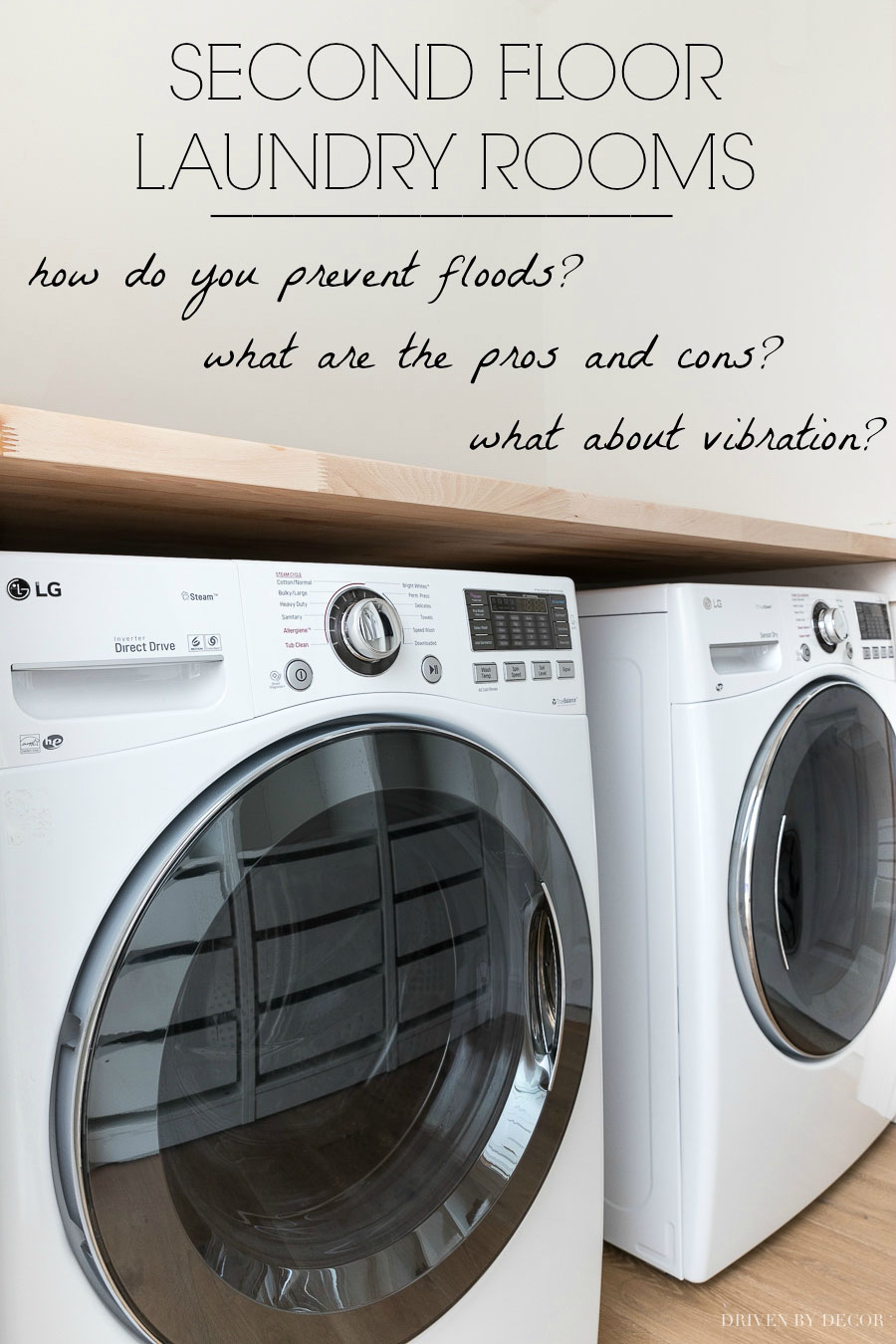
Second Floor Laundry Room: The Pros
1. No more lugging laundry up and down the stairs!
The dirty clothing, sheets, and towels that make up 95% of our laundry are generated upstairs so having a second floor laundry room eliminates the lugging of laundry baskets up and down the stairs.
2. You can eliminate the use of hampers in bedrooms/bedroom closets.
Older houses such as ours have small closets, making closet space a precious commodity. Since our laundry room is in the middle of the second floor, I keep two large hampers in the laundry room and we put our dirty clothes directly in these hampers rather than keeping hampers in our rooms. In addition to freeing up space in the bedroom closets, it eliminates the time it takes to collect the laundry from various rooms before starting the wash.
3. Doing the laundry takes less time
For both of the reasons above, doing laundry takes less time. And let’s face it, could there be a bigger pro??
Second Floor Laundry Rooms: The Cons
1. Second floor laundry rooms can make it hotter in the summer
Running the dryer during the summer months can make it hotter upstairs and increase your a/c bill. However, I found that if I’m vigilant about keeping the door from the laundry room to the hall shut, it’s not an issue.
2. Noise from the washer and dryer can wake nappers
I am blessed with having girls who are great sleepers so it’s never been an issue in our house, but if you have light sleepers and like to do laundry at nap time and nighttime, noise from the washer and dryer being a problem is something to think about.
3. Possible flood damage
A washing machine that overflows or washer hose that bursts can cause much more damage to the house when the washer is on the second floor. Fortunately, if you follow a few simple tips (see below) it will significantly minimize the likelihood that this will be an issue.
Want to save this post?
4. Vibration of Washer
Front loading washing machines can cause significant vibration during the spin cycle and potentially result in the machine “walking”, although it’s much less of an issue with today’s front loading washer and dryers than when they first came out. For this reason, some choose to use the older style top loaders in second floor laundry rooms. If you’re getting a new washer and dryer for an upstairs laundry room, definitely check reviews about how much vibration the sets you are looking at produce and use that information in making your purchase decision. If you have issues with vibration and “walking” of your washer and dryer, anti-vibration pads such as {these} can definitely help (I’ve tried them myself and they work well!).
Flood Prevention in Second Floor Laundry Rooms
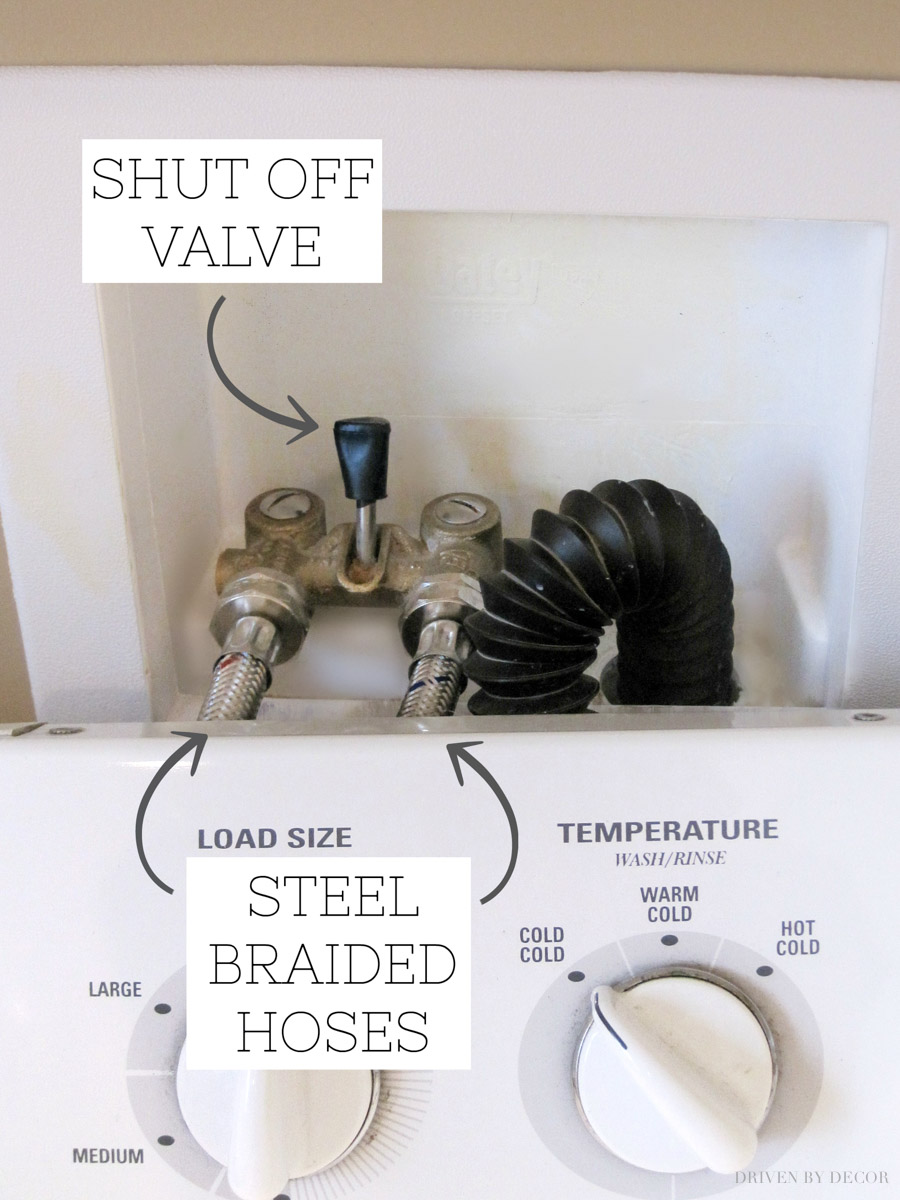
1. Have a Water Shut-off Valve That’s Easily Accessible
When your washer isn’t in use, use the water shut-off valve to turn off the water supply to the washer to eliminate the possibility of a flood due to a burst hose. Another option is to install an electronic valve shutoff kit such as Floodstop (available {here}) that has a water sensor that you place under the washing machine – when water is sensed due to a leak or flooding it automatically shuts off the water supply.
2. Use Steel Braided Washer Hoses
Steel braided washer hoses such as {these} are much less likely to burst than standard washer hoses so paying just a few dollars more for a higher quality washer hose is definitely worth it. Upgrading to steel braided hoses is actually a good idea no matter what floor your washer is located on.
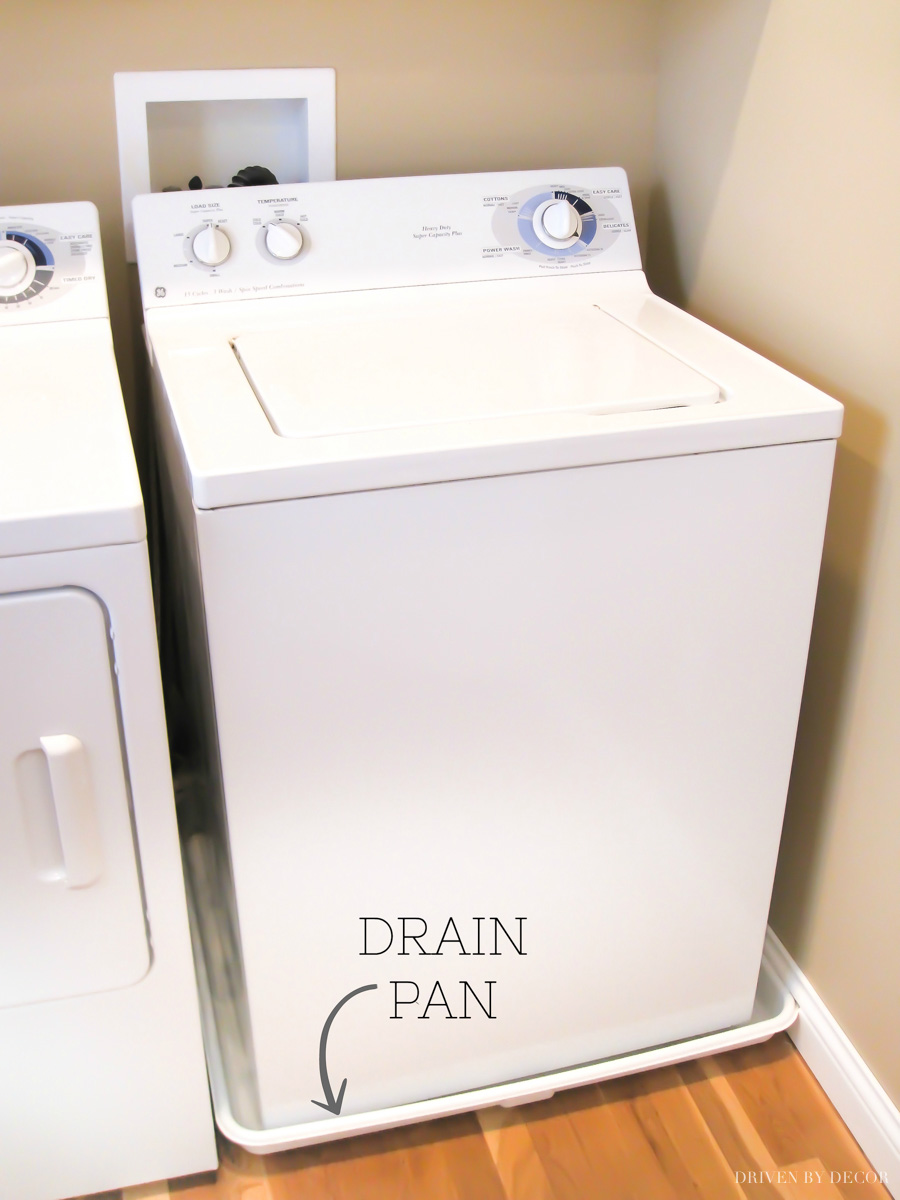
3. Place Your Washing Machine in a Drain Pan
By using a drain pan, if your washing machine were to overflow, it would go down the sides of the machine into the drain pan, which is attached to a pipe that drains the water away and prevent an upstairs flood.
4.Consider Adding a Leak Detector
In a worst case scenario that a floor does occur, a leak detector can alert you to the problem before the damage becomes to great. Newer ones such as {this leak alert device} have the ability to send you an email alert so you are alerted even if you’re not home to hear it. I actually have one of these by our water heater and luckily we haven’t needed it but I’ve tested it and it works great!
Having had homes with laundry rooms on all different levels (including the basement – hated that!!), a second floor laundry room is definitely my preferred spot. I’d love to hear your experiences – if you’ve had both first and second floor laundry, which do you prefer?
Want other ideas for your laundry room? Check out these favorite posts:
Our Laundry Room Cabinets (On the Cheap!)



Ioana says
Another new reply to an old post — but if I’m here looking for advice, others must be here for the same reason. So we are “moving” our small master bathroom towards the window for natural light, taking over a walk-in closed and making the old shower area available for using as a second closed or a laundry. Inclined to do the later, for all the reasons stated in your post. Some updates on technology: We have a new-ish LG dryer and I have just purchased a small pedestal washer that goes under it. Those two stay in the basement, to dry wet towels from the pool, large items like a comforter and other large things. We will replace the old laundry with a laundry tower (LG has just introduced a high capacity tower that is essentially two full sized stacked washer and dryer with a common panel. Rated for apartment, with low vibration, no vibration pads needed). Instead of a pan, we will leave the shower drain in place, so that any water that accidentally comes out will go down the drain like it does downstairs. Finally, many home security systems now have a water detector so that we can get a quick emergency update wherever we are, should a problem arise. The single loss would be the walk-in closet, but the old shower area is just not big enough for that. We will make room for a second closet (smaller) by moving a wall.
As we start tackling this project, we will find out of reenforcement is needed. Fortunately, under thus shower is our old laundry area which is still unfinished. So plenty access to reinforce if needed.
James Hubbard says
What about reinforcing the floor under the washer and dryer due to vibration? Is this necessary?
Ivan says
Hi, I decided I wanted to convert my Duplex into one unit. I tore out the second floor kitchen and replaced it with a laundry room with front loader washer/dryer. Best decision we ever made. I was worried with the vibrations and flooding. We ended up buying the full size front loaders that stack. It reduces the vibration a bit. My spouse always starts the washer just before bed every night. We still get a bit of vibration but find it soothing to sleep as it’s not terrible. I have always been worried about flooding which led me to this site. Thanks for all the information you provided as I wasn’t aware of some of the options.
Originally I wasn’t sure about moving it to the second floor, but wouldn’t have it any other way now. We also have ours built as it is like a closet with bi-fold door, with the door closed we can hardly hear the laundry going and it’s just outside our bedroom door.
If anyone was to ask me, I would say definitely do it!
Also doing laundry at off peak hours saves on our electricity bill.
Kelly Daniels says
Great post. No little ones anymore, but flooding is certainly a potential hazard. Good to have preventative strategies. Thanks!
Kate says
Great tips! Hubby and I finally agreed over the weekend to tackle this project in 2021 as time allows 🙂 Doing all my research now.
Barry says
A laundry chute gives you all the same convenience without the flood worries.
Barry says
You can also install a drain in thr laundry room floor.
Richa Gupta says
Great tips, very helpful article for me as a first time house buyer who is also renovating. Can you share or give an idea of the cost involved?
BryanB says
So much different ideas, gives you food for thought. I was open to being sold on the upstairs Laundry but after all the comments I will go with downstairs laundry. The convenience falls short of the pros for having it downstairs.
1) I am a DIYer, so just the idea of getting the machines upstairs hurt (LOL) even if someone else is installing them.
2) The risk of damage and the follow up inconvenience is way too great even if covered by insurance.
3) I use the laundry sink for washing dirty outdoor wear with mud etc, these clothes/jersey can be left downstairs without bringing them upstairs with the stench, grime and dirty.
4) Who knows what the effect of minor vibrations over time will have on the structure of the house. On the first floor washer is on solid concrete.
5) If we ever decide to use line drying, it is a simple walk outside.
Mark says
Hi there…just one quick comment…the draining water pipe from the laundry machine goes into a larger waste pipe in the wall or floor depending on where you put it…so is there a transition fitting one needs to use from the machine pipe which exits from the back of the machine to the pipe in the floor or wall? I know the pipe from the machine should be at least 4-5 inches into this larger pipe opening but should the opening be closed? Knowing that the water will flow better with accessible air in the pipe I am assuming it would just “sit” in the larger pipe in the floor or wall but is this the case?
Thank you, Mark
Kris Jarrett says
It’s a great question but unfortunately I’m not sure what the proper plumbing set-up is!
Jamies A Halstead says
When i first got married we lived in a single story house (no chose for basement) the LR was in the same hallway as the bedrooms. The twins would only sleep when the dryer was running for white noise.
Then we moved to a bigger place the washer dryer was in the mud room to the garage but bedrooms were upstairs (that was horrible) we were constantly rewashing cloths and it was unsightly.
Then i made first class and moved into e-6 and about housing new construction!! Dedicated LR upstairs in middle of house (best set up) we had a deep sink and counter space! the washer was in a floor pan never had any flooding and we have five kids so laundry was going almost 24/7
We got new orders and moved to a place that was newly renovated. It had laundry closet in the upstairs hallway. The washer & dryer sat side by side. The closet had folding doors and I added a shower curtain rod for hanging clothing above the machines. This worked very well even while sharing a wall with a kid’s bedroom.
My ship home-port shifted & place we rent now has the LR off the kitchen (it is horrible) I was shocked that a house built in 2016 doesn’t have a second floor LR!! everyone knows when party guests are over they spend most time in kitchen so we have to stop laundry operations when we have a party coming up to keep the LR presentable not to mention we store our cloths in bed rooms we change close in bedrooms now were doing the lugging/transport thing again (with 5 kids worth of laundry).
let me mention the cons
the electric dryer drops efficiency when the exhaust pipe gets linted up (i had to move the dryer hose and vacuum the dust if i noticed the close drying slower) I did it maybe once a year when the LR was in the middle of the house long exhaust distance
if the washer was unbalanced spin cycle it would strike against the dryer and make a loud bumping noise but that was nothing. (if the washer was in the basement i would still hear the bumping noise)
I can’t think of any reason not to have a second floor LR. we never had flooding , humidity or room temperature issues in 12 years all of witch with the standard old school washer dryer like exactly as pictured above since we got married.
The next place we are stationed if the LR is not upstairs with the bed rooms it’s a deal breaker for my Wife and I.
Chris says
My washer and dryer have been side-by-side in a closet in the upstairs hall for nearly 36 years. I wouldn’t have it any other way. No going up and down with laundry baskets for me. The original pan under them was sheet metal and hooked a drain. After 33 years, a small leak from the original washer (a 1984 Maytag) rusted out the pan and stained the ceiling below. The replacement washer is in a plastic pan. Vibrations have only been an issued when the washer is unbalanced. When the closet doors are closed much of the sound it muffled. If I ever move, the laundry must be close to the bedrooms.
Sandra says
We have laundry on the second floor and love it. We also have a top loader and the only thing I have trouble with is balancing the load. On occasion when I think I’ve fretted enough about the balancing the washer still bangs in the first spin. I readjust the clothes and it rinses and spins as it should.
I am thinking about replacing the washer with a front loader because of the balancing issue. Could someone comment on this issue?
Thanks!
CB says
I preferred a second floor laundry. Just moved into my second new home and couldn’t believe the laundry room was on 1st floor. Adjusting but already are looking at 2 areas upstairs to move the laundry during our first big renovation.
Mike Linch says
A big concern we see is the vibration from the machines cause a lot of drywall seem popping and cracking on the ceilings and walls below the 2nd floor laundry from the vibration. I was also concerned about the increased noise, humidity, and heat. Even zoned, 2nd floors can struggle with cooling in our hot climate.
My wife wants one in our new house, and I am just weighing the pros and cons. I wish I could get her to consider a ranch, but she feels safer sleeping on the 2nd floor versus a ground level bedroom.
Dan says
I Built a 2nd floor laundry closet with proper venting, exhaust, floor drain, & lighting I can honestly say…. I love it, absolutely love it. As a man at home who does his own laundry and tired of not having a laundry available as it’s usually tied up or a mess of clothing, however, that said, the only thing better than a 2nd floor laundry is keeping the main floor Laundry… Now we have 2. No arguments, no hassles no wait times 2 laundry’s going at the same time is a snap and super convenient. Cant wait to build my third laundry in the basement for the upcoming future in-law/ nanny suite ; )
Carol says
My washer and dryer are in a hall closet on the second floor. For the past 35 years I have not had to carry baskets up and down stairs. The equipment was originally in a galvanized pan. The original Maytags lasted 33 years (small family here) and were working well. However, the washer apparently developed a small leak which eventually rusted through the pan and stained the ceiling below. A new pan went under the new washer. I love my upstairs laundry.
Regina T Chustz says
I know I may be the minority, but our house has a laundry room upstairs and a laundry closet downstairs in our master ensuite. We love this! It has been so convenient, and I highly recommend this to anyone building a home or remodeling.