

Whenever I’m getting ready to hang art or drapes, choose an area rug, or buy lighting, I have a set of go-to interior design rules and measurements that help me get it right every time. They take so much of the guesswork out of decorating! Today I’ve gathered all of my tried-and-true guidelines in one post so you have an easy-to-reference source to turn too whenever you need it! (post includes commissionable links; for more information, see my full disclosure statement {here})
Hanging Artwork
When it comes to hanging artwork, there are a few interior design rules and measurements that can help you get the placement just right, whether you’re hanging a single piece of art or creating a full gallery wall like the one in the office of our previous home:
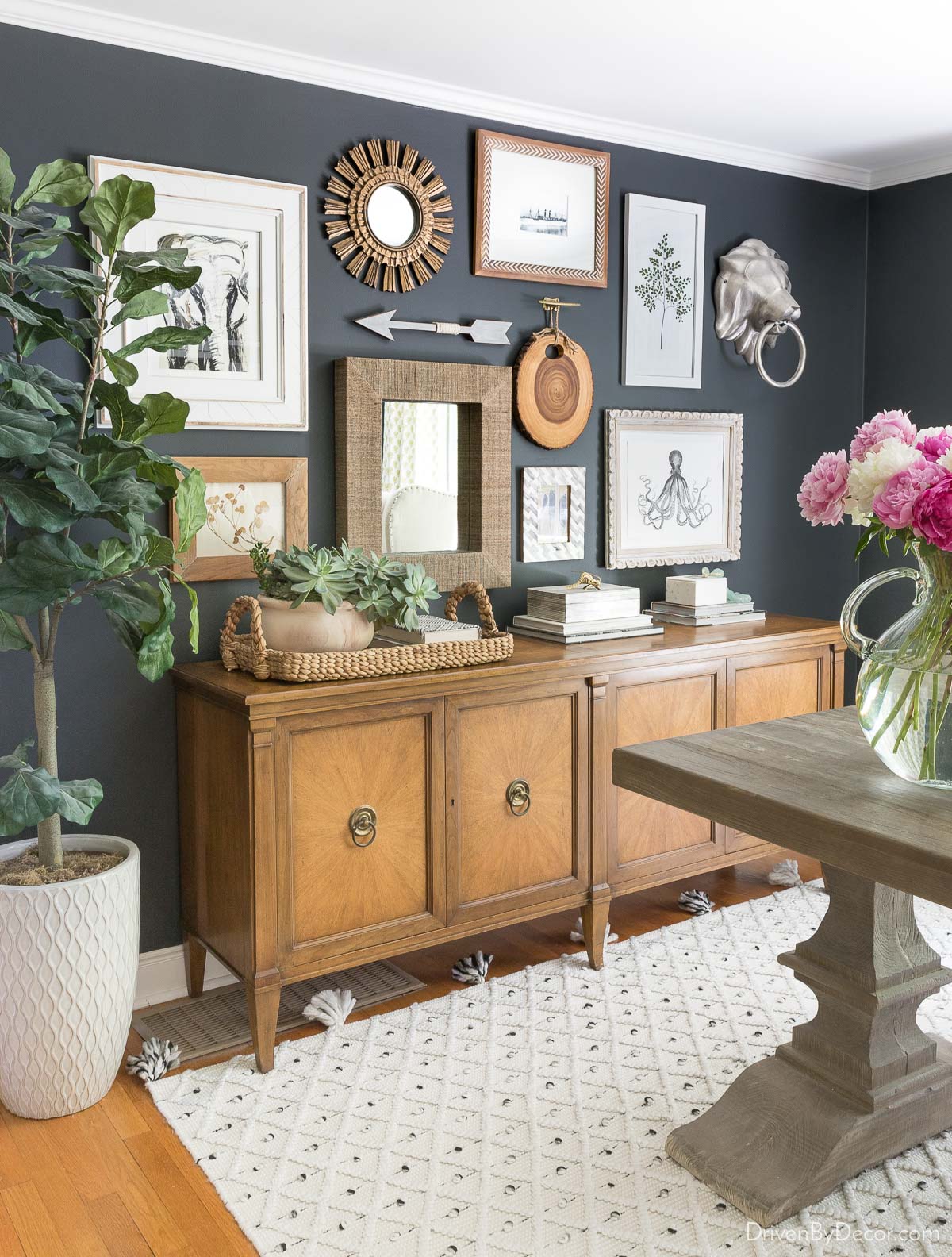
Sources: Desk (similar) | Rug | Faux fiddle leaf fig tree (similar) | Console is thrifted | Woven tray (similar) | Other sources no longer available
- For a single piece of art, the center of the image should be at 57″ – 60″ from the floor, which places it at eye level. The larger the piece of art, the closer to 57″ it should be.
- When hanging two pieces of artwork, one above another, treat them as one large picture – find the center point between them and use the 57″ – 60″ rule.
- For larger pieces of art hung on the same wall, use a spacing of about 2-3″ between them. Smaller pieces can be hung a little closer together.
- When hanging art pieces above a sofa or other piece of furniture, the grouping should ideally be about ⅔ the width of the furniture below it. Leave 3″- 8″ of space between the top of the sofa/furniture and the bottom of the art.
See my detailed post on how high to hang pictures {here} for more hanging tips!
Hanging Window Treatments
If you’re not sure how high to hang your drapes above the window frame or how wide your drapes should be, these tips will help…
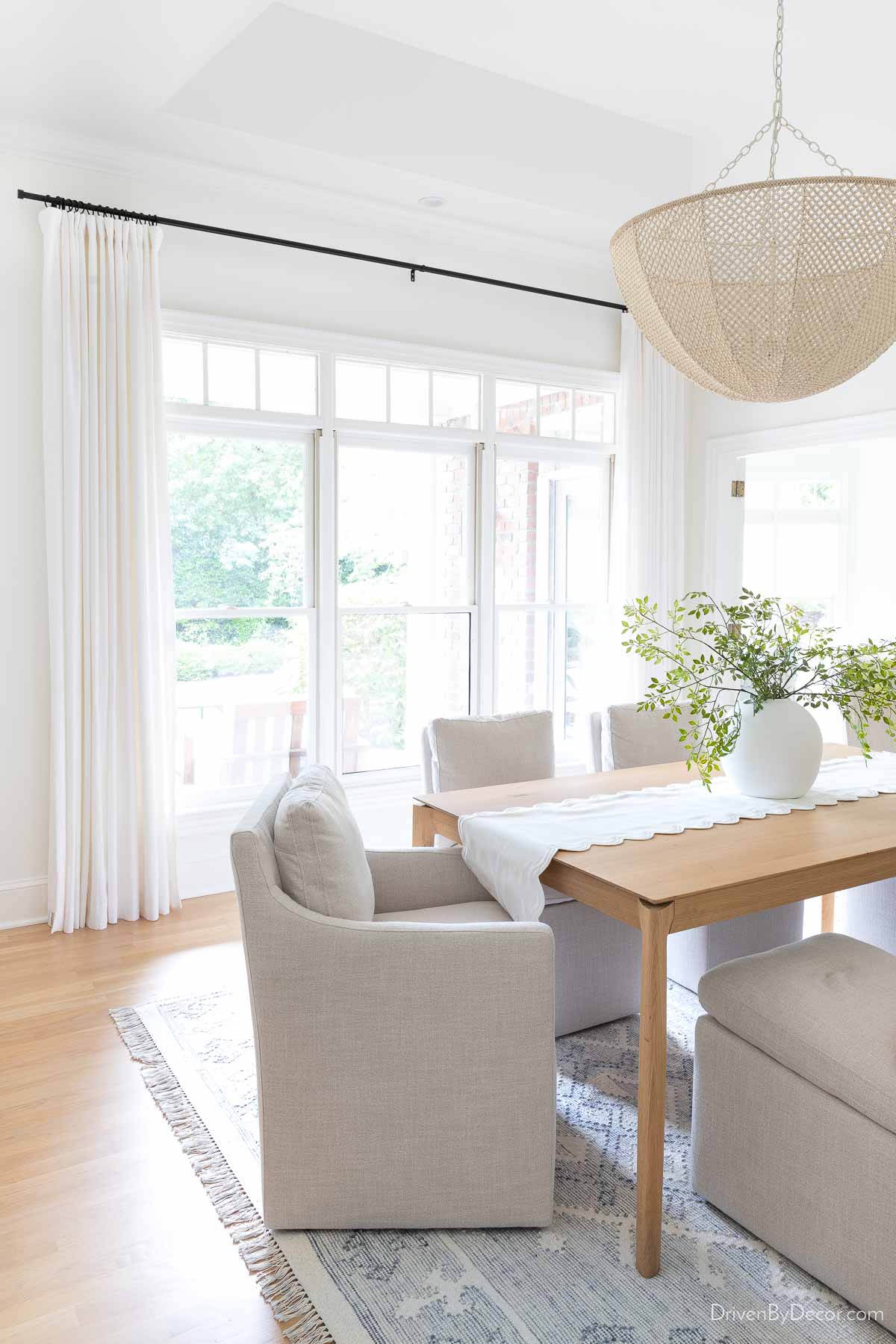
Sources: Drapes | Drapery rod | Drapery rings | Dining table | Rug | Side chairs | Armchairs | Beaded chandelier
- Buy drapery panels that will either kiss the floor or puddle on it.
- To create the illusion of a taller window, mount drapery rods above the window casing. A good rule of thumb is to hang your curtain rod ½ to ⅔ of the distance between the top of your window trim and your ceiling (or crown molding, if you have it).
- To make your windows appear wider and let in extra light, extend the rods anywhere between 4″ and 10″ (excluding finials) beyond the window casing.
- Drapery panels should have a combined width of 2-3 times the width of the window so if you have two panels framing a window, each panel should be 1 to 1½ times the window width.
These two posts have have other helpful tips related to hanging curtains and drapes:
Sizing & Hanging Light Fixtures
If you want to know how high to hang your chandelier above your table or how wide of a dining room chandelier you should buy, here are the measurements you need to know…
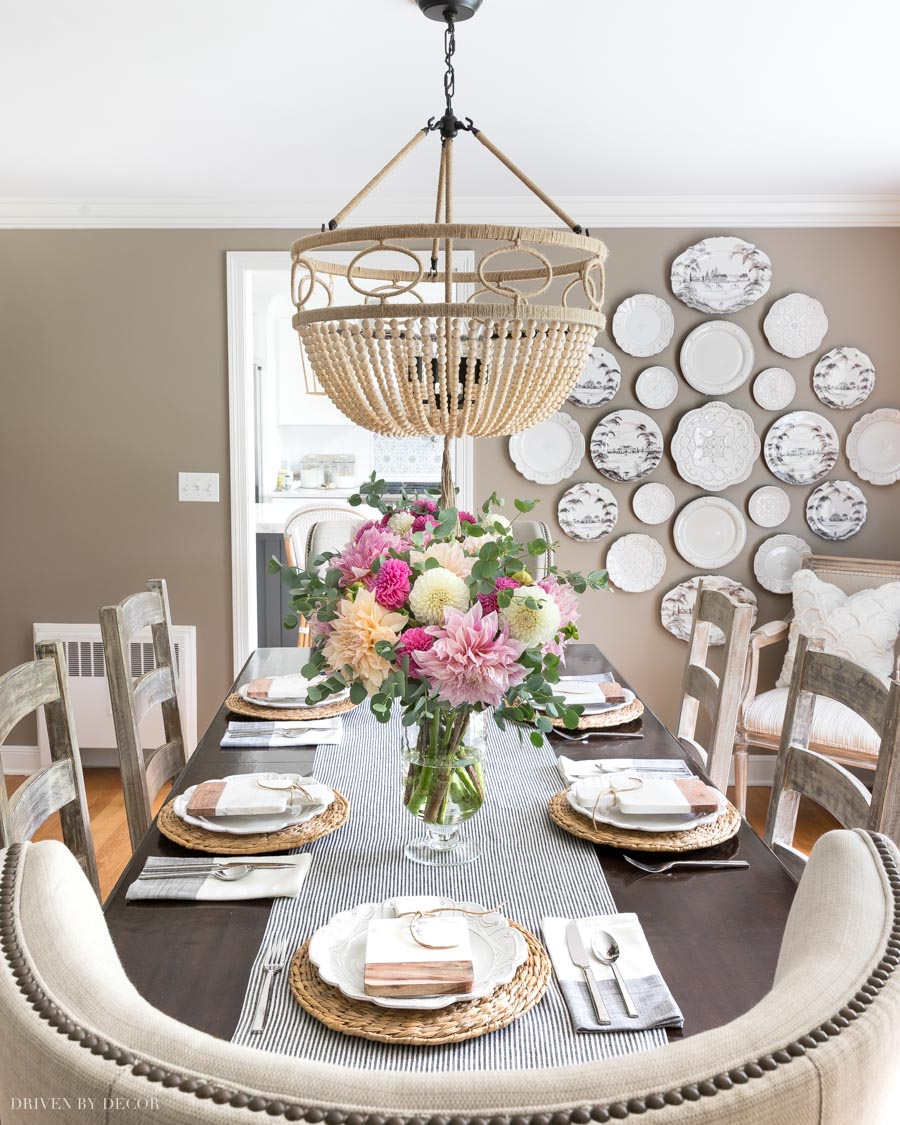
Dining Room Sources: Wood bead chandelier | Table & chairs – no longer available | 13″ Rattan chargers (similar) | Glass hurricane vase | White wall plates | Patterned wall plates
For a chandelier that will hang over a table:
- A good rule of thumb is for the width of the chandelier to be about ½ to ⅔ the width of the table it will be hanging over. Another way to determine the right chandelier size is to choose one that’s about a foot narrower than the width of your table.
- The bottom of the chandelier should hang between 30″ – 36″ above the surface of the table when there is an 8′ ceiling. For higher ceilings, you can hang the chandelier up to 3-4″ higher for each additional foot of ceiling.
For overhead fixtures in rooms such as a living room or entry way that are not hanging over a table:
- To determine a good width for your light fixture, measure the length and width of the room in feet, then add those two measurements together – the number that you come up with is, in inches, a good approximate width (For example, if your room measures 10 feet x 15 feet, add 10 + 15 to get 25. A 25″ wide fixture would be appropriate for this space.) For rooms with high ceilings, you can add up to 6″ or more to the width of the chandelier.
- An overhead fixture that will be walked under, such as in the entry, should hang 7 feet or more above the floor.
For kitchen pendants:
- Space kitchen pendants 30–32 inches apart, measured from the center of one fixture to the center of the next.
- As with chandeliers, the bottom of the pendants should hang between 30″ – 36″ above the island countertops.

(Kitchen sources are in my Kitchen Remodel Reveal post)
Sizing Rugs
If you’re trying to figure out the best size rug for your space, these are the tips you need to know:
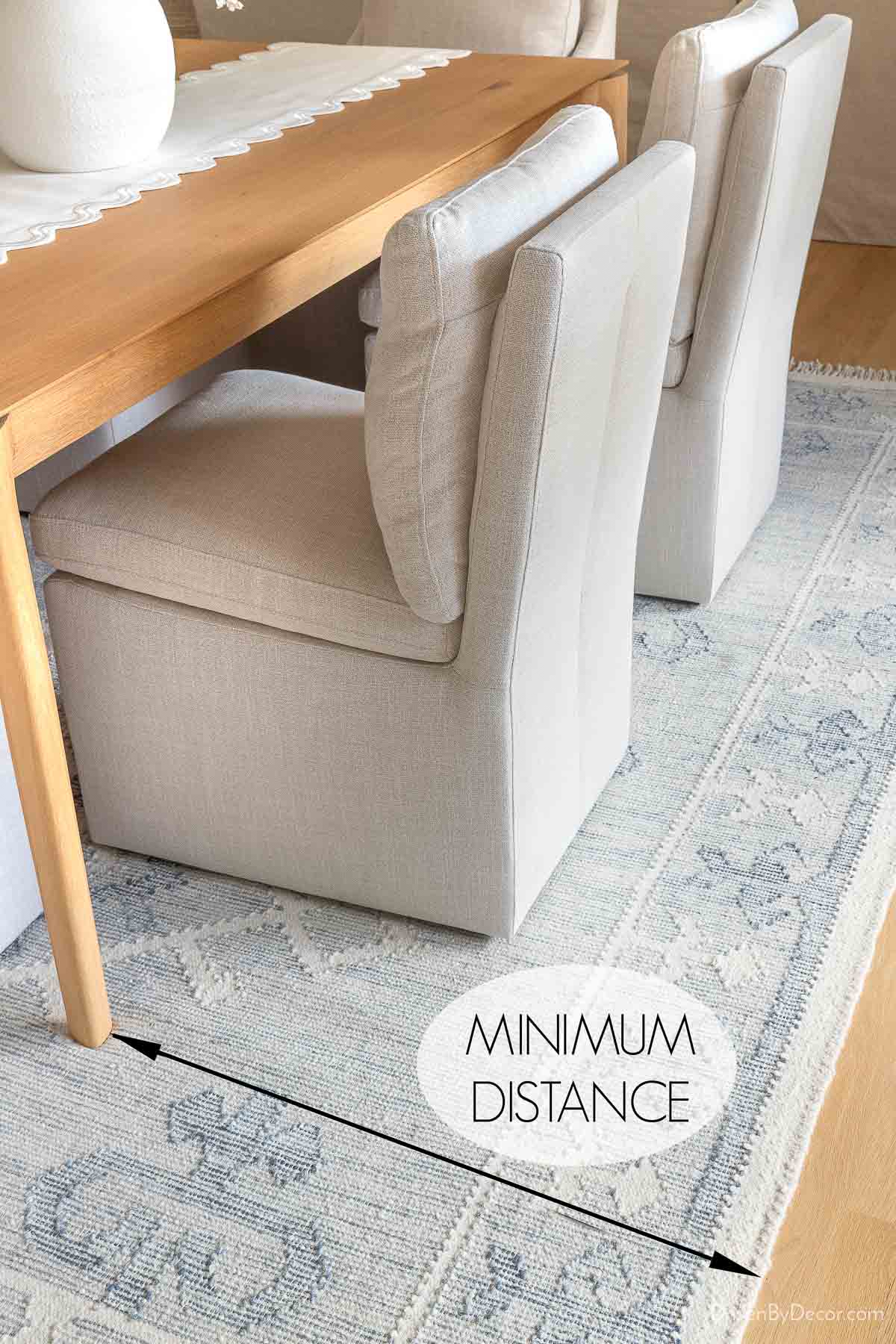
- Rugs under a dining room table should be at least 24-30″ wider and longer than the table, allowing the back legs of the chairs to stay on the rug even when the chairs are pushed out.
- Area rugs under a bed should extend at least 18-24″ beyond each side of the bed. For small bedrooms with a king bed, an 8 x 10 rug is usually best (with the longer 10′ side running in the same direction as the headboard) but if your bedroom is larger, a 9 x 12 can work too. For most rooms with a queen bed, an 8 x 10 rug is going to work best.
- For most typically sized rooms, there should be approximately 12″ – 18″ of bare floor between the edges of the area rug and the walls of the room. For small rooms, approximately 8″ of exposed floor is a good rule of thumb.
The last (and maybe most important) rule? Don’t be afraid to break the rules! These interior design rules and measurements are meant to be helpful guidelines, not squash your creativity or take the fun out of decorating. If something doesn’t follow the “rules” but looks and feels right in your space, go for it!
One example of a rule is choosing to hang {this oversized pendant} above the bathtub in our previous home:
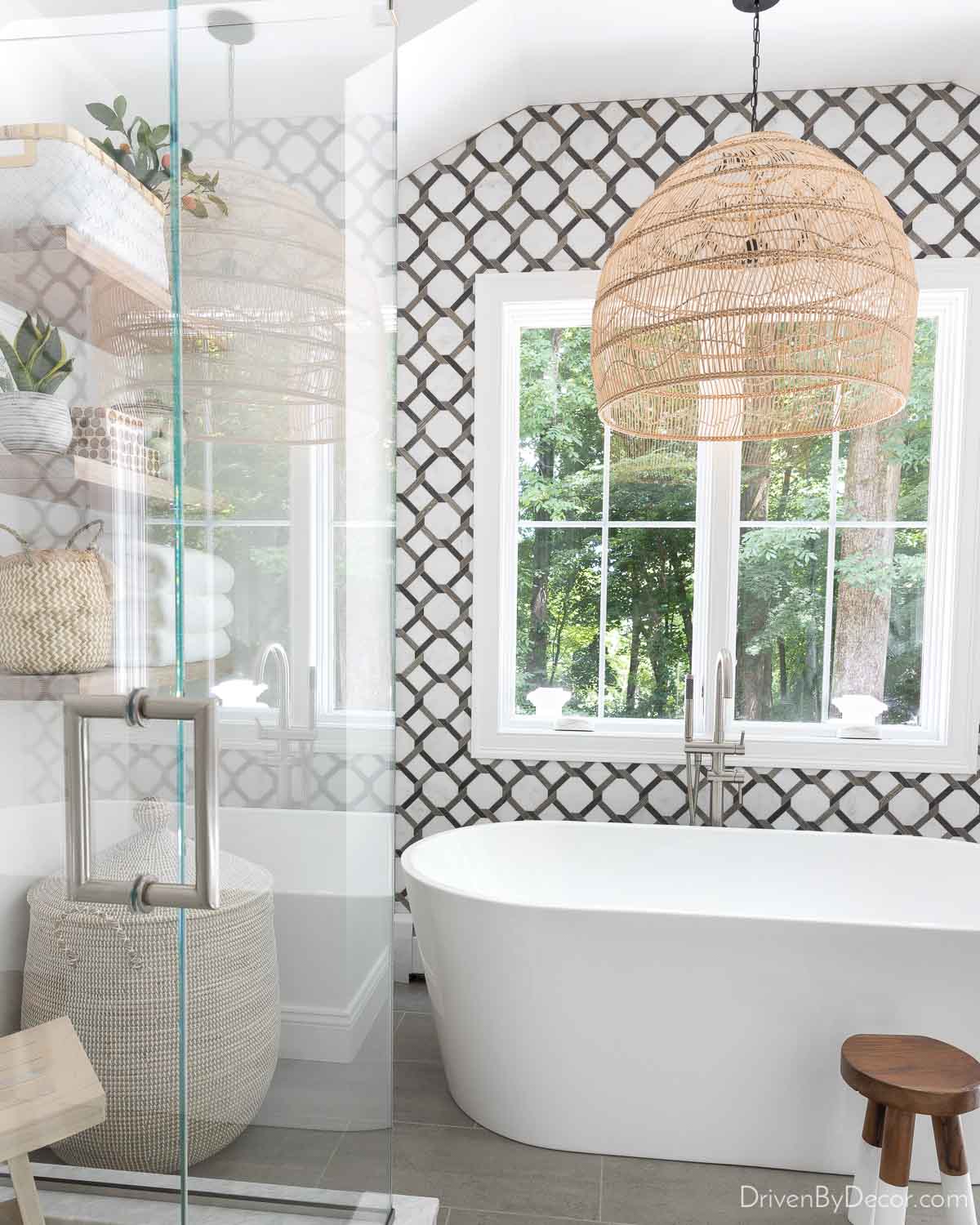
It may not be everyone’s taste, but I loved it! I hope you found these decorating guidelines helpful and have a few new measurements to tuck away for your next decorating project!



Inspire Me Heather says
This post is a keeper! Thank you so much for this and I’ve got it linked to my “measurements” post as well today, you’ve done a great job putting all that together!
Kris @ Driven by Décor says
Thanks Heather!
Sarah S. says
Love this! I’ve pinned it and referred to it several times, as we’re decorating our new home. Is there a rule of thumb for the distance between curtain rings? How many rings would I need for a curtain rod that’s 78″ wide (70″ window + 4″ on each side)?
Kris @ Driven by Décor says
Hi Sarah,
I don’t know if there is a great rule of thumb for this because it’s going to depend upon the width of your drapes, the weight of the fabric, and the style of drape (pinch pleat, flat panel, etc.). For my shorter dining room rod, I’ve got 14 rings whereas for my longer rod I’ve got 20 – the difference being that my panels on the longer rod are fuller, as they should be for a bigger window. Good luck with decorating your new home!
LiveLaughDecorate says
Great tips lady! Thanks for taking the time to pull this all together.
Anonymous says
Here’s another one as well. The 6″ rule. Instead of pushing furniture right up again the wall, pull it about 6″ out from the wall, as well as furniture being at least 6″ from another piece. Not only will these 6″ protect your walls but the fabric on chairs from rubbing against each other.
Kris @ Driven by Décor says
That’s a great rule. Rooms where the furniture is all lined up touching the walls are a pet peeve of mine!
Marlene Fast says
As a professional photographer who frequently sells wall decor portraits, and suggests to clients the perfect size and height for their portraits – I always say that I learned these tips from an interior designer – now I actually have a visual post that I can refer them to! I will be pinning this to my Pinterest page immediately – thank you so much!
Kris @ Driven by Décor says
So glad that you found this helpful for your business!
Surabhi Surendra says
Kris..
Loved this. I am going to set up my home in Delhi very soon and I have been looking for such tips. Thanks for putting this up! 🙂
Kris @ Driven by Décor says
Congrats on your new home!
Kris @ Driven by Décor says
Hi Paula – thanks for the nice comment – I’m so glad that the info on hanging the art helped! As far as your dining room and study, I don’t think that both rugs necessarily have to be neutral but I would buy rugs that complement each other (i.e. if you laid them side by side, the colors in the rug work well together). By the way – I’m dying over the fact that you have handscraped hickory wood floors – LOVE!
Paula says
I just wanted to tell you that you really helped me on positioning a large art piece on a wall behing a sofa. I had hung it and every time I looked at it, it looked wrong. I never knew the rules on this type of thing. I repositioned it according to your ideas, and it is just perfect. It made all the difference in the world. Thank you for sharing what you know with all of us. I really appreciate it. I do have a question. I have a dining room and a study that are separated by a small entry way and you can see both room from the entry way. I need rugs down in both rooms. I love lots of accent color and am not afraid of it so I do use lots of color in accessories. Do I need more neutral rugs that complement each other in both rooms or does it matter. I have handscraped hickory wood floors that are a medium to darker color.
Angela says
Kris–this helps so much! I have a quick question. When buying an area rug with a wide boarder should the whole rug be seen or would it still be correct to place it under the furniture? I’m shopping traditional rugs for my den and our sectional sofa is half against a wall and open on the other L.
Kris @ Driven by Décor says
Hi Angela – I would absolutely still recommend putting at least the front legs of your sectional on the rug. I can see your concern with the border, but it’s definitely the way to go. Having a small rug that ends in front of your sectional won’t look right. Thanks for reading!
Ali Macaluso says
Love this! I included it in my “Favorite Finds” for this week (http://www.punkwife.com/favorite-finds-of-the-week-drink-like-a-honey-badger-guide-to-decorating-and-a-foldable-you/). Great site!!!
Kris @ Driven by Décor says
Thanks Ali!
Anonymous says
HI
Are there any rules to how tall a lamp should be that is placed on a dining room buffet? Thanks Cheri Morgan
Kris @ Driven by Décor says
Hi Cheri – traditionally, dining room buffets have lamps that are more tall and slender than a typical lamp and often they are used in pairs. However, I’ve seen buffets with just one lamp or lamps that are more typical in height and they can look great too. A lot of it depends upon the size of the buffet, the size of the room, and what else you have on and over the buffet. Since there are so many variables, I don’t think there is a great rule of measurement in this case!
Anonymous says
Great information! Thanks for posting. I see many pictures hung way too high….
or way too small pictures hung on a huge wall…..hopefully…..this will help!
Craftberry Bush says
What a great post ! thank you so much for sharing…xo I’m pinning to our Happy Hour linky board as well as my personal Pinterest account…thank you.
Kris @ Driven by Décor says
Thanks so much – LOVE your new Happy Hour Linky Parties!!
Sorella Style says
Aaaaaaand bookmarking! Great post – thanks!
Clare Bury says
I have a cottage with really big – well, 5’x5′ wide windows that come down to about 20″ from the floor. The best look ever—-full, full, full, draperies on traverse rods that hang just to the edge of the bottom window molding. Long to the floor would look so formal and just not “cottagey”. So, always remember you can break the rules when it makes sense!! Thanks for this post, it’s great!
Kris @ Driven by Décor says
You’re absolutely right! It sounds like the way you hung your drapes is perfect for your home!
Mackenzie says
The Department of Energy says drapes should either touch the ground or the window sill to have the most insulatory value.
Judy says
Such a great post. These are tips that everyone needs. I will be pinning this one. I would love for you to link this up to my Fall into Fall party that opens each Tuesday evening at 8pm EST. Hope to see you there.
Kris @ Driven by Décor says
I’ll definitely check it out – thanks Judy!!