

Wondering you should use for sealing butcher block countertops? I tried both Waterlox and mineral oil and am sharing what worked best for me!
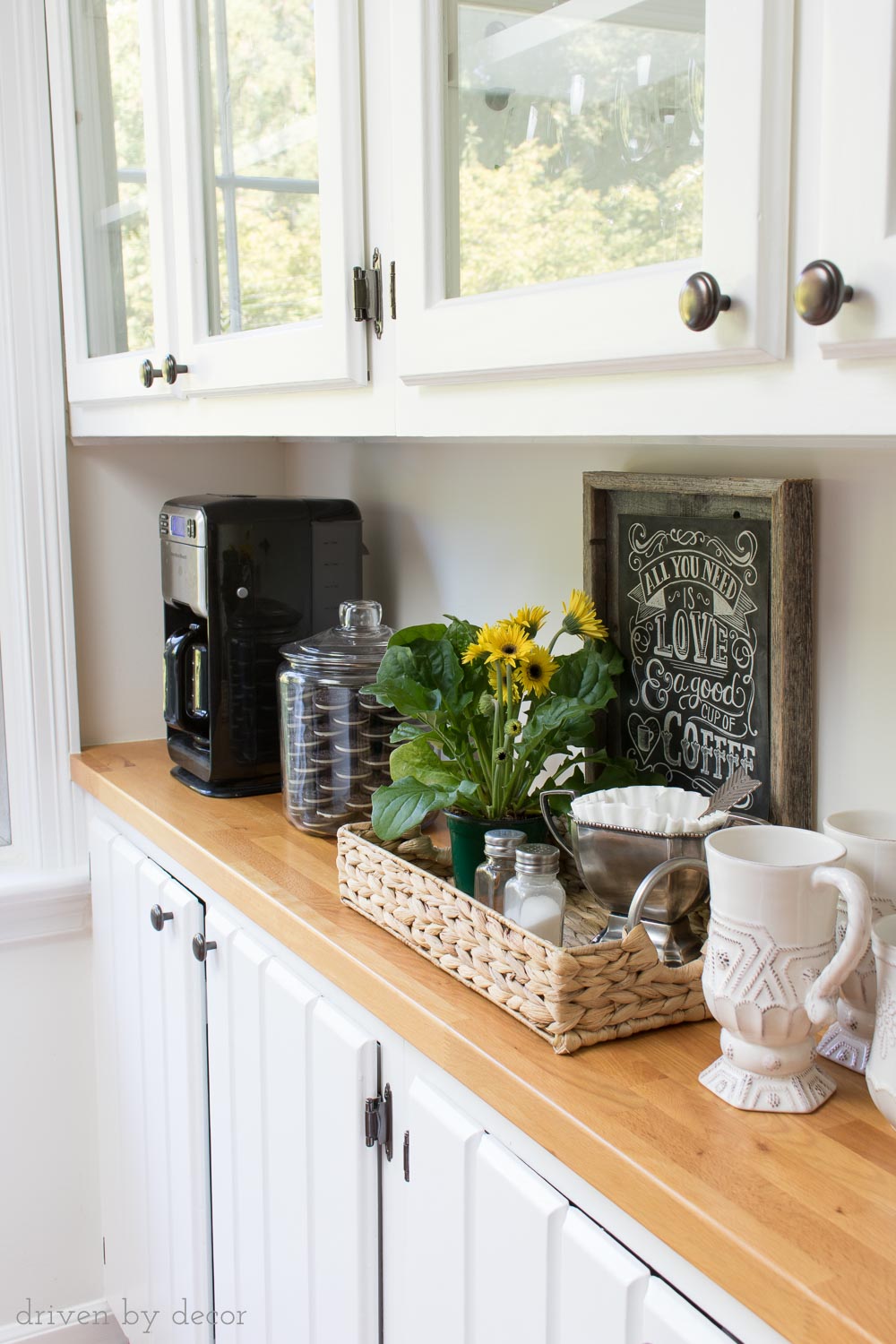
After sharing our new coffee station last week, several of you had questions about what we used to seal our new butcher block countertops so I’m going to fill you in on those details today. (post includes affiliate links – full disclosure statement available {here}). As you known, we only have them in a small area at the far end of our kitchen where we ripped out the old, ugly tiled countertop:
Scroll & Click/Tap to Shop the Look!

Once installed, it’s important to treat or seal the butcher block to keep it from drying out and staining. There are a lot of options for products to treat butcher block, but one of the simplest and least expensive is mineral oil. And that’s what I went with for the first several months.
Sealing Butcher Block Countertops with Mineral Oil
To seal butcher block with mineral oil, you simply apply the mineral oil generously, let it soak in, and wipe off the excess. You need to do it fairly regularly at first but then only about once a month after you’ve gotten through several applications. But here’s the problem that I found with mineral oil. Any paper that you lay down on it will absorb the oil from the butcher block and stain the paper. Even if it’s been weeks since you oiled it. I’d love to say that our kitchen is always neat as can be with no random school papers strewn about but…not so much. After several papers got ruined by laying them down in the wrong place, I knew that mineral oil wasn’t going to work for us.
Sealing Butcher Block Countertops with Waterlox
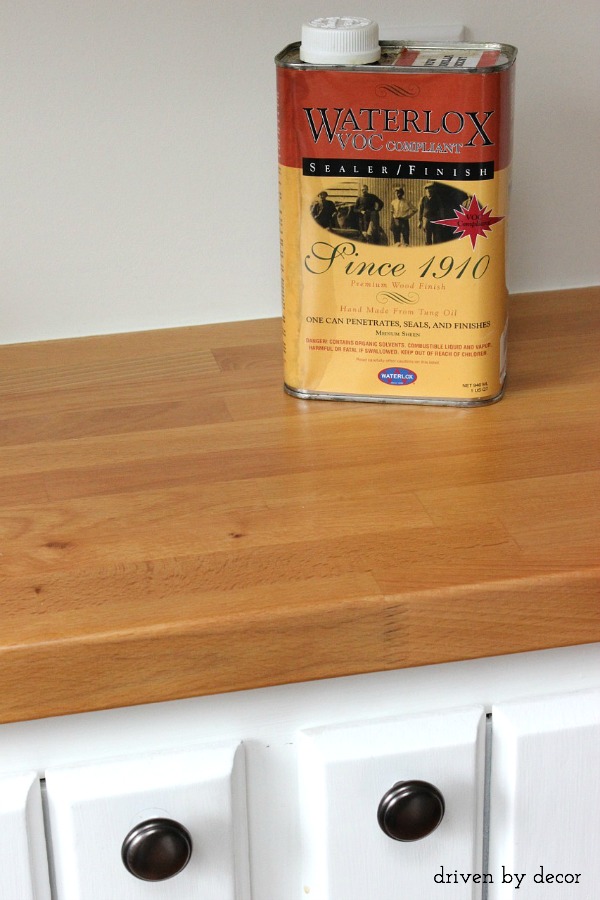
So after a lot of research into other options, I ended up trying Waterlox and I’m so glad I did – I love it! It’s a blend of Tung oil and resin with a water-resistant finish that’s also food safe. The company has great instructions on application of Waterlox on their website that are a must-read before using it, but the main steps are to sand the butcher block, clean it with mineral spirits, and then apply 3-5 coats of Waterlox with 24 hour dry time between coats.
Want to save this post?
Waterlox comes in three different sheens but it’s recommended that you start with Waterlox Original Sealer/Finish (available {here}) for the first coats and just do the last coat in either the satin or high-gloss finish if you want a different sheen. I’m not a big fan of shiny countertops so after three coats of the Sealer/Finish, I applied a coat of the Waterlox Satin (available {here}) which is less glossy. The color of the butcher block definitely changes depending upon the treatment that you choose with the Waterlox making the butcher block a deeper, just slightly more orangey color than the mineral oil.
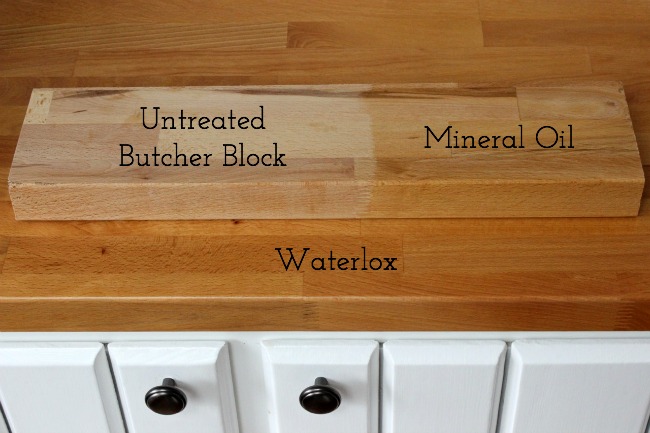
You can see the difference even more clearly looking at this angle – the countertop was sealed with Waterlox and the board on top of it was treated with mineral oil:
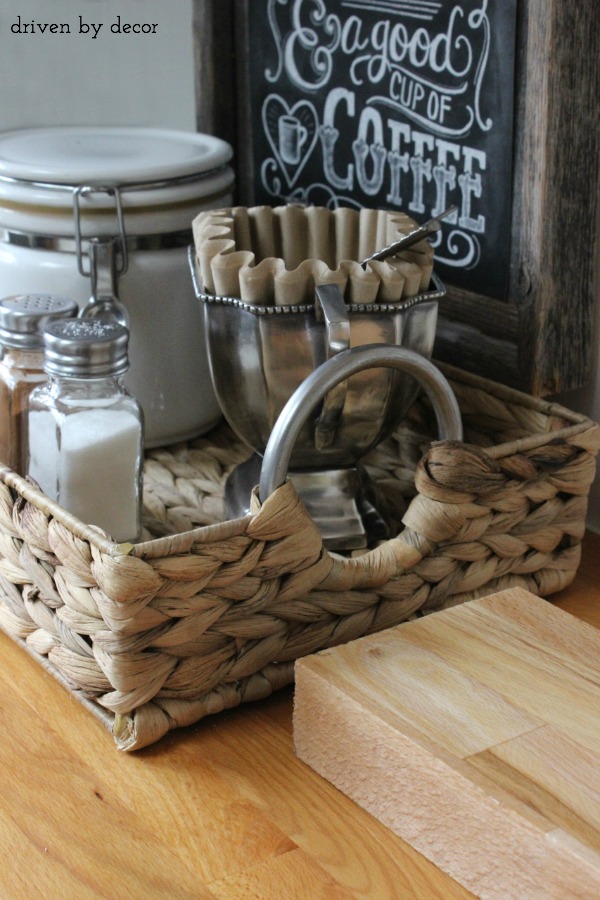
Honestly, I prefer the lighter look of the oiled countertop to the darker Waterloxed countertop but with all of the other advantages of Waterlox (no more oil spots on stray kitchen papers, no more monthly maintenance, and better water resistance) it was the way to go for us.
If you’re thinking about using Waterlox too, be sure to read {this info on care and cleaning of Waterlox} so you are aware of what products you should and should not use on Waterloxed countertops.
So that’s my long-winded answer to your short question about our countertops. Butcher block countertops aren’t for everyone and we only have them in this one spot with granite in the rest of the kitchen but I love them and honestly wouldn’t hesitate to use them throughout a kitchen. How about you?



Jennifer says
How has this held up over time?
Kris Jarrett says
It has! My countertops look exactly the same as the day that I sealed them!
Mel says
Did you use a wood conditioner before applying Waterloo?
Kris Jarrett says
No I just sanded and then cleaned off any remaining residue with mineral spirits per the Waterlox instructions!
Rose B says
I have had ikea butcher block counters for over a year now and I treat them only with mineral water. One thing that bothers me about my counters (besides the oil stains!) is they are a little rough to the touch. If that was your experience, did you notice that the Waterlox made the surface smoother to the touch?
Rose B says
*oops, I’ve been treating them with mineral OIL, not water.
Kris Jarrett says
Hi Rose, yes our Waterloxed butcher block is pretty smooth – definitely smoother than when we were using mineral oil. The only negative of the Waterlox is that it casts an slight orange hue to the butcher block – I like the look of the mineral oiled butcher block better. Wish I could have the best of both worlds!
Kim says
On waterlox website they now have a rub in stain. I saw a video that said if you use the “white” stain (not pickled white) your butcherblock will remain light colored.
Anonymous says
Just wondering where do you buy “waterlox”?
Kris Jarrett says
If you go on Waterlox’s online site, you can search for a store near you that sells it – several of our local hardware stores and a woodworking store do.
hennalyne says
just a quick question for you; did you end up sanding your blocks?
Kris Jarrett says
Are you wondering if I sanded before applying the Waterlox? If so, the answer is yes! If you are asking something else – leave me another note 🙂
Macie says
I really like the color of your counter tops. Are they maple?
Kris Jarrett says
Thanks so much Macie! Our countertops are beech butcher block from IKEA. Have a good night!
Emily says
Hi Kris,
This is exactly what we’re hoping to do! Thanks for the tips. Did you get the IKEA Oak or Beech countertop? We too are looking for a lighter appearance…lighter even than the mineral oil. I’ve seen people use white stains on other furniture, but can you put a stain down under the waterlox?
Thanks,
Emily
Taylor Greenwalt says
That looks so good…my daughter has wood counter tops…I will pass this on to her…
Lisa @ Shine Your Light says
Great post Kris! I love real life comparisons and what works for others. The Waterlox is clearly the way to go for any counters that are going to get used. Filing this away for future reference! Thank you!
Kris @ Driven by Decor says
I have a feeling that when you get rid of your baloney countertops, you’re going to treat yourself to the good stuff (marble, granite, soapstone, etc.)!
Martha Mackey says
Oops just realized I misspelled Waterlox on the previous email.
Martha Mackey says
I was so excited to find your article as we are just buying our wood countertops, but I’m wondering how stain fits into this process for those of us who don’t want the natural wood look.
Kris @ Driven by Decor says
Hi Martha, I’ve seen butcher block countertops stained and they can look very pretty. They just need to be sanded and have a wood conditioner applied first.
Carrie says
Good tip! I love the look of butcher block and hope to have it somewhere in our kitchen someday. 🙂
Debbie says
Kris,
I am debating about what type of counter top to install when I makeover my kitchen. I am on a limited budget so granite is out. I love the look of soapstone but that is also expensive. I was wondering about butcher block counter tops and could they be stained a dark walnut color and covered with poly? That way I would have my dark counter tops without the expense and the monthly work. What do you think? Thanks in advance.
Kris @ Driven by Decor says
I think that would look beautiful Debbie! I would just make sure that you use a wood conditioner first so that the stain isn’t splotchy (I learned that the hard way). As far as the finish, I think the issue with using poly on countertops is that it’s not considered to be food-safe like mineral oil and Waterlox are.
TR says
can you use waterlox on top of other stains to get a more desired color?
Kris Jarrett says
Unfortunately, I’m not sure of the answer to that. If you give Waterlox customer service a call, I’m sure they can answer your question – I had a few before I used the product and they were super helpful!
Bev says
I read another article that said – you CAN STAIN it before using the Waterlox on it .
Tom says
We stained our butcher block countertops with a cognac stain and covered with 3-4 coats of satin polyurethane. The painter was inexperienced at this and didn’t sand between coats. We have many bubbles and some chipping due to this. Also our dog has jumped up to search for food and has scratched out countertop in a number of places. This option is not for everyone and these are some of the negatives we have encountered. I will be sanding and reapplying polyurethane correctly in the near future.
Susan P. says
We just put butcher block on our island. It is European walnut and we purchased from Home Depot. Beautiful variegated colors. Reasonably priced. Very pleased so far. Planning to paint island/cabinets.
Katie says
This all depends on what your planning on doing on the butcher block. If your going to be kneeding bread or pie dough I wouldn’t stain. Stain isn’t food safe. Waterlox is food safe as long as your not planning on cutting dough on it.
I went with stove side with butcher block and the sink side has laminate counter top. They are affordable and you can cut to size yourself. I used Howard mineral oil since I might decide to cut on it I used 3 coats waiting 1 hr each coat and then the conditioner made from beeswax used 2 coats the last coat I let it sit overnight.
cassie says
we use the mineral oil- it doesn’t bother me at all and even though it is more maintenance, when an issue comes up (watermark, or food stain) i can fix it easily and i like that aspect. 🙂
Stephanie says
Good to know! I have IKEA butcher block counters in my kitchen for 5 years and they are holding up well! I have used mineral oil, but not like I am should. I am lucky if it gets done once a year … I, like you, like the mineral oiled look better than the Waterlox.
Kris @ Driven by Decor says
Totally agree about the look Stephanie – I like the more natural look of mineral oil but it just didn’t end up being a practical solution for our family. Maybe once the kids are out of the house?? 🙂
linda says
hi stephanie, i am getting butcher block from ikea or meandrous for my kitchen and want to use mineral oil as well but want the countertops to be a nice deep oak, but i heard ikea birch is better than oak and also heard not to stain. what kind of wood do you have and are you still happy? if birch, has it darkened? feel free to send a photo, thank in advance!
linda
Rick says
Most IKEA BB counters are laminated and not solid. Using an oil over time may swell the substrate of particle board. There are some decent solid wood countertops through Lumber Liquidators that are solid wood and will do much better over time. With IKEA you only have about 1/4 inch of actual wood.
Kris Jarrett says
That’s true for some of IKEA’s countertops but they also have some options that are solid wood butcher block.
Susan says
I have a lot of counters 😉 and they are all Birch IKEA BB. Fortunately, I was able to hauled the LAST 5 SOLID BB counter tops they had in Charlotte, NC!! Yes, I clean with Vinegar and use Mineral Oil. A bit of work, BUT I never fear putting all my hot pots and pans down:):)
Jojuan Cedergreen says
I’ve read that oak is not good for cutting boards or countertops as it has very large pores – the kind that bacteria lurk in. Wood with tighter-pores is preferred (e.g. cherry, maple, beech, etc.). Plus, my now-retired local woodworker says that oak is sensitive to humidity changes and sometimes pulls away from the glue leaving gaps….another cozy harbor for bacteria. (My OAK end-cut butcher block cutting board is sad proof of this, while my larger non-oak end-cut is still pristine after 40 years!)
Kris Jarrett says
That’s why you seal it!
Tina says
Home depot has butcher block countertops for really cheap right now. I just installed them in my kitchen…just did 3 layers of oil and had to buy more.
Kris @ Driven by Decor says
I’m glad the mineral oil works for you – I really, really wanted it to work for us because I love the mineral oil finish (and you’re so right about the ease of any “repairs”) but it just didn’t. You must keep a much less messy kitchen than I do 🙂
Sylvia Shelnutt says
I have a large butcher block table in my kitchen and a butcher block counter top. I refinished the table several years ago because it was dirty from newsprint embedded on the top edge where my husband sits reading the morning paper. I sanded and sanded then used a clear water based polyurethane coating to seal. With this finish, I don’t have to oil and it has a nice clear sheen that lets the wood show through without color change from the finish. This finish has worn well over the past several years. The counter top came from our old house and was never fastened to the top of a counter so it is large but portable. I am now using the underside as a large bread board laying on top of a stainless steel cart. The topside has the original finish which I didn’t want to disturb, so I flipped the board over, sanded the underside and keep it oiled it with mineral oil. I agree, mineral oil can be aggravating to use but for what I am using the board for it is my best choice.
Thank for the info about Waterlox. You have done your research. I am glad to know about Waterlox.
Kris @ Driven by Decor says
Your table and butcher block bread board sound beautifully done! I have a butcher block cutting board too and mineral oil works great for that. It’s just the countertop area that’s difficult in our busy kitchen. Poly is a great choice for a table but I was hesitant to use it for countertops because I don’t think it’s food safe.
Val says
Excellent insight, thank you!
Dagmara @ GlamistaHome says
I don’t have a butcher block counter, but I have always admired the look of it, but wasn’t sure how to treat it to keep it looking beautiful. Thank you for sharing the information. Your counter top really looks as new and it’s nice to know that mineral oil might not be the best option if you choose to work on it with paper.