

Wondering you should use for sealing butcher block countertops? I tried both Waterlox and mineral oil and am sharing what worked best for me!
After sharing our new coffee station last week, several of you had questions about what we used to seal our new butcher block countertops so I’m going to fill you in on those details today. (post includes affiliate links – full disclosure statement available {here}). As you known, we only have them in a small area at the far end of our kitchen where we ripped out the old, ugly tiled countertop:
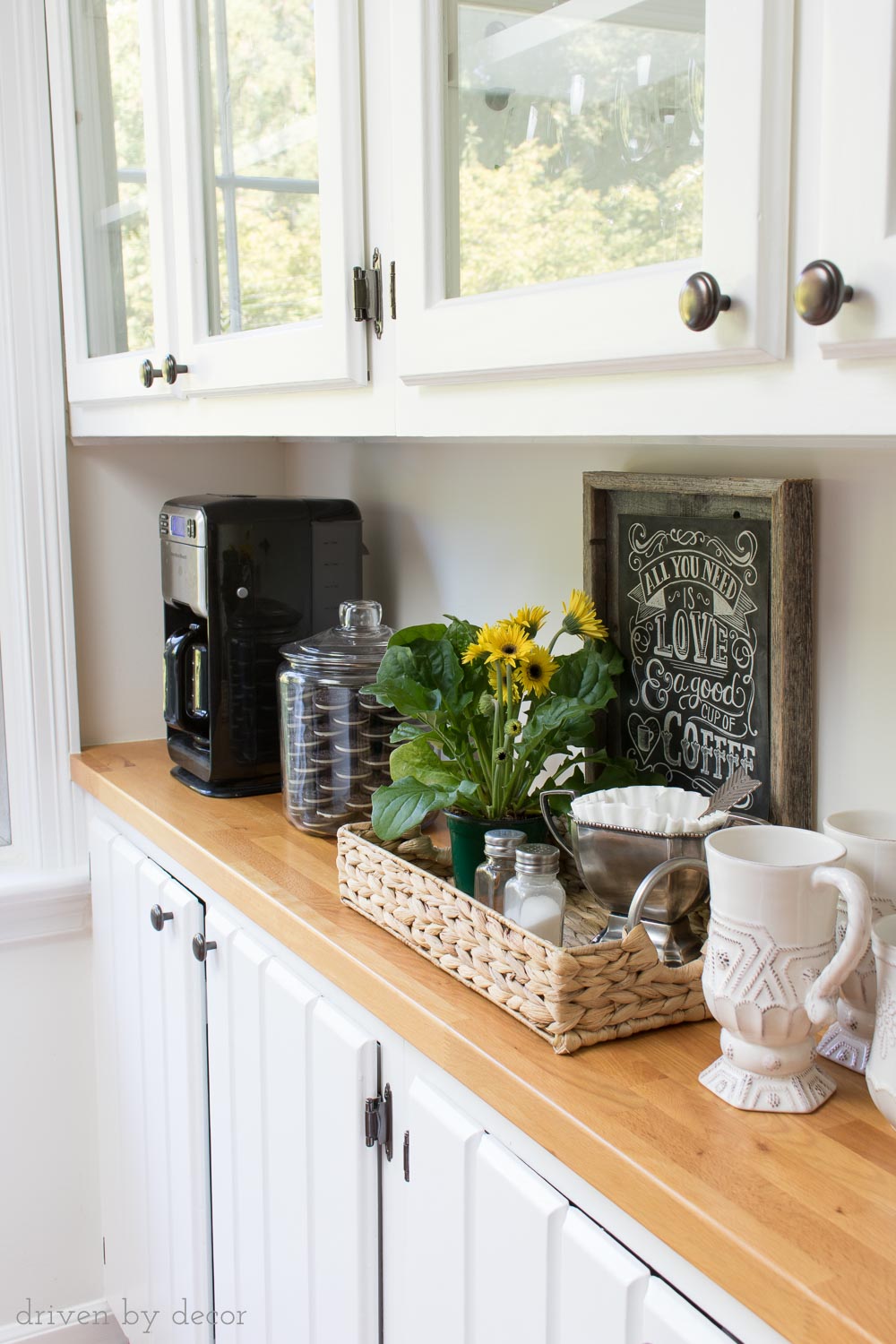
Scroll & Click/Tap to Shop the Look!

Once installed, it’s important to treat or seal the butcher block to keep it from drying out and staining. There are a lot of options for products to treat butcher block, but one of the simplest and least expensive is mineral oil. And that’s what I went with for the first several months.
Sealing Butcher Block Countertops with Mineral Oil
To seal butcher block with mineral oil, you simply apply the mineral oil generously, let it soak in, and wipe off the excess. You need to do it fairly regularly at first but then only about once a month after you’ve gotten through several applications. But here’s the problem that I found with mineral oil. Any paper that you lay down on it will absorb the oil from the butcher block and stain the paper. Even if it’s been weeks since you oiled it. I’d love to say that our kitchen is always neat as can be with no random school papers strewn about but…not so much. After several papers got ruined by laying them down in the wrong place, I knew that mineral oil wasn’t going to work for us.
Sealing Butcher Block Countertops with Waterlox
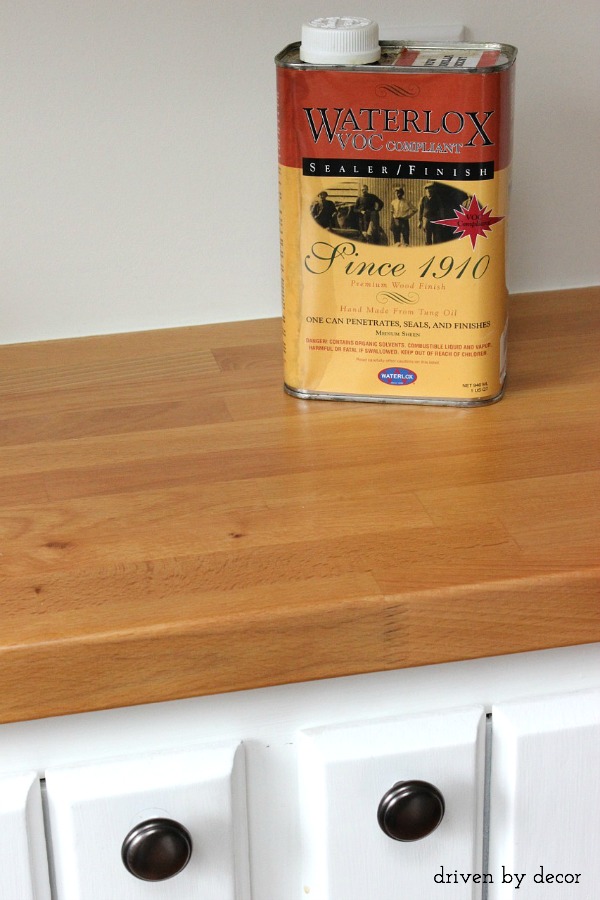
So after a lot of research into other options, I ended up trying Waterlox and I’m so glad I did – I love it! It’s a blend of Tung oil and resin with a water-resistant finish that’s also food safe. The company has great instructions on application of Waterlox on their website that are a must-read before using it, but the main steps are to sand the butcher block, clean it with mineral spirits, and then apply 3-5 coats of Waterlox with 24 hour dry time between coats.
Want to save this post?
Waterlox comes in three different sheens but it’s recommended that you start with Waterlox Original Sealer/Finish (available {here}) for the first coats and just do the last coat in either the satin or high-gloss finish if you want a different sheen. I’m not a big fan of shiny countertops so after three coats of the Sealer/Finish, I applied a coat of the Waterlox Satin (available {here}) which is less glossy. The color of the butcher block definitely changes depending upon the treatment that you choose with the Waterlox making the butcher block a deeper, just slightly more orangey color than the mineral oil.
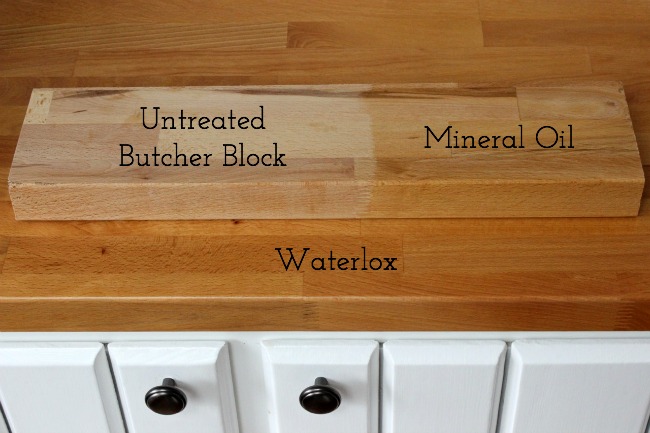
You can see the difference even more clearly looking at this angle – the countertop was sealed with Waterlox and the board on top of it was treated with mineral oil:
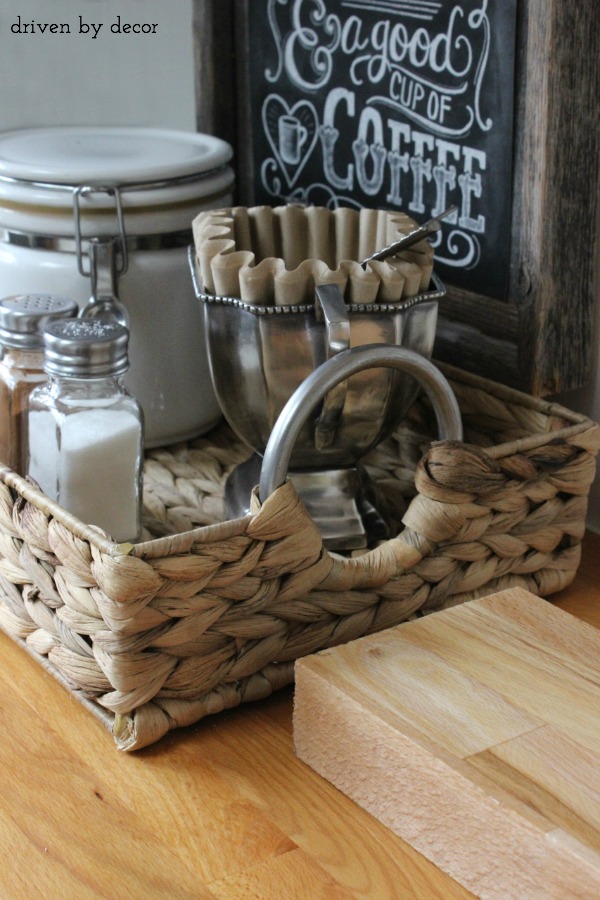
Honestly, I prefer the lighter look of the oiled countertop to the darker Waterloxed countertop but with all of the other advantages of Waterlox (no more oil spots on stray kitchen papers, no more monthly maintenance, and better water resistance) it was the way to go for us.
If you’re thinking about using Waterlox too, be sure to read {this info on care and cleaning of Waterlox} so you are aware of what products you should and should not use on Waterloxed countertops.
So that’s my long-winded answer to your short question about our countertops. Butcher block countertops aren’t for everyone and we only have them in this one spot with granite in the rest of the kitchen but I love them and honestly wouldn’t hesitate to use them throughout a kitchen. How about you?



Corey says
Can I stain first? I want it to match some of the other wood finishes that I have in my house. This is my first time using butchers block and didnt realize the maintenance. Would your solution still be best in my case where we installed it into our laundry room? I want it protected but stained. Thoughts? Thanks in advance.
Kris Jarrett says
Yes you can stain first! Waterlox can be used over most stains (nothing that contains waxes or silicones) once they’re completely dry. If you go to the Waterlox website, they have more info and advice on using stains in conjunction with this product. I think it would be a good choice for your laundry room! Good luck!
Joel Hunnicutt says
Thanks for taking the time to post about this – we are getting ready to install butcher block counters and have been undecided about the finish. Your experience has moved me over to the non-oil side!
Adrienne says
Good info, thank you! So there is no problem using the Waterlox over a mineral oiled butcher block countertop?
Kris Jarrett says
You can use it over mineral oil but there is some prep that you need to do first involving mineral spirits and sanding. If you go to Waterlox’s website, they have detailed instructions about exactly what you need to do!
Jason says
I just installed butcher block in my kitchen yesterday. Do you think I should oil them a few times before I use the Waterlox?
Kris Jarrett says
No, if you’re going to use the Waterlox I wouldn’t oil it first!
Jessica says
Did you use the mineral oil for a while, then sand the counters and then apply the waterlox?
We just had ours installed and have done a week of mineral oil but wonder if waterlox is the way to go for water protection, didn’t know if we needed to sand the tops again?
Kris Jarrett says
Yes, I followed the prep instructions from the manufacturer – you can find them here (look under “Previously Finished Wood Application”): https://www.waterlox.com/project-help/guide?id=9e334e28-21c6-4a24-942c-fed2aaedbbaa&q=
Marcia Coté says
My new IKEA kitchen installation was completed yesterday including the oak countertop. My friend suggested Waterlox as she uses it on her cherry wood countertops and it works well.
I am wondering if you recall what grit sandpaper you used. Currently the finish feels a bit rough. I had planned to use my orbital sander with a finer grit sandpaper before applying the Waterlox.
Also since it’s been three years since your original post how long does the Waterlox finish last?
I appreciate your blog with such great details. Thank you.
Kris Jarrett says
The Waterlox has held up really well for me! This page has all of the details of how to apply it, including sanding details: https://www.waterlox.com/guide-builder-finish
michelle says
from what i read, most people used 220 grit
Paul Anschel says
Thanks for that info. The pic comparing Mineral Oil to Waterlox / Tung Oil is very useful. I’m just going to throw this out there for others who are looking for low maintenance alternatives to the oils and others who expect a lot of water / coffee spills – Polyurethane IS an option! For those who plan to use their countertop for food prep, cutting, I’d probably advise against it. Polyurethane is essentially a plastic. So you wouldn’t want to cut on it. While I’m crazy anal about minimizing plastics in my kitchen (no plastics in microwave or dishwasher), I’ll admit I bag my greens in plastic to come home from the store. And I rarely ever put my food directly on my countertops so I don’t see the a major issue here. In my case, I’m building a Kitchenette to be used in my guest house as a Coffee Bar primarily. I KNOW coffee will be spilled regularly on the countertop as I’m going to have a manual espresso machine on it. So, I opted for 1 coat of Clear Shellac to provide an initial seal and raise the grain. Then I sanded smooth and put 3 coats of Satin Poly on it. Looks beautiful, retains the original color. I’ve done the same on a wood countertop in my bathroom 2 years ago and it has held up to regular water spillage. Again, I wouldn’t recommend this for constant direct food contact but I think it is more than acceptable for the small amounts of contact you get daily (e.g. putting your mixing spoons down, etc.). But that’s just my opinion. Honestly, if I was putting the butcher block in my kitchen, I’d probably go with the Waterlox so I could easily repair minor damage, etc. I just wanted to throw this out there as I couldn’t find many comments about using Poly.
Kris Jarrett says
That’s a great point! I’m thinking about using butcher block in my laundry room and will likely use poly on that since I’m not worried about food safety.
Courtney Canfield says
Okay, so question for ya’: After you Waterlox the countertops a few times, do you have to do it regularly/on a monthly basis? You said, “no more monthly maintenance,” but every other blog I’ve read said you can’t get around monthly maintenance. I want to install over 18 feet of butcherblock in my kitchen (so much countertop space!!! Ahhh!) and after reading all these posts about having to oil it down monthly and sand it too, it scares me! Would love to hear your thoughts.
Kris Jarrett says
No there is no monthly maintenance with Waterlox – as the surface ages you might want to clean, sand, and re-coat but that’s definitely not needed monthly. I’ve had my Waterloxed countertops in place for years and have not yet needed to re-coat them. However if you use mineral oil instead, then yes you will have monthly maintenance. Hope that helps!
Brooke says
Hi! I’ve been treating my butcher block countertops with mineral oil but would like to seal it so I don’t have to worry so much about water spots, etc.
Can you put the waterlox directly over mineral oil treated butcher block or does it need to be sanded first?
Thanks!
Kris Jarrett says
If you go to Waterlox’s website, they have specific instructions on what to do with butcher block that has previously been oiled. It’s been a while so I can’t remember the specifics but I believe you had to wait 30-60 days since the last oiling and then do some light sanding and wiping with mineral spirits. Their customer service was really amazing when I called so don’t hesitate to contact them if you can’t find those instructions on their site!
Heidi says
We have 4 high end rentals where I installed butcherblock counters in all the kitchens. (Yes, I’m brave!). I purchased the butcherblock from Lumber Liquidaters. I went ahead with a mineral oil finish but as expected, I’ve not been thrilled with how they’ve held up. I’m going to try the Waterlox.
Kris Jarrett says
I love butcher block countertops! Let us know how the Waterlox does for you!
michelle says
i also am using butcher block for my rental & have to say- if they screw it up I figured most sins can be sanded away & resealed myself and if all goes to hell, butcher block is readily available & easier to replace! Fingers crossed for both of us!
Jessie says
Hi,
I’m looking at sealing a small butcher block rolling island and this sounds like a great solution. I was just wondering, what type of brush did you use to apply the Waterlox? With 3-5 coats recommended, wasn’t sure if it would be easy to clean a regular brush between coats or if a foam brush would be better.
Thanks!
Kris Jarrett says
Hi Jessie,
Waterlox recommends using a natural bristle paint brush!
Karen says
I am having the same problem with our new butcher block island countertop. All my papers get oily! It’s driving me crazy and I’m ready to try something different. I am curious, how has the Waterlox seal help up over the past couple of years?
Kris Jarrett says
Hi Karen,
The Waterlox has held up beautifully! The only negative I’ve seen to it is what I mentioned in my post about it creating a more yellowy tint than when it’s just oiled. Otherwise, it’s been great!
Jennalyn says
What did you have to do to your already oiled countertops before applying waterlox? We’re in the same boat, tried the mineral oil for a few months and it’s not working
Kris Jarrett says
If you go to Waterlox’s website, they have specific instructions on what to do with butcher block that has previously been oiled. It’s been a while so I can’t remember the specifics but I believe you had to wait 30-60 days since the last oiling and then do some light sanding and wiping with mineral spirits.
carol says
Just ordered birch butcher block counters from lowes. Unfinished. Have 2 very messy teens that leave standing water near sink all the time. Which is better to use. Waterlox or the Howards butcher block conditioner (which I already ordered)
Kris Jarrett says
Carol I’ve never used the Howard’s conditioner but after just a quick look at it, it looks like it might just be a conditioner and not a sealer? If true Waterlox would be the better choice for standing up to water.
Shelley says
Hi! I’m am wondering if you can tell me what type of wood your countertop is.
Thank you! 🙂 Shelley
Kris Jarrett says
Mine are IKEA’s NUMERAR which I don’t think they have anymore – they are Beech!
Peter says
Can I use waterlox after I have used mineral oil for over a year?
Kris Jarrett says
Hi Peter – I would call Customer Service for Waterlox and ask that – you can find their contact info online. They were very helpful when I called with questions!