

Wondering you should use for sealing butcher block countertops? I tried both Waterlox and mineral oil and am sharing what worked best for me!
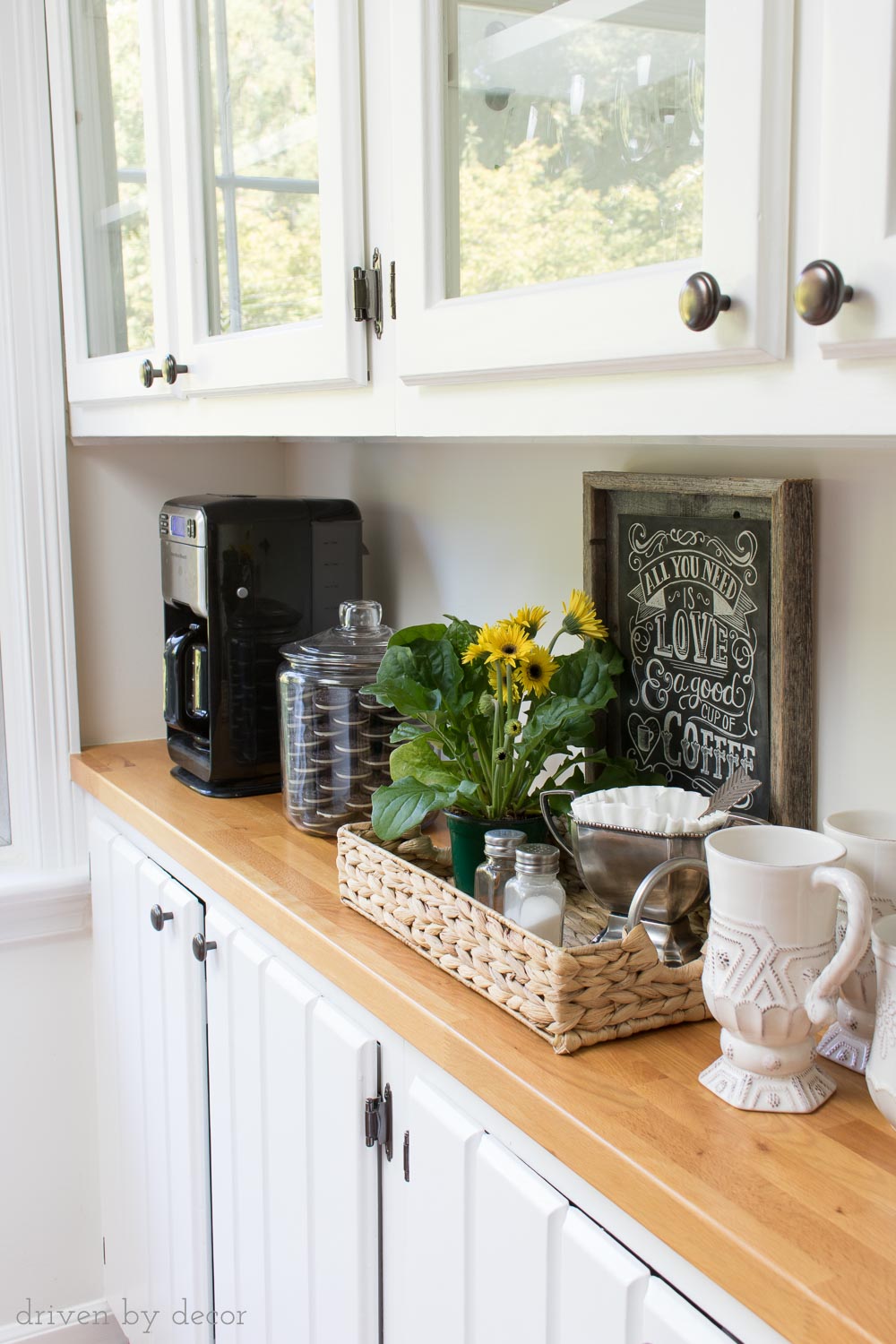
After sharing our new coffee station last week, several of you had questions about what we used to seal our new butcher block countertops so I’m going to fill you in on those details today. (post includes affiliate links – full disclosure statement available {here}). As you known, we only have them in a small area at the far end of our kitchen where we ripped out the old, ugly tiled countertop:
Scroll & Click/Tap to Shop the Look!

Once installed, it’s important to treat or seal the butcher block to keep it from drying out and staining. There are a lot of options for products to treat butcher block, but one of the simplest and least expensive is mineral oil. And that’s what I went with for the first several months.
Sealing Butcher Block Countertops with Mineral Oil
To seal butcher block with mineral oil, you simply apply the mineral oil generously, let it soak in, and wipe off the excess. You need to do it fairly regularly at first but then only about once a month after you’ve gotten through several applications. But here’s the problem that I found with mineral oil. Any paper that you lay down on it will absorb the oil from the butcher block and stain the paper. Even if it’s been weeks since you oiled it. I’d love to say that our kitchen is always neat as can be with no random school papers strewn about but…not so much. After several papers got ruined by laying them down in the wrong place, I knew that mineral oil wasn’t going to work for us.
Sealing Butcher Block Countertops with Waterlox
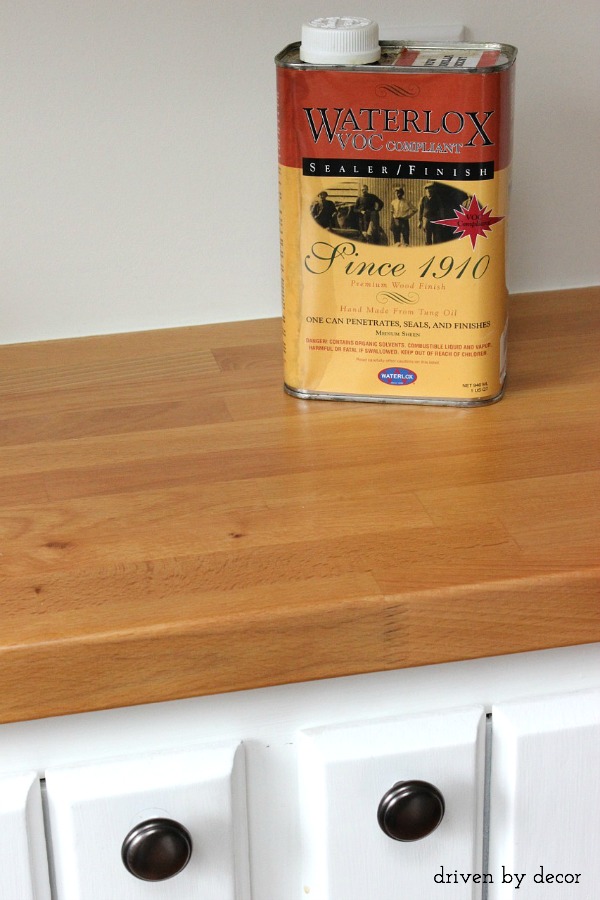
So after a lot of research into other options, I ended up trying Waterlox and I’m so glad I did – I love it! It’s a blend of Tung oil and resin with a water-resistant finish that’s also food safe. The company has great instructions on application of Waterlox on their website that are a must-read before using it, but the main steps are to sand the butcher block, clean it with mineral spirits, and then apply 3-5 coats of Waterlox with 24 hour dry time between coats.
Want to save this post?
Waterlox comes in three different sheens but it’s recommended that you start with Waterlox Original Sealer/Finish (available {here}) for the first coats and just do the last coat in either the satin or high-gloss finish if you want a different sheen. I’m not a big fan of shiny countertops so after three coats of the Sealer/Finish, I applied a coat of the Waterlox Satin (available {here}) which is less glossy. The color of the butcher block definitely changes depending upon the treatment that you choose with the Waterlox making the butcher block a deeper, just slightly more orangey color than the mineral oil.
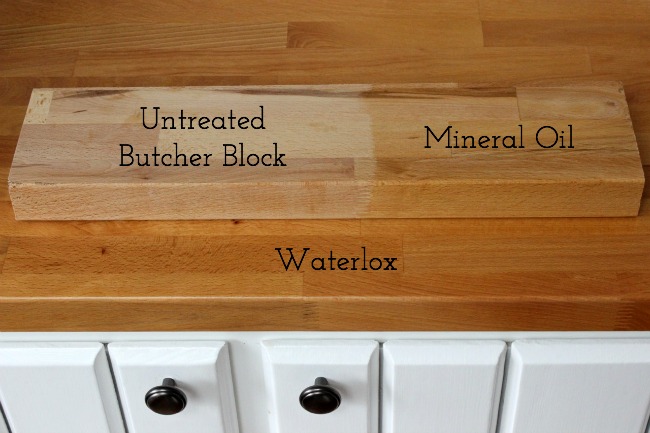
You can see the difference even more clearly looking at this angle – the countertop was sealed with Waterlox and the board on top of it was treated with mineral oil:
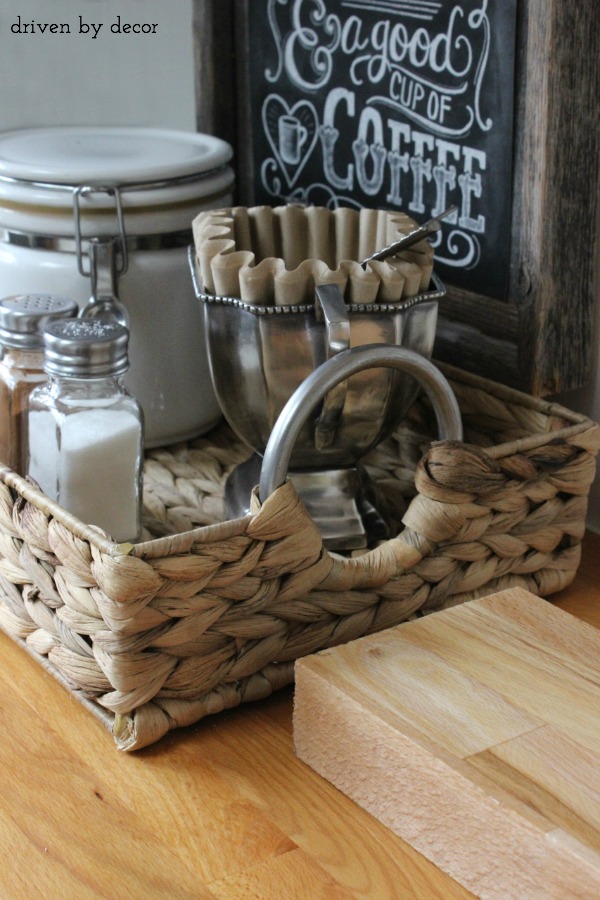
Honestly, I prefer the lighter look of the oiled countertop to the darker Waterloxed countertop but with all of the other advantages of Waterlox (no more oil spots on stray kitchen papers, no more monthly maintenance, and better water resistance) it was the way to go for us.
If you’re thinking about using Waterlox too, be sure to read {this info on care and cleaning of Waterlox} so you are aware of what products you should and should not use on Waterloxed countertops.
So that’s my long-winded answer to your short question about our countertops. Butcher block countertops aren’t for everyone and we only have them in this one spot with granite in the rest of the kitchen but I love them and honestly wouldn’t hesitate to use them throughout a kitchen. How about you?



Jennifer Hill says
What type of wood is your butcher block counter? Thanks!
Kris Jarrett says
Mine are Beech!
Becki says
If you use the Waterlox, can you stain first?
Kris Jarrett says
Yes, you can stain first! But I would read the guide “Stain and Waterlox” on their website for more details to make sure you get a stain that works with it.
Tina says
Thank you! Used mineral oil on butcher block but unhappy with results. Waterlox sounds like the fix and results I am looking for.
Kris Jarrett says
I hope it works well for you Tina!
Misty says
Hi Kris! We just ordered our butcher block to arrive next week. Planning to use Waterlox, but in the instructions it says to avoid real use for 30-90 days? Did you have any issues with using yours right away? We can avoid using them for the 4 days of curing and applying and a week or so after, but are hosting a new years eve party. Hoping it would be OK to use them by then. Any thoughts?
Kris Jarrett says
The 30-90 days is for complete 100% cure – it is 95-98% cured within 7-14 days so so you’ll have good protection after that initial 1-2 weeks.
Richard Lawrence says
I installed butcher block counter tops from Floor and Decor this summer. I started one of them with mineral oil but also experienced the bleeding off onto papers. I followed the Waterlox instructions in cleaning it off and letting it sit for 30 days then applied Waterlox. It is pretty strong and I had to seal off the room used to finish. My wife and I love the beauty and water resistance it provides. Worth considering.
Vickie L Benoit says
Is there anyway to get around the orange ish color. I did almost all my countertops in butcherblock with the exception of the one piece over the dishwasher. Would I be able to put a little touch of stain in the Waterlox to eliminate that without damaging the seal.
Kris Jarrett says
Unfortunately, I don’t know of any way to get around the fact that there’s that slight discoloration with using it.
Shay Trask says
Awesome! Thank you so much for taking the time to write this article! I have been between the two myself!
Have you heard of anyone darkening up their countertops before applying this to get a different color?
Kris Jarrett says
Yes, you can stain your countertop before applying Waterlox – just look at the detailed instructions on doing so on their website since they talk a bit about some types of stain NOT to use.
Roberta Rehbock says
Could a white wash be applied before the Waterlox ?
Kris Jarrett says
You could do a white wash stain before applying Waterlox – just look at the detailed instructions on doing so on their website since they talk a bit about some types of stain NOT to use.
Kimberly Coble says
Thank you so much for sharing. You helped me decide how to do mine and what product to use.
Ann Taylor says
Did you seal the countertop after all the oil applications? For some reason I thought once you oil the wood, it can’t be sealed…. Thx!
Ann Taylor says
Sorry… I see that you did. We just installed the walnut butcher block countertops and although my husband has thoroughly oiled them multiple times they continue to get water stains from just tiny drops of water. I’m gonna freak out… how can I operate in a kitchen like this? I seriously want to cry!!! So, maybe we should seal them…. ???
Jean says
I recently had butcher block tops installed. I don’t like them at all . I don’t feel like my counters are ever really clean. I am considering having them replaced.
June Reeves says
My butcher block has only had Howard’s butcher block conditioner from Home Depot on it. What should I do to it before putting Waterlox on it. I have Waterlox on my other custom countertops and I love them.
Kris Jarrett says
Waterlox has great information on what to do if you’ve already applied something else to your countertops – you can find those details here: https://www.waterlox.com/project-help/guide?id=9e334e28-21c6-4a24-942c-fed2aaedbbaa&q=
Jodi says
I have the same issue……I used Howard’s butcher block conditioner first. What did you end up doing beforeputting on the drylox? Not sure since it’s mineral oil and wax.
M
Thank you!!
Jodi says
Oops waterlox.
Danielle Durand says
Waterlox seems great, but is it food safe? I prepare a lot of bread dough, pasta dough and pastry, would this be ok? And if you use Waterlox, does it prevent stains? If not, how do you take care of stains, burns, etc.? We are installing a butcher block countertop jext week, and I want to be ready to seal it.
Kris Jarrett says
It looks like I saw your comment too late to reply before your countertop installation but yes, it is wood safe. You can find all the details on cleaning, care, and maintenance on Waterlox’s site here: https://www.waterlox.com/project-help
Cassie says
We are fixing to install dark American walnut butcher block in our kitchen and sealing with with waterlox because I don’t like the idea of oil seeping into our mail etc. My question is what do I clean it with? 409, water/vinegar mix, bleach?
Kris Jarrett says
I just used warm water and mild soap to clean mine!
Damon Boggess says
Do you need to sand your butcher block countertops between last application of WaterLox Original and WaterLox Satin?
Kris Jarrett says
You can find all of the recommended application details in this guide: https://www.waterlox.com/project-help/guide?id=33a6bb91-ad85-475c-b4e0-6ae4f854afd1
Anita Haun says
I am going to put a drop in cook top in my butcher block island. Do you recomend this product or more of a polyurethane finish for a better clean up?
Kris Jarrett says
In an area where you’re cooking, I’d probably go with Waterlox since it’s food safe.