

Wondering you should use for sealing butcher block countertops? I tried both Waterlox and mineral oil and am sharing what worked best for me!
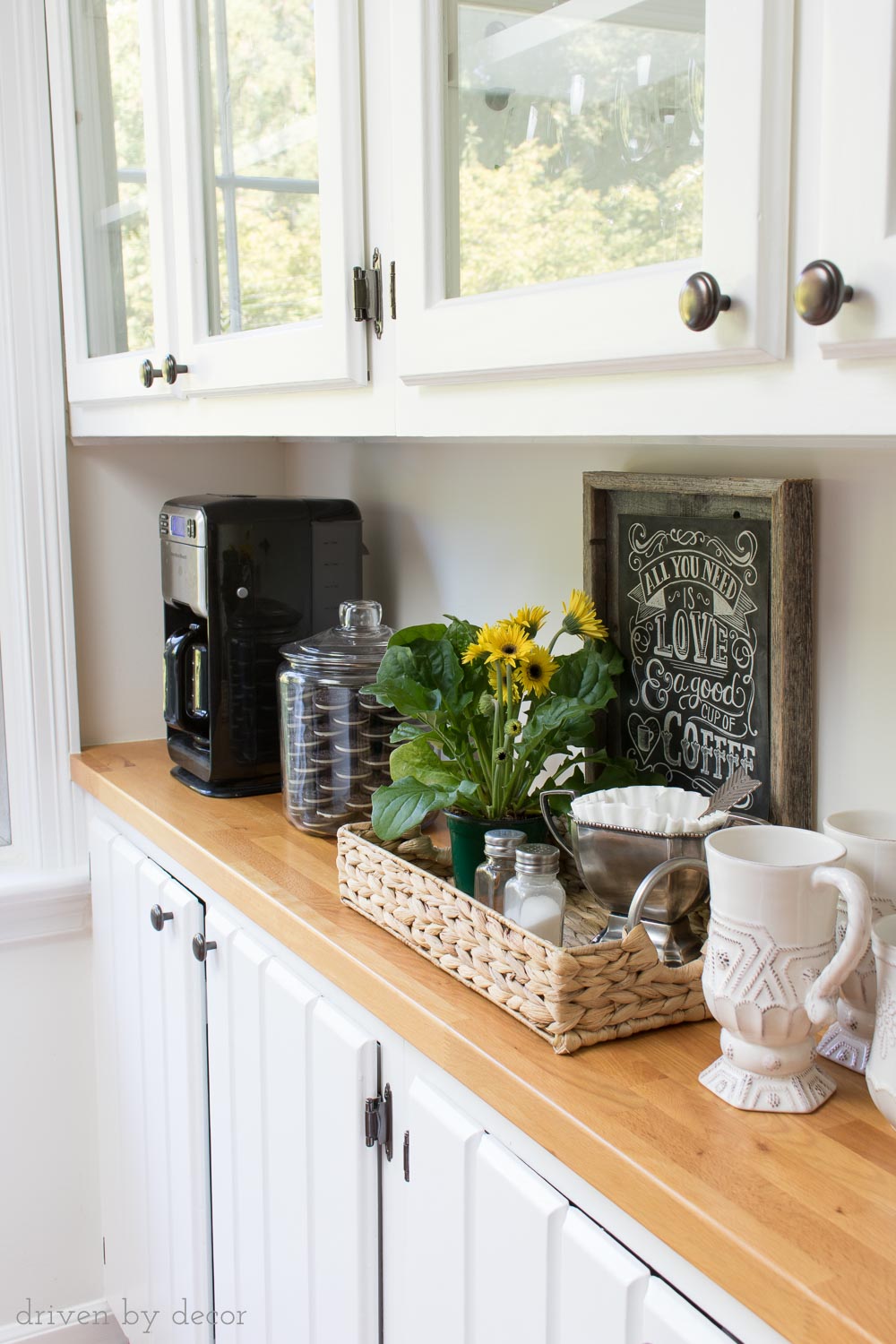
After sharing our new coffee station last week, several of you had questions about what we used to seal our new butcher block countertops so I’m going to fill you in on those details today. (post includes affiliate links – full disclosure statement available {here}). As you known, we only have them in a small area at the far end of our kitchen where we ripped out the old, ugly tiled countertop:
Scroll & Click/Tap to Shop the Look!

Once installed, it’s important to treat or seal the butcher block to keep it from drying out and staining. There are a lot of options for products to treat butcher block, but one of the simplest and least expensive is mineral oil. And that’s what I went with for the first several months.
Sealing Butcher Block Countertops with Mineral Oil
To seal butcher block with mineral oil, you simply apply the mineral oil generously, let it soak in, and wipe off the excess. You need to do it fairly regularly at first but then only about once a month after you’ve gotten through several applications. But here’s the problem that I found with mineral oil. Any paper that you lay down on it will absorb the oil from the butcher block and stain the paper. Even if it’s been weeks since you oiled it. I’d love to say that our kitchen is always neat as can be with no random school papers strewn about but…not so much. After several papers got ruined by laying them down in the wrong place, I knew that mineral oil wasn’t going to work for us.
Sealing Butcher Block Countertops with Waterlox
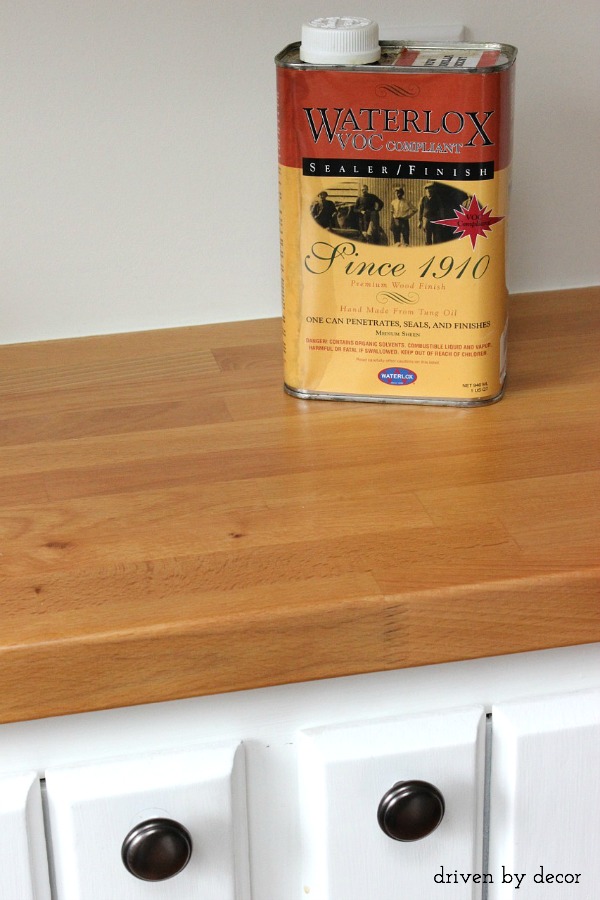
So after a lot of research into other options, I ended up trying Waterlox and I’m so glad I did – I love it! It’s a blend of Tung oil and resin with a water-resistant finish that’s also food safe. The company has great instructions on application of Waterlox on their website that are a must-read before using it, but the main steps are to sand the butcher block, clean it with mineral spirits, and then apply 3-5 coats of Waterlox with 24 hour dry time between coats.
Want to save this post?
Waterlox comes in three different sheens but it’s recommended that you start with Waterlox Original Sealer/Finish (available {here}) for the first coats and just do the last coat in either the satin or high-gloss finish if you want a different sheen. I’m not a big fan of shiny countertops so after three coats of the Sealer/Finish, I applied a coat of the Waterlox Satin (available {here}) which is less glossy. The color of the butcher block definitely changes depending upon the treatment that you choose with the Waterlox making the butcher block a deeper, just slightly more orangey color than the mineral oil.
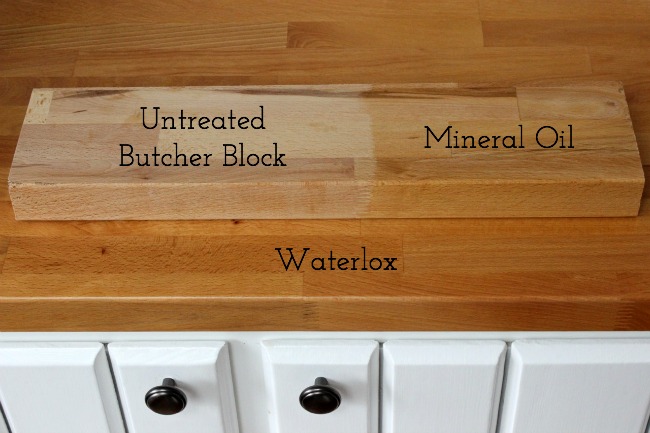
You can see the difference even more clearly looking at this angle – the countertop was sealed with Waterlox and the board on top of it was treated with mineral oil:
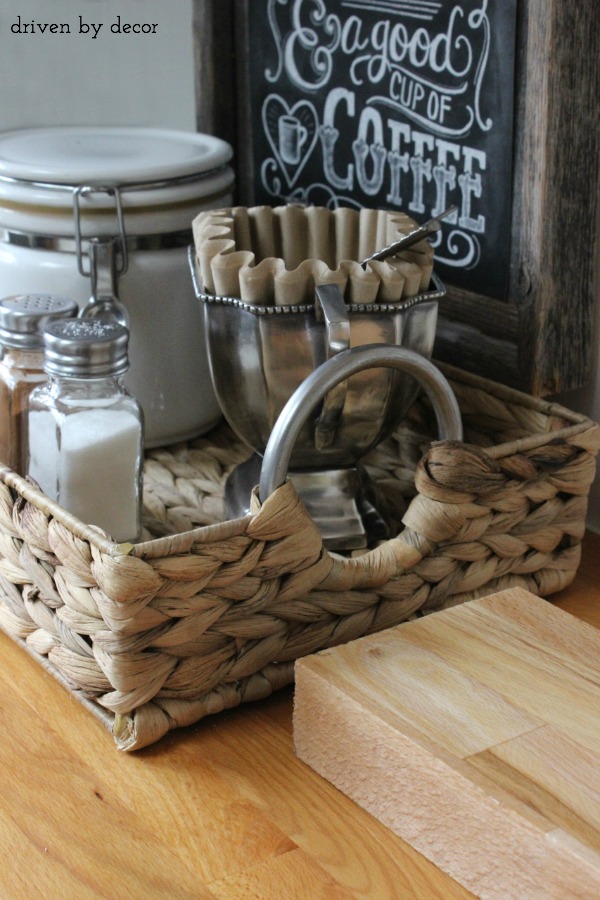
Honestly, I prefer the lighter look of the oiled countertop to the darker Waterloxed countertop but with all of the other advantages of Waterlox (no more oil spots on stray kitchen papers, no more monthly maintenance, and better water resistance) it was the way to go for us.
If you’re thinking about using Waterlox too, be sure to read {this info on care and cleaning of Waterlox} so you are aware of what products you should and should not use on Waterloxed countertops.
So that’s my long-winded answer to your short question about our countertops. Butcher block countertops aren’t for everyone and we only have them in this one spot with granite in the rest of the kitchen but I love them and honestly wouldn’t hesitate to use them throughout a kitchen. How about you?



John says
Hi Kris, We’re thinking of switching from old school ceramic tile to butcher board countertops. The only concern I have is that we often take hot food out of the microwave or hot pots/pans off of the stove top and set them on our tile counters with no problems. Do you think that would be the case with Waterlox? In other words, is it heat resistant?
Kat121 says
Thanks for this. My new BB counter is sitting on the patio to be installed tomorrow. Ours will be on one brand new cabinet nearest the stove for a work area. The cabinets we installed haven’t had the ends covered yet, and we’ve decided to leave them bare, a light natural wood, to offset the BB which will be across the room, so keeping everything in the same color family is my plan. Seeing your photos and everyone else’s input on repairs and maintenance, I think we’ll be using mineral oil for ours as I anticipate serious wear and tear being next to the stove/oven. But it’s nice to see an option of it doesn’t work for us. I’ve read many articles today and this was the most helpful.
Debbi says
Thanks for this! Exactly the information I was looking for. Great share.
Ada says
Food grade mineral oil! I use half a lemon and salt to clean wooden cutting boards.
Betty C says
With Waterlox: After the initial preparation / installation of my butcher block counter tops, how often do I need to treat them and what is the treatment at that time?
Also, I live in the Caribbean, is there any problem you have heard of with tropical woods, well treated?
Thanks
Mimi Underwood says
Thanks! We just yesterday installed a walnut butcher block counter on one of our walls and just love it! It’s gorgeous. We will try the Waterlox.
Andrea Monto says
Thanks so much, I’m getting butcher block installed right now and this is very helpful! I did have a question: would you recommend staining butcher block, and if one does stain it, are they still able to spot repair? (If i were to do a walnut stain and seal with tung/mineral oil, for example)
Kris Jarrett says
Sorry Andrea – I don’t have any experience with staining butcher block so unfortunately don’t know the answer to your question.
Joe Lucuski says
I reside in south florida and humidity is a big concern so I am planning to purchase kitchen counter tops from IKEA. They have a productive that’s a butcher block countertops wood / veernan it has a finish. But my major concern is it acquit enough to protect the sink area. What are your thoughts about protecting this area ?
KT says
Now do you still do wipe it monthly with the Waterlox too ? Like you would with mineral oil ?
Ron says
Have you tried Osmo? They have a real good and food safe finish for wood.
I used it for a large 9′ by 4′ with a sink in it. It would be good to see your thoughts on it, and to include it in your review.
Robert B. says
Thanks for you blog post. I recently ordered a butcher block 8′ table to update my studio from Lowes and wanted to seal it….I purchased the Waterlox based on your writeup and as you mentioned, all the great tut’s they have on their website.
Shawn says
I’ve used waterlox petty extensively on furniture. Last I knew, it wasn’t approved for food prep. Waterlox would have to be removed from market while being tested by FDA.
Mark Silvester says
If I already tried mineral oil and then want to use Waterlox, can I just use the Waterlox on the previously treated wood (it’s been drying for a few weeks), or do I need to start over and re-sand to remove some of the mineral oil treatment?
Krisandra says
I’m thinking of installing IKEA butcher-block countertops in my small galley kitchen. I had a few questions. Did you have to sand your IKEA countertops before applying the waterlox? If so, do you have the veneer countops or the completely wood ones? Thanks!
Erin says
Hi Kris!
We are going to be installing butcher block soon and I believe we have decided on Waterlox to seal. What do you use to clean and maintain it?
KT says
Waterlox makes a wood surface cleaner and it’s for food safe surfaces.
sabrena simon says
Did you seal the underside of the butcher block as well? I’m reading that it is necessary, but it would sure require more work!