

Wondering you should use for sealing butcher block countertops? I tried both Waterlox and mineral oil and am sharing what worked best for me!
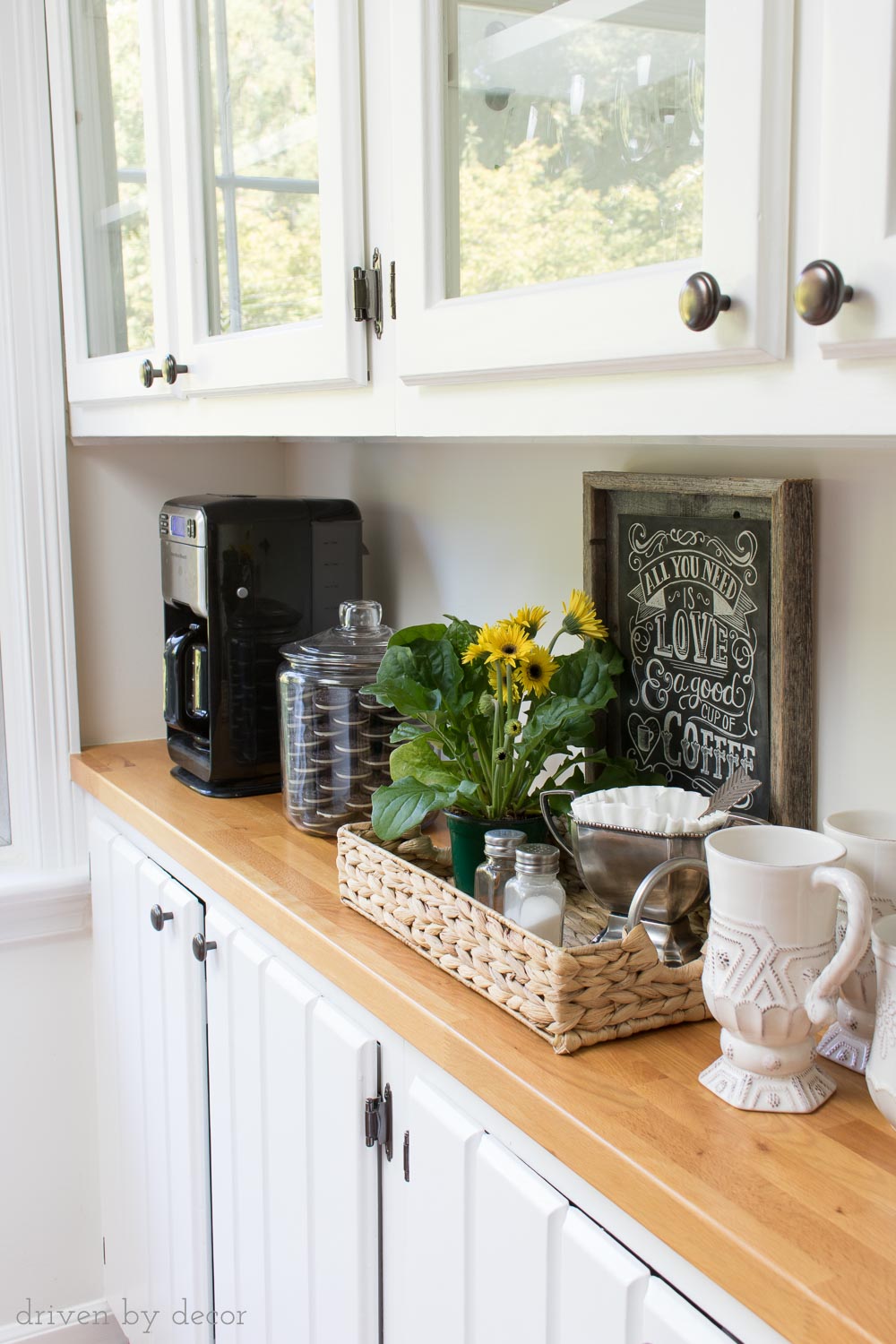
After sharing our new coffee station last week, several of you had questions about what we used to seal our new butcher block countertops so I’m going to fill you in on those details today. (post includes affiliate links – full disclosure statement available {here}). As you known, we only have them in a small area at the far end of our kitchen where we ripped out the old, ugly tiled countertop:
Scroll & Click/Tap to Shop the Look!

Once installed, it’s important to treat or seal the butcher block to keep it from drying out and staining. There are a lot of options for products to treat butcher block, but one of the simplest and least expensive is mineral oil. And that’s what I went with for the first several months.
Sealing Butcher Block Countertops with Mineral Oil
To seal butcher block with mineral oil, you simply apply the mineral oil generously, let it soak in, and wipe off the excess. You need to do it fairly regularly at first but then only about once a month after you’ve gotten through several applications. But here’s the problem that I found with mineral oil. Any paper that you lay down on it will absorb the oil from the butcher block and stain the paper. Even if it’s been weeks since you oiled it. I’d love to say that our kitchen is always neat as can be with no random school papers strewn about but…not so much. After several papers got ruined by laying them down in the wrong place, I knew that mineral oil wasn’t going to work for us.
Sealing Butcher Block Countertops with Waterlox
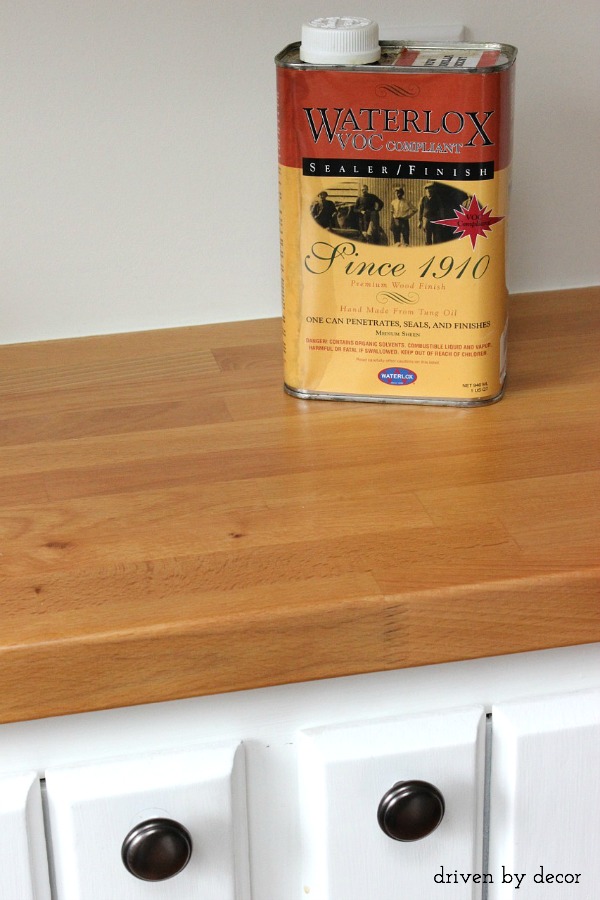
So after a lot of research into other options, I ended up trying Waterlox and I’m so glad I did – I love it! It’s a blend of Tung oil and resin with a water-resistant finish that’s also food safe. The company has great instructions on application of Waterlox on their website that are a must-read before using it, but the main steps are to sand the butcher block, clean it with mineral spirits, and then apply 3-5 coats of Waterlox with 24 hour dry time between coats.
Want to save this post?
Waterlox comes in three different sheens but it’s recommended that you start with Waterlox Original Sealer/Finish (available {here}) for the first coats and just do the last coat in either the satin or high-gloss finish if you want a different sheen. I’m not a big fan of shiny countertops so after three coats of the Sealer/Finish, I applied a coat of the Waterlox Satin (available {here}) which is less glossy. The color of the butcher block definitely changes depending upon the treatment that you choose with the Waterlox making the butcher block a deeper, just slightly more orangey color than the mineral oil.
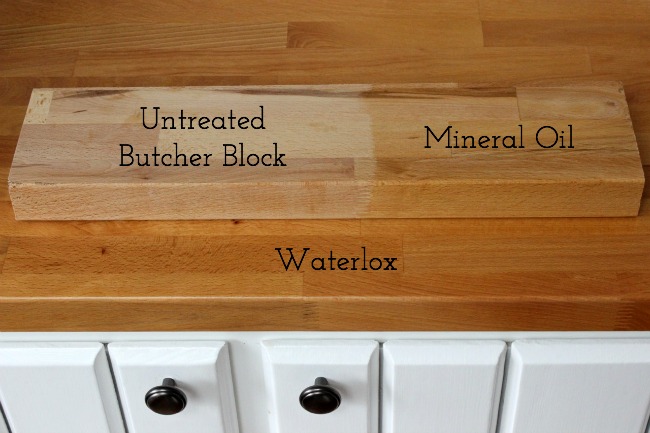
You can see the difference even more clearly looking at this angle – the countertop was sealed with Waterlox and the board on top of it was treated with mineral oil:
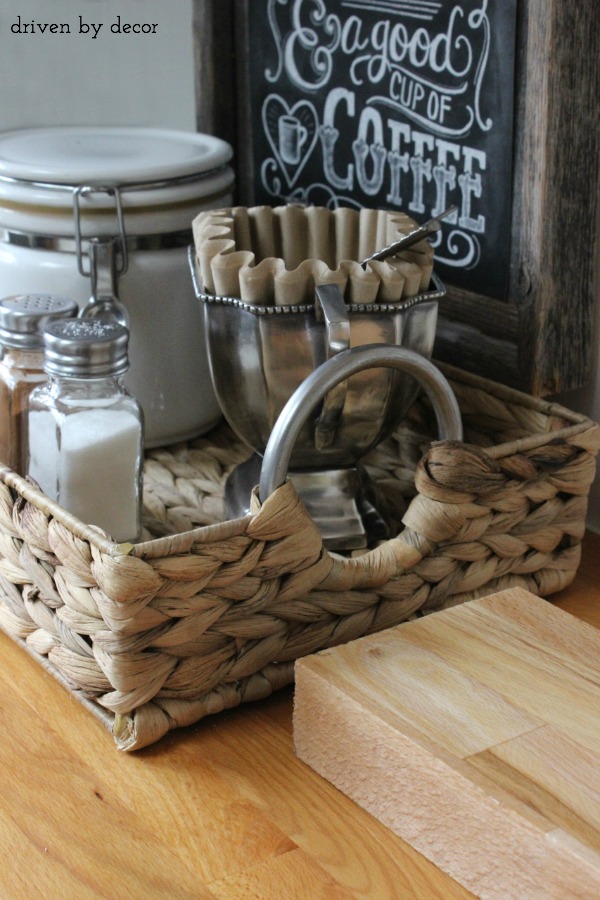
Honestly, I prefer the lighter look of the oiled countertop to the darker Waterloxed countertop but with all of the other advantages of Waterlox (no more oil spots on stray kitchen papers, no more monthly maintenance, and better water resistance) it was the way to go for us.
If you’re thinking about using Waterlox too, be sure to read {this info on care and cleaning of Waterlox} so you are aware of what products you should and should not use on Waterloxed countertops.
So that’s my long-winded answer to your short question about our countertops. Butcher block countertops aren’t for everyone and we only have them in this one spot with granite in the rest of the kitchen but I love them and honestly wouldn’t hesitate to use them throughout a kitchen. How about you?



Anonymous says
Use Waterlox Truetone if you prefer the natural wood color.
kurumsal dijital pazarlama says
I stumbled upon your blog while searching for information on this topic, and I must say that I am thoroughly impressed with the content you have put together. Great job!
David Phillips says
It’s really disappointing and honestly reckless that you didn’t go more in-depth into the safety of Waterlox as it cures. It takes weeks / months for the VOCs to fully evaporate, all the while those of us who bought and used the product at your recommendation are breathing in compounds which cause permanent neurological damage.
I hope your Amazon affiliate commission from my purchase was worth it, because you’re killing my family and yours.
Pamela says
We used warerlox a few years ago on our new oak countertops. They turned out beautifully. We have recommended it to several people. Now we are applying waterlox in our new home. This time we are using Acacia wood. Very excited to see how it turns out. I know it will be beautiful.
Bonnie Wilcoxson says
What species wood is your countertop. I didn’t notice that in your text. Thank you.
Bonnie Wilcoxson says
Never mind; found the species in the comments. But I noted a few others asked as well so maybe a short edit to your main text would be helpful to others.
Denise says
We installed our butcherblock countertops over 10 years ago using waterlox and they still look great. Have never recoated…just 3 coats when installed (top and bottom). Have even accidentally left wet cups on them leaving a white ring. A few hours after drying them the rings disappeared! Really happy with waterlox.
Ron Kubicki says
I have been mixing linseed oil and turpentine and Thompson water sealer for years on the teak wood of boats
Pat says
The info you provided was so useful as we redid our kitchen. It hasn’t been touched since maybe the 1950’s or 60’s?? Anyway, we took the plunge and ordered butcher block counters (in walnut). I knew I wanted to waterproof the countertops or at least make them water resistant. I appreciate your info on Waterlox (and other finishes). We went with Waterlox in a satin finish and I also ended up buying and using their new H2OLox product to further seal after a few coats of the sealer/finish. Hoping for great durability!
Paul says
I really love the cabinets. Any clues on how to find that planked style?
Kris Jarrett says
Unfortunately I don’t have a source for them since they were installed by a previous owner.
Walt Jones says
Thank you for the great description.
Linda says
We are planning on using butcher block for some shelving in our kitchen. They will only hold some small plates and coffee mugs along with some decorative items. Can you please share what kind of wood your butcher block is? That is, birch, acacia, maple, etc?
Thanks so much. I love and enjoy Driven by Design.
Linda
Lor says
I’m a fan of oil finishes as they are easy to maintain however Waterlox is my choice for ” high traffic ” areas that are likely to meet water and adult beverages. There is also an exterior Waterlox product that I plan to use on our acacia wood counter on a covered porch. Thanks for steering me away from oil this time!
Patrick Riley says
Great information. We were leaning towards Waterlox. had several wood countertops with sprayed lacquer and another with satin poly. both worked fine. the waterlox will go on a edge grain hickory 45 x 144 island.
Annmarie Klopferlopfer says
I have butcher block countertops throughout my kitchen and I love them! I used waterlox to seal mine as well and have not been disappointed with the results
Emily says
Hi! Where did you purchase your butcher block, and what kind of wood is it? Beautiful! Thank you!
Kris Jarrett says
I bought them at IKEA years ago – they are solid oak. They don’t sell these exact ones anymore though unfortunately.
Marla Hollandsworth says
Waterlox gives a nice finish BUT DO NOT USE IT ON A KITCHEN COUNTERTOP! I have 60 sq. ft. of maple countertop that was ruined when my daughter was baking and spilled some baking soda on the counter. I wiped it up with a damp sponge and the entire surface was stained black! Do a Google search – lots of folks have had this happen. Not suitable for the kitchen – who doesn’t bake with baking soda?!
Reenee says
I am about to use the Waterlox product on our bare oak butcher block countertops. I’m hoping for that amber color, but it’s a hardwood. What type of wood are yours? They look fabulous!
Kris Jarrett says
Mine were oak!