

Can you paint tile floors? Yes! I’m sharing how to paint a tile floor so it looks good and lasts! We painted the ceramic tile floors in our bathroom and this simple, inexpensive DIY transformed our space!
Have you ever had a project that ended up being so much easier than you expected that you wished you hadn’t procrastinated so long to do it? Painting the ceramic tile floors in our first floor bathroom was one of those projects!
I decided I was going to figure out how to paint our tile floor way back in 2014 when I was making over my space for the One Room Challenge. But.. the stenciling of the bathroom walls took so long that I ran out of time to do it before my big reveal. Somehow THREE full years went by before I finally knocked this little DIY project. It ended up being so cheap and easy to do and I LOVE the result! Welcome to my its-five-hundred-times-better-than-those-ugly-reddish-floors-were bathroom!
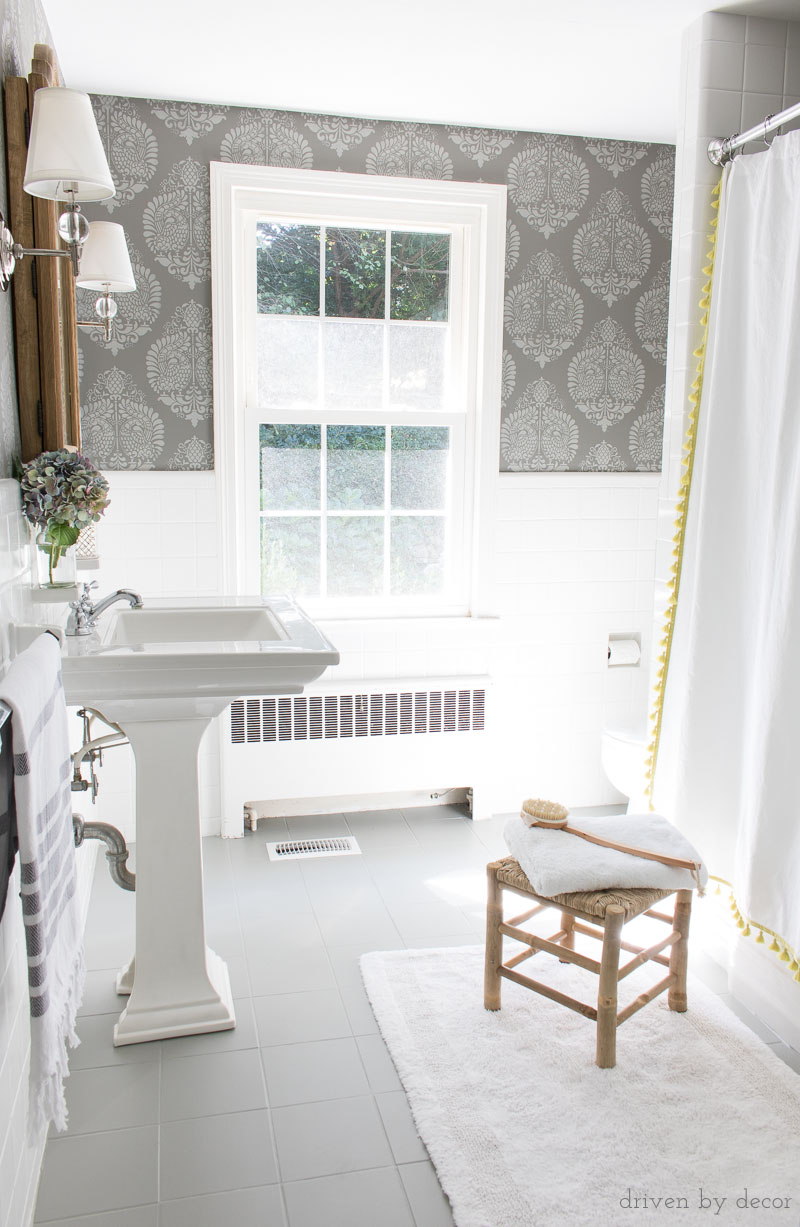
Such a HUGE improvement over the reddish tile we started with, right?!
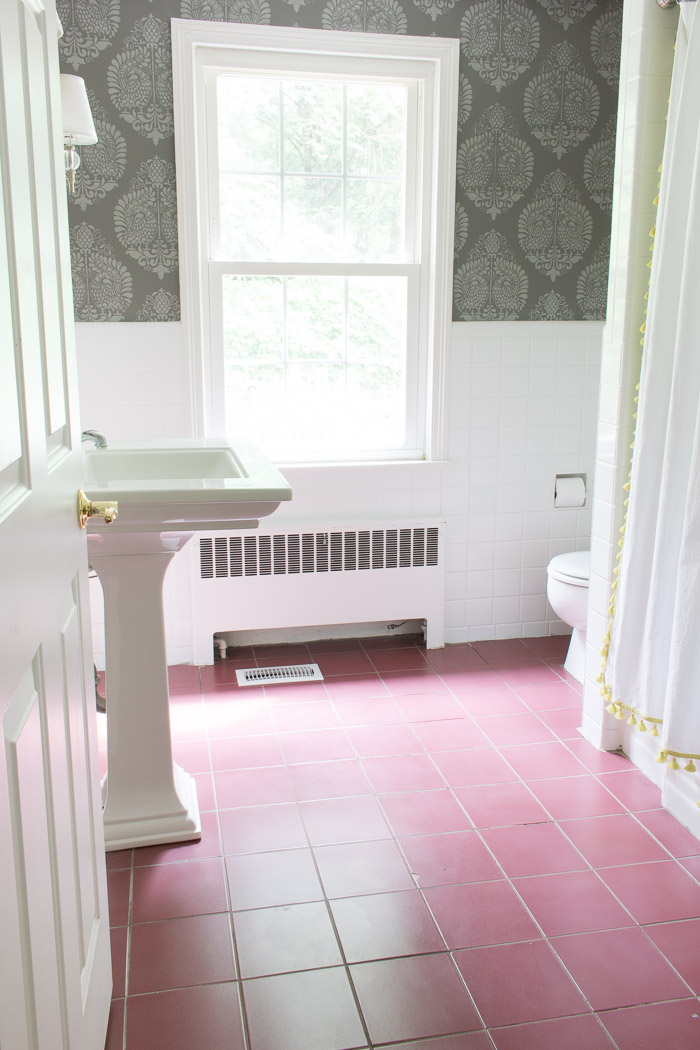
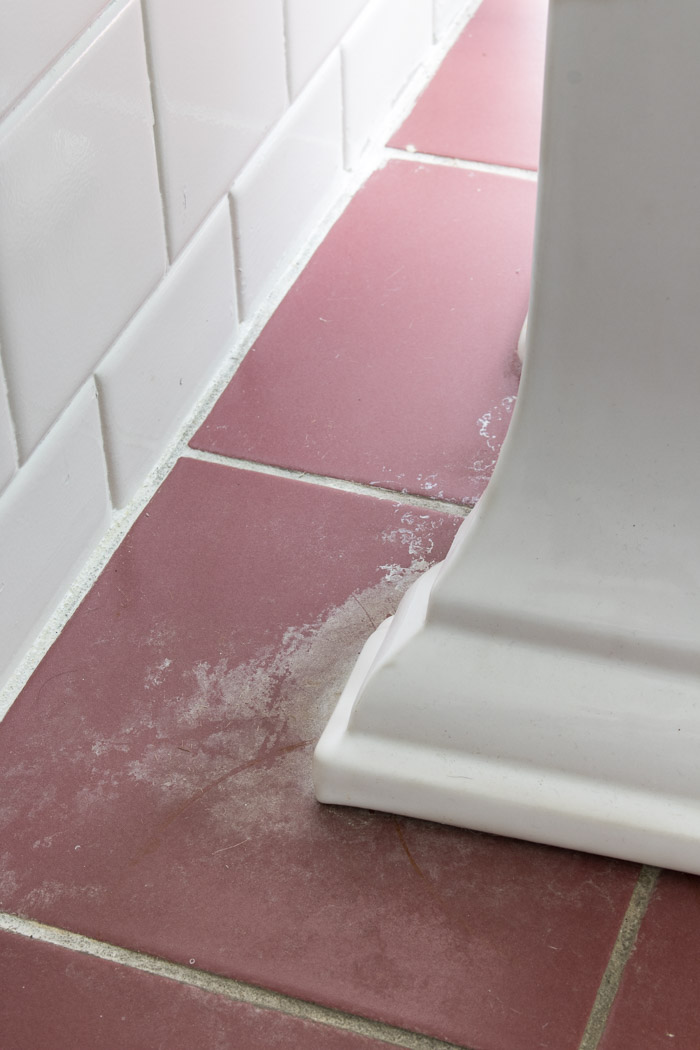
And believe it or not, the ugly color wasn’t even the worst thing about the old tile floors. Behind both the sink and the toilet, the tile had gross, ugly stains that I couldn’t get off no matter how hard I tried. It was completely gagworthy and something the previous owners hid under a custom cut rug they had in this bathroom when we bought the house:
Now you’d never know that my poor tile had such an ugly past!
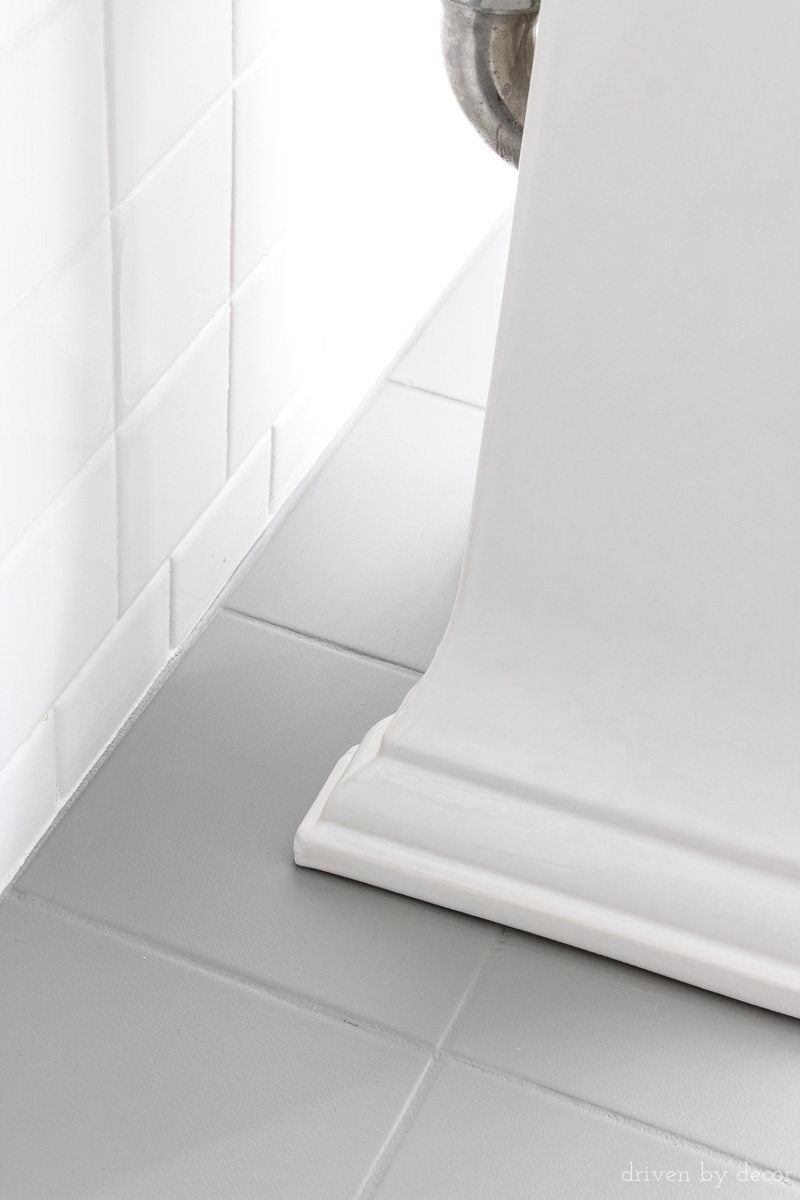
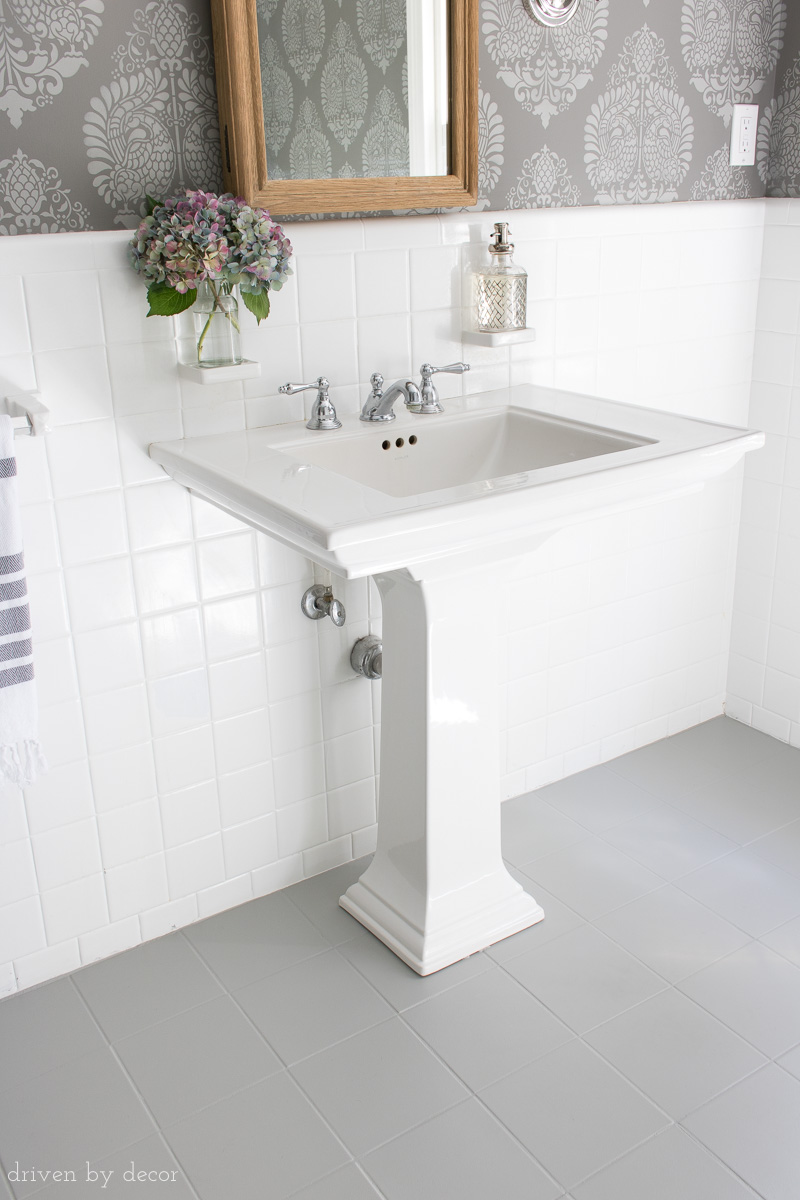
It’s been six years now since we painted our tile floors and I would do it all over again! Today, I’m sharing everything you need to know about how to paint a tile floor so it lasts! 🙌🏻 (post includes commissionable links; for more information, see my full disclosure statement {here})
Step 1: Gather Your Supplies
These are the supplies you’ll need to successfully knock this project out:
- Sandpaper (I used 80, 120, and 220 grit) and/or an electric sander (I used {this sander} and {this sandpaper} that fits it.
- Stripper and cleaner (I used {this one})
- Grout or caulk to repair cracked/missing grout (if needed)
- Bonding primer (I swear by {this STIX primer})
- 4″ mini rollers such as {these} that have ¼″ nap
- Mini roller frame
- Paint brush
- Benjamin Moore Floor & Patio Paint
- Polyurethane topcoat (optional)
Step 2: Sand Your Tile Floors
The first step is to lightly sand your tile floors. The purpose is not to remove the glaze on the tile, it’s just to scuff it up which helps the primer adhere. And it also removed the disgusting crap on the surface of my tile that I couldn’t get off no matter what I tried.
It’s important to note that ceramic tile can contain lead so consider testing for it or consulting with a professional if you’re unsure about your tile. Always use protective eyewear and an appropriate mask or respirator to prevent you from breathing in the sanding dust. And contain the dust so it doesn’t go into other areas of the house.
I used {this electric sander} which makes the job so much quicker and easier than doing it by hand. If you do a lot of projects around the house and don’t already have one of these electric sanders, I’d highly recommend it. It’s lightweight, fits in the palm of your hand, and has an angled head to get into corners easily:
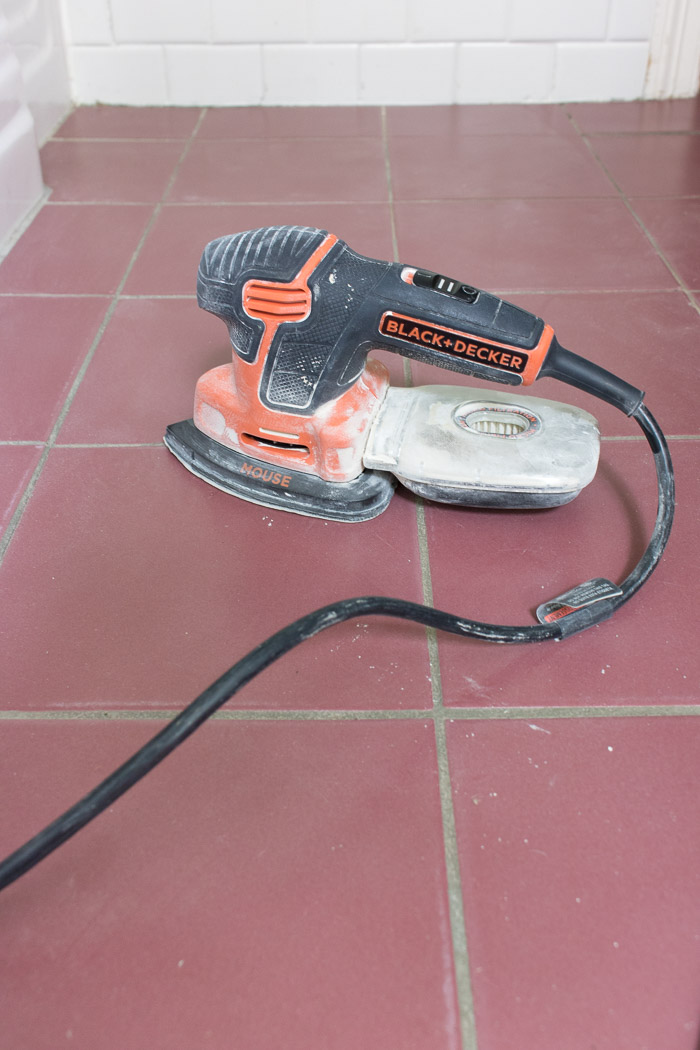
I sanded the tiles that had a build-up of crud on them with 80 grit sandpaper, did a light sanding of the whole floor with 120 grit, and then finished off with a quick once-over with a fine 220 grit sandpaper. A variety pack of sandpapers that fit the mouse sander such as {this one} is perfect.
Step 3: Clean Your Floors (Super Well!)
After finishing sanding, I vacuumed up all of the dust and debris and then went to town on cleaning my floors. Any heavy-duty stripper & cleaner should do the job – you can get the one that I used online {here}.
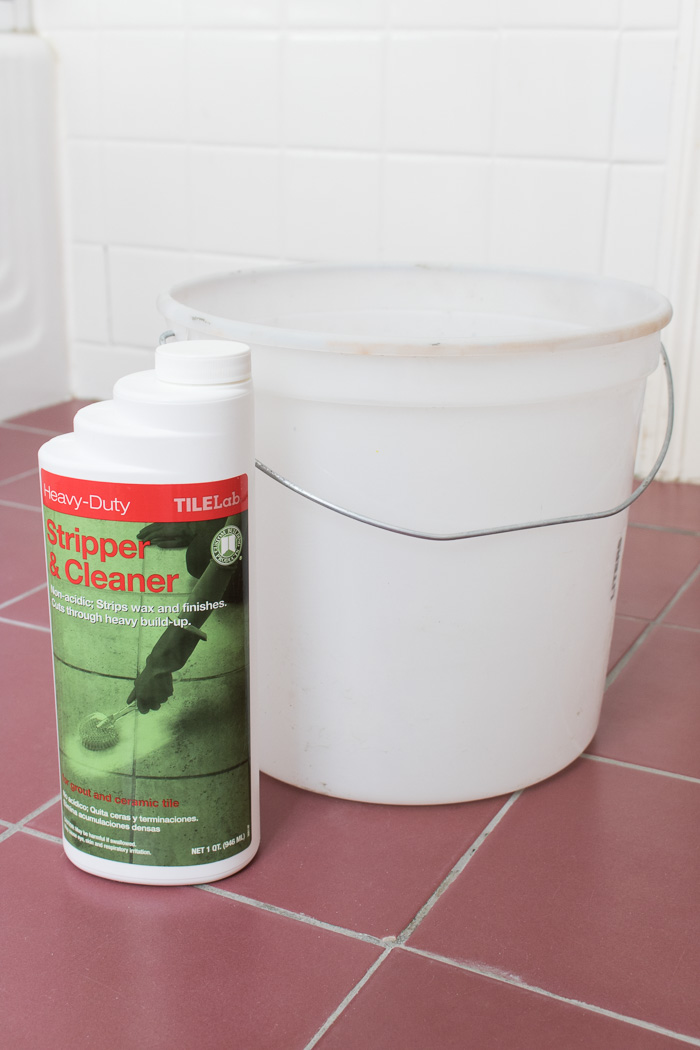
I mixed the cleaner with water (per the instructions), mopped it onto the floor, let it sit for about 15 minutes, and then scrubbed the entire floor with a nylon scrub brush. Then I cleaned it off with bucket of warm water and did it a second time. The cleaner the floor, the better your paint will adhere!
Step 4: Repair any Missing Grout or Cracked Tiles
The grout on our floor was a mess and there are several areas where chunks of it were missing. Regrouting is a pretty huge job since you need to spend a lot of time digging out the old grout first so I went the easy route and simply used paintable caulk to fill in and smooth over any bare spots in my grout. The caulk adhered well and now that it’s painted, you would never know that I had done it.
Now would be the time to replace or repair any cracked tiles too. I had one tile closer to our bathtub with a crack in it but knew it would be covered by our bathroom rug so I simply caulked the cracked portion and sanded down the rough edge a bit instead of replacing it.
Step 5: Apply a Good Primer
Using a really good primer is the key to success for painting ceramic tile! I used INSL-X STIX (available {here}) which is my go-to primer for painting surfaces that paint might normally have a hard time adhering too.
I used a paint brush and small roller simultaneously (I use a ¼ inch mini roller like {these}), painting the edges and grout lines with my brush and then rolling on the primer for the rest. Just make sure to start at the far end of the room and work towards the door so you don’t paint yourself into a corner. Once it was dry, I recoated using the same technique.
Step 6: Paint Your Tile!
I painted our floor tile in the same way as I primed it, using a paint brush on the edges and on the grout and rolling the rest as I went (as with the primer, I used a 4 inch mini roller like {this}):
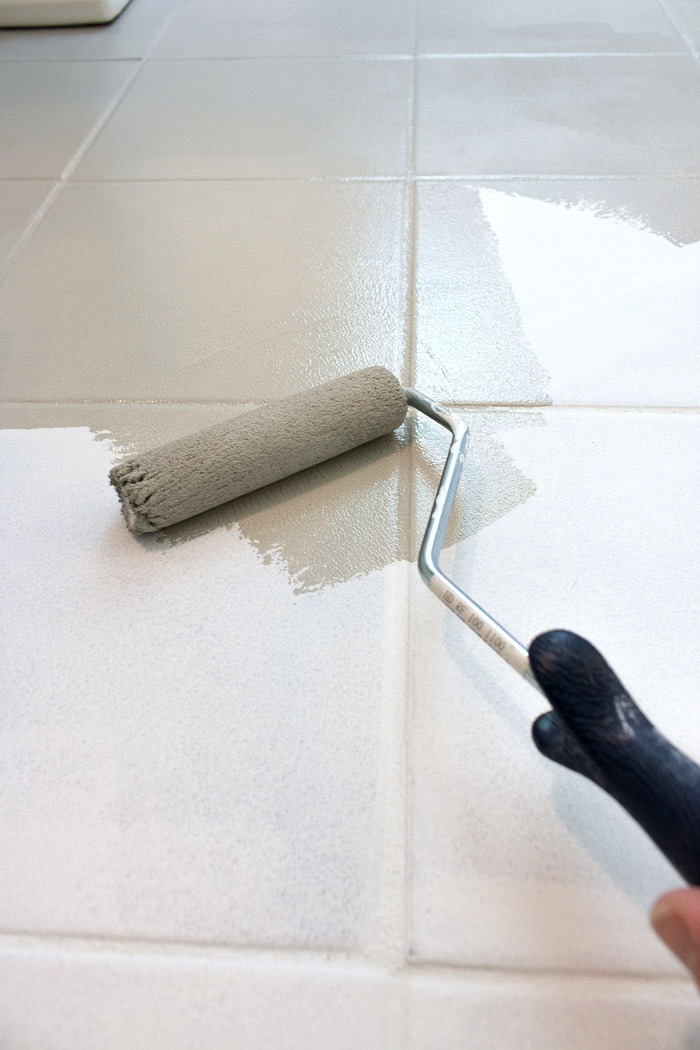
The type of paint that I used was Benjamin Moore’s Floor & Patio Paint since it’s meant to stand up to lots of use and abuse. It comes in High Sheen and Low Sheen options. I chose Low Sheen just for personal preference.
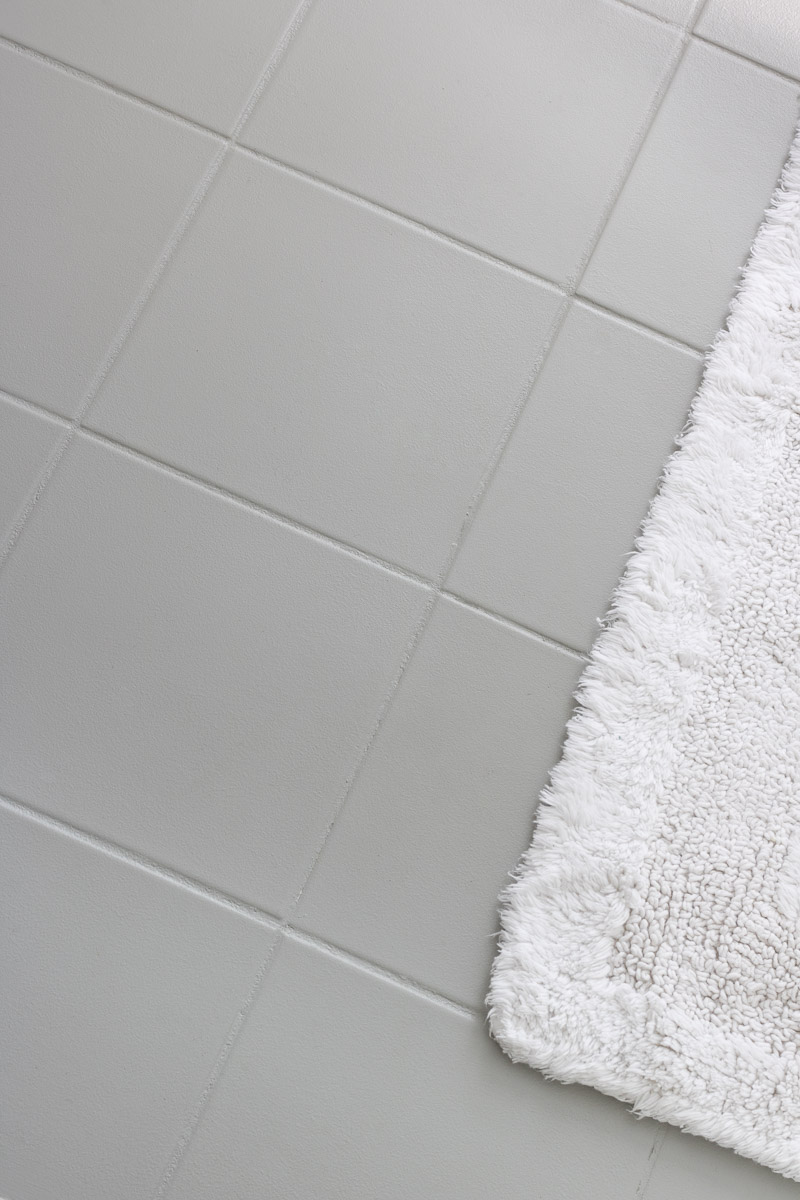
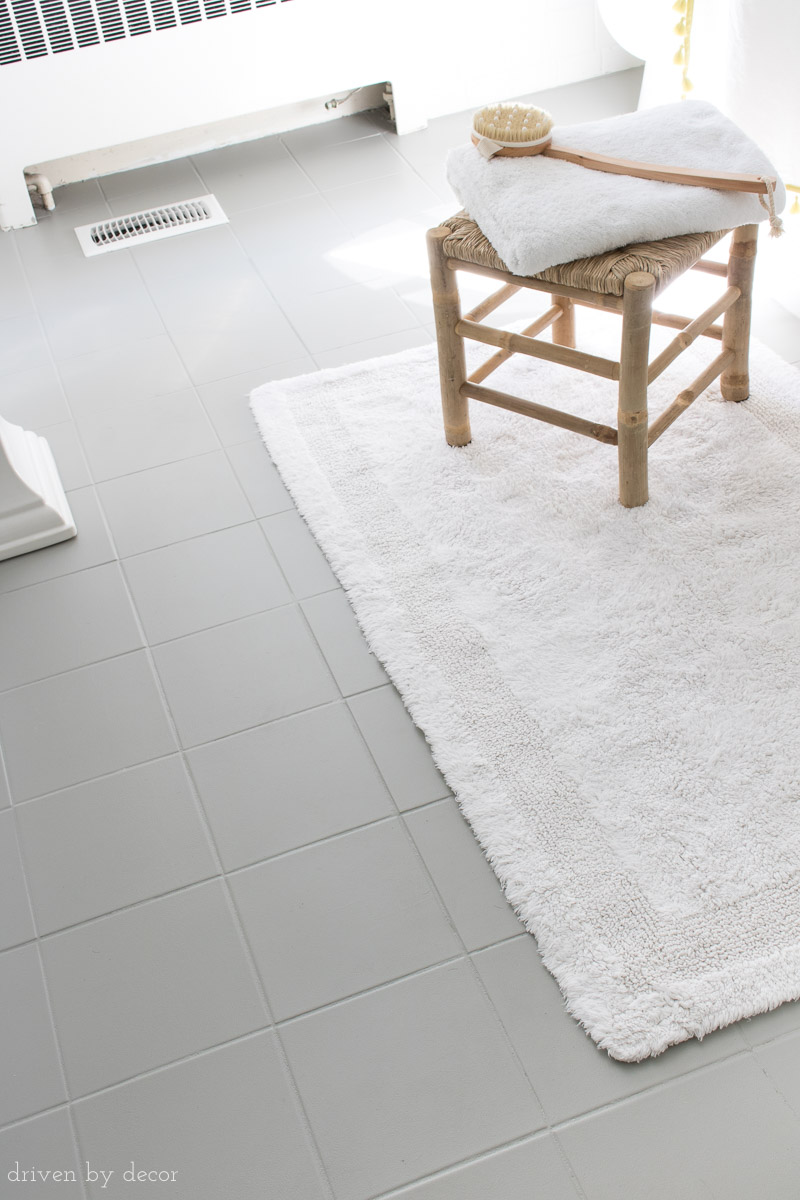
I applied three coats of paint, letting it dry according to the paint instructions in between coats. The color I chose is Benjamin Moore Platinum Gray, which is the same gray color as the lighter portions of my stenciled walls.
Step 7: Seal Your Tile?
The last step, if you choose to do it, is to seal your tile. I was definitely torn on whether or not to seal mine. With porch paint you technically don’t need to seal it since the paint is made to withstand a lot of wear. The pro of adding a polyurethane topcoat is that it will make your painted tile more durable. The negative is that with a polyurethane topcoat, if you get a gash in your floor that needs to be repaired, it’s a little trickier to fix in a way that it blends in perfectly if you’ve topcoated with polyurethane.
I decided NOT to use a polyurethane topcoat and years later I’m happy with that choice. At one point a deep scratch appeared on one of our tiles that I’m guessing was made by stone getting stuck in someone’s shoe tread while construction was being done on our house. I was able to sand and repaint just that one tile and it blended in perfectly.
I also recoated our painted tile floors a few years after they were first done to freshen them up, and since I had no polyurethane topcoat I didn’t have to do any prepwork to remove it before repainting.
Step 8: Let Your Floor Dry & Then Put It To Use!
After your last coat of paint or polyurethane, give your floor at least a couple of days to fully dry before walking on it. The more humid it is, the longer it will take. It’s best to be gentle with it (no heeled shoes, etc.) for the first week or two until everything is fully cured.
Overall, I’m incredibly happy with how our painted tile floor looks and how it’s worn! Especially for a project that cost me under $100!
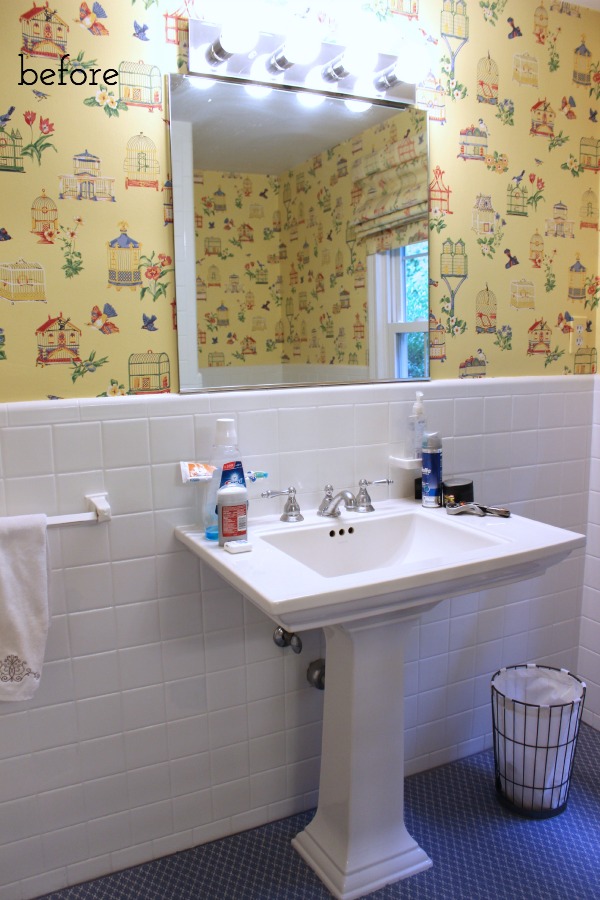
It’s fun to look back and see how far this bathroom has come. This is what it looked like when we moved in and the tile was covered by carpet (which I promptly took out because I decided that even the ugliest tile is better than a rug that goes around the toilet – yuck!):
and here it is today:
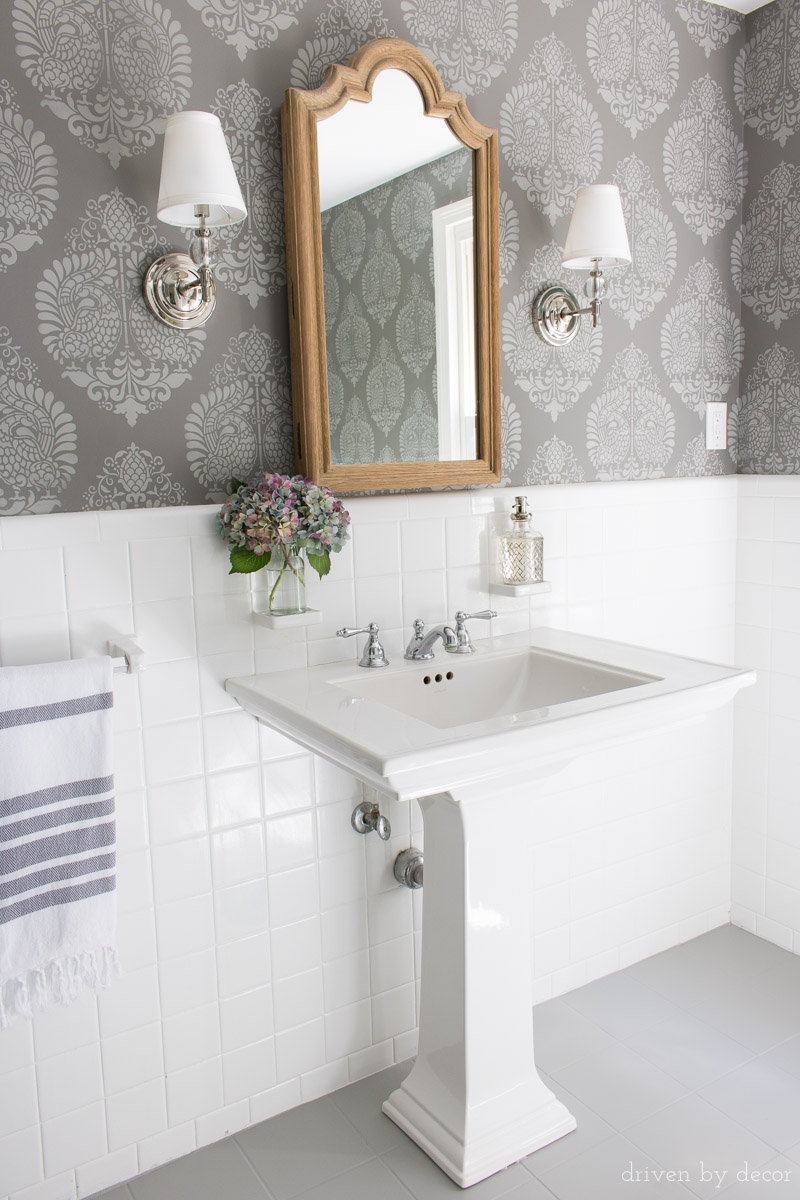
Powder Room Sources: Damask Wall Stencil (11.25″ x 15.5″) | Arched wood medicine cabinet mirror – no longer available | Pedestal Sink | Sconces (Polished Nickel) | Gray & white striped towel
The best part is that it’s a room we didn’t spend a ton of money on. Other than the money spent on the wood medicine cabinet and sconces, the rest of the changes were accomplished with inexpensive DIY projects. To learn more about our bathroom makeover check out my posts on:
Wall Stencils (yes, those walls are stenciled, not wallpapered!)
How to Replace a Towel Bar with Fixed Ceramic Ends
Also check out my post on our painted bathroom vanity which was another easy painting project that made a huge difference!
UPDATE!! If you’re wondering how our painted tile floors have held up, check out my post how how our painted tile lasted with an update of how they had done years later!
Thanks for stopping by!



Jill says
Looks fantastic! Thanks for being brave enough to give it a go & sharing your process.
Kris Jarrett says
Thank you so much Jill!
Brenna@Domestic Charm says
Such a difference a little paint makes! It definitely needed the grey!
Kris Jarrett says
Thanks Brenna! The power of paint always amazes me! That ugly floor had nowhere to go but up!
Monique Lawson says
Gorgeous! Thank you for the tips! I was thinking about sealing! Good job!
Kris Jarrett says
Thanks Monique! Enjoy your weekend!
Jenny says
Hi, when can you come and do mine. I live in England- is that a bit too far to travel?
I seriously love what you’ve done with your bathroom. I would never have used grey and white, thinking it’d be too cold looking. What you’ve done is amazing.
Kris Jarrett says
Jenny, if you send me a plane ticket and give me a place to stay, I’m there! Ha! Thanks so much for your sweet words and enjoy your weekend!
Marty Oravetz says
Oh my word, this looks amazing. Great job.
Kris Jarrett says
Marty – thank you so much! Enjoy your weekend!!
Vanessa says
WOW!!! What a transformation from the original bathroom! The space is gorgeous!
I have a couple of accent tiles in the shower of the guest bathroom that I’ve been giving the stink eye to. They are travertine that has been sealed. Do you think this same method could work on those?
I purchased the grout paint, per one of your previous posts; and really need to get started on that project.
Thank you for sharing such a beautiful space and the sources.
Kris Jarrett says
Hi Vanessa,
I’m not sure about using it on tile in the shower itself – I would be worried that with so much exposure to water it might eventually peel!
Pamela says
What I great idea. I never thought of painting tile floors. It looks amazing.
Kris Jarrett says
Thank you so much!!
Sharon says
Kris, you are a wonder! I’m still in awe of your stenciling job (those corners!) and now your ‘new’ tile floor! Gorgeous. Thanks for sharing your sources, btw.
Kris Jarrett says
You are too sweet! Thank you Sharon and enjoy your weekend!
Linda Grubbs says
Wow! Very nice Kris….amazing improvement!
And I love that it was so inexpensive. ????
Kris Jarrett says
Thank you so much! The price was definitely a plus!!
Kathy says
Wow, the floors look fabulous! I used your grout paint for a spot in mine and that
worked well too.
Kris Jarrett says
Thank you so much! And I’m glad the grout paint worked as well for you as it did for me!
Anonymous says
How are your tiles holding up today? I have been going back and forth trying to decide if painting my kitchen tiles or not. It gets high traffic so I’m hesitant.
Stacy Connolly says
Wow!!!!! Looks fantastic!
Kris Jarrett says
Thank you so much!
Megan Roberts says
Looks great! I’ve been thinking of painting one of our bathroom floors so your post has been really helpful. How do your floors stand up to cleaning?
Kris Jarrett says
So far so good! I can actually get them a lot cleaner than I could my old tile. I’ve just been using warm water with a touch of all-purpose cleaner in it.
Carrie says
In my bathroom, I have dated Burgundy tiles spread out randomly with white tiles~ do you think it would be worth the effort to try and individually paint these gray (or greige) to be a complement to the white or should I try and paint all the tiles? The tiles go up and around a jetted tub too……
Thanks for the post!!
Your floors are spectacular and I LOVE the stenciling. 🙂
Kris Jarrett says
With your tile situation, that’s a tough call! It would definitely take a whole lot longer to do individual tiles than do all of the tiles plus the grout – I think it just depends on how much time you’re willing to put into it and which look you like better. I would be hesitant to do it around a tub if those tiles get a lot of water splashed on them but if they don’t, you should be good! And thanks for your sweet words about my post!
Cassie says
Looks great!! Love that you took 3 years – makes me feel like it’s never too late : )
Kris Jarrett says
Thank you! I have way too many projects that I should have knocked out sooner than I did!
Gail Wozniak says
How long did you wait to apply the primer after stripping your floors. I got the one you used and the instructions indicate you need to wait 48 to 72 hours. I’m curious if you followed that. Thanks!
Kris Jarrett says
It’s been several years now since doing this so I can’t remember the exact amount of time I waited but I would follow the product instructions.
Sandra Hattingh says
How does your painted tiles stand up to cleaning? I’m thinking your shower.
Looks lovely by the way!
Kris Jarrett says
So far it’s held up great! I’ve just used warm water with a splash of all-purpose cleaner in it. I didn’t paint any of the tile in the actual shower – I’d definitely be worried about that holding up!
Sarah says
Hi Kris,
Would this work if our tile is glazed? Yours looks more porous.
Bests, Sarah
Haneen says
Kris, this is amazing! So impressive!
Kris Jarrett says
Haneen, thank you – so sweet of you to stop by! XOXO
Dominique Stevens says
This is lovely. thanks for the article. It’s really inspiring!